

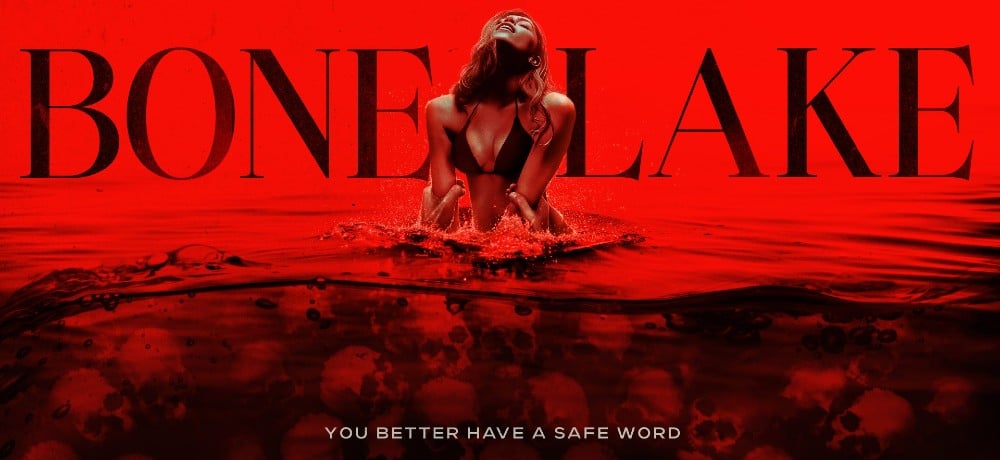
Bone Lake turns an idyllic romantic weekend into, as director Mercedes Bryce Morgan puts it, “a fucked-up form of couples therapy.” In the unabashedly erotic horror thriller, communication and trust are tested with mind games as well as bloodshed. Bone Lake is an equally psychological and physical piece of horror.
In Bone Lake, which reunites Morgan and her Spoonful of Sugar cinematographer Nick Matthews, Diego (Marco Pigossi) and Sage (Maddie Hasson) are forced to address their relationship problems to survive a weekend with a mystery couple who just so happen to have double-booked their beautifully isolated rental house. The unwanted guests, picture-perfect Will (Alex Roe) and Cin (Andra Nechita), hold a mirror up to Diego and Sage that may make or break the lead couple.
It’s a mostly one-location horror movie that’s rich in personality and style. Morgan and Matthews shot the film over 18 days with real bravura. There’s a boldness and frankness to Bone Lake that’s, to put it simply, an absolute blast of horror cinema.
[Spoiler warning for those who haven't seen Bone Lake.]
The film’s opening is, without a doubt, one of the best of the year. What expectations did you want it to set?
Nick Matthews: For us, how do we cold open with something that feels heightened in the way that the end of the film will? You tease the audience with, Where are we headed, but then, how do we come back to normalcy? We thought about it in terms of a three-act structure. As we move into the discovery [that] there's another couple, and that we're going to have to witness this interplay between the two couples, that's when we start to enter this weirder language, more heightened camerawork, more heightened lighting. And then as it descends into night, we had this built-in shift.
Where it gets into surrealism is when we get into the scene where they use molly. It's raining at sunset and there's light shafts falling into the room. It's sort of this sunset that you've never experienced. There's really a pretty charitable progression, which we had planned in pre-production, of going from this shaped naturalism into duo-tone surrealism, and then into these tritone colors: the greens, the reds, the ambers, and some of the purple even. You're getting more and more zany. We were looking at Evil Dead II and Clockwork Orange.
Mercedes, the nighttime sequences aren’t just eye-catching but thematically rich. You can see people and relationships in a new light, not just literally, after the sun goes down. Was that the goal?
Mercedes Bryce Morgan: Totally. I think it's the more you get to know someone, the more you get to discover deep secrets. They handle this couple with this feeling of politeness, and they keep being pushed, but what's even more disturbing is what they hide from each other that ultimately pushes their buttons.
With that in mind, how’d it shape portraying each characters’ perspectives?
Nick Matthews: A lot of what we were interested in doing was there is a mixture of voyeurism—seeing through hallways and we're seeing down the stairs and ramming them within these spaces. Ultimately, we are living mostly with Diego and Sage.
There are a few moments where we break from that. We get to go underneath the dock and see that there's cars and bodybags where we have a more objective point of view. We're almost the omniscopic eye. It is a part of the comedy of the film, setting up an anticipation.
Mercedes Bryce Morgan: Whenever we have an unraveling and a new plot twist, it's always breaking from our character's POV. We flashback to the couple prepping the house even or when they're dancing outside the door. And so that's how we break it until those merge together and our couple are just fully in the horror.
Did you both have any other rules for what the camera should or should not do for Bone Lake?
Mercedes Bryce Morgan: Nick and I have a big rule for all our movies where if something is supposed to be dramatic or emotional, we shouldn't notice the camera too much. When we're having fun, we should have a lot of fucking fun. Let's twirl the camera and push it through this way. I feel strongly about the marriage of those two.
Nick Matthews: Generally, we try to minimize our use of handheld devices. There are some handheld sequences in this which made sense for some of those action set pieces where the characters are in a state of chaos. Even when we're doing handheld work, we're still trying to be very intentional about what we see and how we see it.
I know this question kind of answers itself, Mercedes, but that camerawork in the movie really is “a lot of fucking fun.” What appeals to you about having a ball with the camera?
Mercedes Bryce Morgan: Yeah, I love this question. It's something because that's what I've always loved about cinema. It is something that makes someone go from, "Oh, that was kind of a fun experience," to, "I love this movie."
To me, this is why we're telling this story in this medium more so than any other way. I always want to make stuff that I want to see. I'm like, "How can we move this camera in a way? Oh wait, the camera is the lock on the door. Let's hit the camera. I haven't seen that before. That would be a new cool way to do this."
Obviously you don't want the house to give away the true owners, but at the same time, how did you and your production designer want the house to reflect the couple’s personality?
Mercedes Bryce Morgan: Yes, totally. If you look at the walls, there's lots of various sexual pictures throughout the entire house. There’s even a shot where we're close up and go through pretty graphic chess pieces. People could watch the movie a second time and maybe notice things they didn't notice before.
How much was the horror of lack of communication driving Bone Lake?
Mercedes Bryce Morgan: I think there's a really interesting dynamic of trust that we wanted to look at because trust is something that you can't really prove or see. It's something that takes a really long time to build up, but it's broken instantly. And if you want to trust your partner again, you just have to choose to trust or not trust.
A question that I get a lot of times after screenings: “What did Sage really do?” I'm like, “Well, there's no way to prove or not prove, so it's whatever you choose to believe is your answer to that.” It sounds very cliché, but it is for a reason that communication really does solve a lot of things. Seeing people have these issues, you know what? Maybe this is a fucked-up form of couples therapy that you guys need to go through.
What else did you want to explore in Bone Lake, in making the movie—as you said—that you want to see?
Mercedes Bryce Morgan: Another thing I wanted to look at is just male-female couple dynamics. In a lot of ’90s erotic thrillers, you see these women who are sexual and they're punished for being that way. Seeing certain desires not punished, but as something that needs to be talked about. All of our characters are treated equally, we have nudity for all genders.
Nick, just hearing Mercedes’ thematic interests, how did that inspire your work?
Nick Matthews: When we're going into every scene, we're asking, "Whose point of view are we talking about? What story beats are we trying to communicate? And then how can we do that in a way that doesn't feel completely straightforward or pedestrian because this is a film, and a visual film after all?"
I always think of it [as] we're spinning a lot of plates. You're scouting, you're having conversations about what's going to be, what cameras you're going to use, what lenses you're going to use, what filters you're going to use, and all those things are kind of spinning. And then right before you go and make the movie, all of those things coalesce and then you're like, Okay, this is it, and then you have to go actually do the thing.
Mercedes has a distinct process, and that's really informed how I've worked even with other directors. I'm like, Hey, this is a great process logistically but also creatively. I think of it as, if you want to think outside of the box, you need to know the box. Prep is when we build the box, and then we have the framework and think outside of it.
To do the complex movement and lighting that we have in the film, you have to be very prepared working on an 18-day principal photography schedule. How do we maximize two cameras at all times? How do we maximize a small but mighty lighting team? And there's a lot of cranes holding lights up in the air and stuff like that, but it all comes back to the creative.
Mercedes, was that a fair description of your creator process: knowing what's inside the box to get outside of it?
Mercedes Bryce Morgan: Definitely. You make a movie based on the script, but then whoever you cast really paints a tone to it and is going to be very specific to that person. And then especially when you find a location, it's just narrowing in what things actually are because you have all these ideas. You're like, This is this beautiful box that we created. We know everything we don't want because we've had so many hours of discussion so that we were able to move fast on the day. We're all making the same movie.
Anything you both really appreciate about erotic thrillers that you wanted to emulate or pay homage to?
Mercedes Bryce Morgan: Totally. What I appreciate about those movies a lot is yes, they're erotic, but they also have this fun to them. They're kind of funny in a lot of ways because how can you not be, and that's something with Bone Lake… I mean, the title Bone Lake, we couldn't make a serious movie called Bone Lake. We just wanted to lean into the titillation of that.
Nick Matthews: One of the things Mercedes does really well is even when I read the script, I was like, There is another version of this movie that somebody directs this in a straightforward, mundane way. I knew that Mercedes would approach this with a sense of play and camp. That's what the film needs. In order for you to be able to take these characters seriously, you actually need to laugh at them. Because of our relationship on Spoonful of Sugar, a big part of the appeal of this was knowing the tone that Mercedes would bring.
Taking the fun very seriously, right?
Mercedes Bryce Morgan: We do take our fun very seriously.
Speaking of, how big did you really want to go with the ending?
Mercedes Bryce Morgan: It's something we always wanted to be big, but because we're an indie production… I said from the beginning, “Oh my God, you guys, we're shooting a fight scene on a boat. We don't have enough time.” We then had this storm that prevented us from shooting the end of the movie. It's 3:00 a.m. after our entire shoot. We got told, "You can't film anymore. It's too dangerous. There is two feet of water around everybody."
We actually got more time to do what we originally wanted to do. We really were given the ability to, "Okay, when this ends, it's not just fingers that are being chopped up. The propeller goes and her face is ripped apart." We wanted to deliver on that. And so, having creative producers support us when we say, “Hey, this is what we really think we need,” and to push for that for us, that makes all the difference.
You both do not hide the gore and body horror in the shadows.
Mercedes Bryce Morgan: For me, it's important to have medical-grade practicals because that's where we're at in this era of horror. We wanted to show that because that's what people want to see. We have so much character buildup to get to this place to care when stuff happens to people at the end. When we understand their dynamics, now is the time to pay that off, and now is the time to play.
Nick Matthews: We're in this descent to madness where we're hearing sex and violence and we're seeing the palette unfold. We get to really have these characters in a pretty fun set piece that lasts for most of the third act. We have this expectation of violence even in the opening sequence. You don't shoot an arrow through somebody's genitals without expecting the film to go somewhere a little bit crazy. So, it was fun. Also, as a horror fan, I want a payoff. Sometimes violence works better when you don't see it, but in this case, we need to see the violence to have the satisfaction of this ending.
Mercedes, did you always know this story was going to end with The Graduate-type ending?
Mercedes Bryce Morgan: I always believe in shooting multiple endings, because endings are the hardest thing to land. And so, there are many different versions of how they interacted and acted with each other on the boat. I literally had us do four different versions.
I love testing things with people, and I thought that this would be the ending, but I needed to see how it felt for everyone going on this journey. Because after we make a film at the end, I'm too close to the script. I've read the script 150 times, I've watched the cut 200 times. I think, Okay, what is the actual journey we brought people on? And that's what people responded to. It's been cool because that's some of the best feedback we've gotten. People are like, "That fucking ending." We're like, "Yes."
---
Go here to catch up on all of Daily Dead's Favorites of 2025 lists and interviews!
A film journalist with over a decade of experience writing for Slash Film, The Credits, and High Times Magazine.
A film journalist with over a decade of experience writing for Slash Film, The Credits, and High Times Magazine.











![[Editorial] AI of the Living Dead: Why Have So Many Already Accepted the Simulation?](https://dailydead.com/wp-content/uploads/2025/09/M3GAN-180x83.jpg)

![[Comic-Con 2025] Interview: Michael Giacchino Talks Marvel’s WEREWOLF BY NIGHT: BLOOD MOON and Why He Loves Classic Monsters](https://dailydead.com/wp-content/uploads/2025/07/Werewolf-1000-b-180x83.jpg)
![[Editorial] ANNIHILATION (2018): The Algorithm of Natural Selection Just Unfollowed You](https://dailydead.com/wp-content/uploads/2025/07/Annihilation-1000-180x83.jpg)