

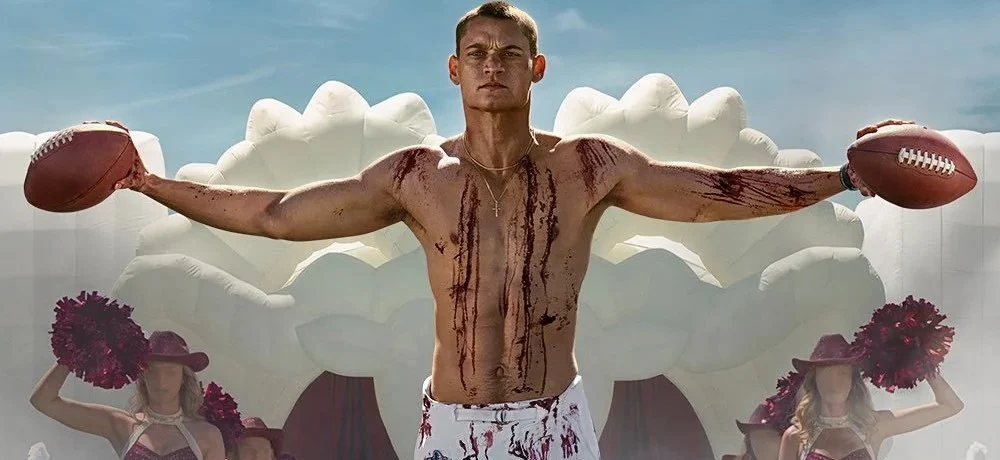
HIM is a mean, lean, arthouse fighting machine of a sports horror movie. Justin Tipping’s film did not buck to expectations. Even the director/co-writer himself is surprised he got to make such an absurdist and provocative slice of horror for Universal Pictures, thanks in no small part to producer Jordan Peele.
Tipping’s first studio film polarized—as many button-pushing horror films do.
Time will tell with HIM, but the goods are already there. “From murderous mascots to rabid fans, Tipping and company have a blast thinking of every football staple to bastardize,” Matt Donato wrote in his review. “It's Hard Knocks gone to hell with a violently cult-driven punch, and while style trumps substance in some parts, the very scarcity of sports-centric horror films makes HIM a Hail Mary pass that finds the end zone.”
Recently, Tipping spoke with Daily Dead for our best of the year coverage, discussing his ambitions with the film, its creation, and its reception.
Where did you and your cinematographer Kira Kelly (Rez Ball) begin in creating the atmosphere for HIM?
Justin Tipping: We were immediately drawn to how to make it immersive and put an audience into Cameron Cade's (Tyriq Withers) experience. Whatever he was going through, we wanted it to reflect tonally, getting weirder and weirder as it progressed. In setting it up, it was more like ESPN's 30 for 30 or a Nike ad. And then, once you get to the compound and the home and that environment, it will start to unravel. Every department we told a similar story with the light, so it might be warmer, natural, and then it starts to get a little more contrasty, dark, and even fluorescent. We also wanted to give it this divine feeling throughout and to play with this new mythology.
What were some of the other visual references for HIM?
Justin Tipping: The Nike sports we were referencing were more the Nike Freestyle ads, where they did very fine art–driven work [as parodied in Scary Movie 2]. We were looking at more fine art and Goya paintings. The descent into madness in a lot of fine art—that was the North Star.
We'd have conversations like, "Well, how do you subvert football and how do you shoot it?" Once he's getting hit in the face and we're entering that language, it was more of a challenge to say, "What if we were just on a locked dolly and living in a language that is more akin to horror or genre than going handheld or getting on certain crazy rigs that the NFL might use?" For what you would do on a typical sports ad, it was subverting those expectations.
Was there ever a debate involving the NFL? Did you always know you were going to have to create your own universe?
Justin Tipping: It was also just legal from the beginning. I think the original draft I inherited even had references to the NFL. The legal team and everyone was like, “There's no way we’d ever be able to clear this content, so we have to make it our own.” It was actually way more fun and freeing to start world-building and coming up with a whole new league. At one point, we almost snuck in an Any Given Sunday reference.
What was it?
Justin Tipping: At the end, Al Pacino's going to coach an expansion team in New Mexico. We tried to sneak that in to connect the universes, but legal caught it. I was like, Damn, that would've been hilarious.
That's such a deep cut.
Justin Tipping: It was such a deep cut, but I tried. It was more legal issues and business than anything else, but I do think the distance helps create a more objective analysis or critique of the sport itself.
The movie addresses many pertinent subjects, especially mental health. As much body horror as there is in HIM, how important was the psychological horror?
Justin Tipping: It was both. When I first talked to Jordan and Monkeypaw, I told them the body horror is inherent in the game itself. Athletes I had talked to or knew described it as getting into a wreck every weekend because of the collisions and all the behind-the-scenes stuff like cortisol shots, the meds you're taking, and the new technology with ice baths and oxygen tanks. That's all just real. The approach was just how we lens it and what we show.
Psychology was the more interesting way to lean into it, for me, with some of my favorites being Jacob's Ladder and The Shining. Having this unreliable narrator freed us up to have more fun with the maximalist, bombastic tropes of both football and horror, mashing them all up.
Watching the movie gives you flashbacks to some horrifying injuries, like RG3’s leg injury or Tua Tagovailoa’s concussion.
Justin Tipping: That was terrifying.
Horrific. I don't ask this lightly, but did you and your VFX team study past injuries closely?
Justin Tipping: It was pretty sobering, I must say. The more you look, the more you actually dig in, the more you're like, "This is so, so dangerous." Part of the reason for looking at these videos was understanding the fencing response, when you get a concussion or head trauma and your body freezes and seizes. We had to watch a lot of that. Even working with our special effects makeup team, they're sending me 30 images of all these snapped wrists or fingers. It was crazy to be like, "What's the craziest thing you could think of?" And then you just see a hundred video clips, and you're like, "Oh, there's too many to choose from."
How tricky was managing the tone of HIM?
Justin Tipping: The whole movie felt like this line: how do you walk it? If you go too far one way, it becomes too over-the-top comical where you can't take the brutality seriously. And if you go too dark or grounded at times, sometimes it feels like we're now sitting, the pulse is gone, and we need to be moving forward. It was really that balance of sports horror and humor, but done in a way that is an intentional, beautiful satire of all those things that the subject matter had going for it. So yeah, it got weird.
The cutting is so aggressive. How far did you want to push the extremity of the cutting, especially in the finale?
Justin Tipping: For that last scene, I was making everyone watch Holy Mountain. I had the same conversations with the editor, Taylor Mason, wanting it to feel like the volume's turned all the way up and he has no time to rest. There is no time to think and reflect.
How deeply did you look into the occult for the internal rules of the movie?
Justin Tipping: I got into Zoroastrianism.
What's that?
Justin Tipping: It's a very old, old religion that no longer exists, but it is in some of those monologues about how we used to prepare boys to be men. There was a lot of research into rites of passage for warriors. It’s kind of universal across cultures, even blood rituals in Hawaii with sharks. There's something specific in the universality of this idea of how you become men.
The Big Bad Evil is essentially the franchise and the owners treating their players like commodities. Once their bodies or whatever are used up and no longer necessary to keep the prophets going, they're disposable. From that point of view, the main mythology for them I was looking at was Mammon, who's the archdevil and god of greed. Actually, they didn't use his real name in The Craft, but they're actually invoking him. I based it off the same devil. If you look at the pentagram symbol at the end, it's a symbol for Mammon. I mean, there are TikToks that are dedicated to Mammon.
It's a collage of ideas inspired by the art design too, with the production designer, where again, we needed a new mythology, but something we could point to. A lot of the texture of the occult and what they're doing are also touchstones of alchemy and Freemasonry. And there's this group in San Francisco near where I grew up. It's the Bohemian Club. A lot of our past presidents have been a part of this.
I've got to look into this.
Justin Tipping: It's fucking weird. It's only a hundred years old, which is how we looked at this league.
So kind of like Yale’s Skull and Bones?
Justin Tipping: Exactly. It's a very heavy Republican private club in the Redwoods in Northern California. There's just a group of dudes who get together. People say the decision to drop the first atomic bomb might've been through this club. They just made up their own rituals. "What if we just put on this gown and went to a stage in the Redwoods and put on this performance?" It's just a frat. It's a fraternal order that dudes make up.
None of that is all explicitly stated or delves into one specificity, but I could probably go into every scene or every frame and then break down the conversations we all had like, "This is what we're really saying." This checkered print here, this Klein blue here, is all in service of this idea of the occult being this insidious capitalist entity.
I think that's also where that pace and the frenetic energy comes from. I knew it's absurd. It's all absurd. There are men in tights running around chopping each other's heads off and kicking a man's head like a football. It was very much self-aware, meta, like, "Let's just be fucking punk."
What was your own state of mind while making HIM? How was it personal for you?
Justin Tipping: When I got there, I was burnt out after directing television, and COVID had just happened. I worked through the pandemic on a TV show overseas, and I missed my brother's wedding and the birth of a nephew. When I got back, I was so burnt out, so depressed, and probably made the most money I ever made. And in that time too, my father had passed.
I'm sorry.
Justin Tipping: I didn't deal with that. When I had time to stop and do some soul-searching, Jordan called with this script and I was like, "Oh shit, I want to go back to features." What I saw was universality in that psychology: how bad do you want it, and what does it take to be the greatest? In filmmaking, in writing, musicians, any kind of person I started talking to, it’s like, "If I just keep grinding, if I stay up a little later… I'm not going to go out tonight and see my friends because I've just got to finish the thing."
I think we were all reckoning with it, but that’s what I brought to this. It’s probably reflective of the mental state I was in—as a person, artist, everything. I wanted to critique and make fun of the absurdity of our cultural norms, the thin line between support and worship, obsession and dreams. It all gets mixed up in the American dream, the pursuit of it. The myth of meritocracy is, “Work your ass off and it’ll happen.” Probably far from the truth [laughs]. It’s been wild to see the reactions, for sure.
What were your expectations?
Justin Tipping: I knew going in, Fuck it. [laughs] People are going to love or hate this, but at least I’m trying something new.
How do you feel after the release and response? It does sound like it was kind of cathartic, just letting it rip with a studio movie.
Justin Tipping: Yeah, I was actually shocked because I had no idea that they were going to release it in IMAX and do 3,000 screens and put the machine behind it. This was a much smaller thing. As a first-time studio director, I don't have unlimited money or unlimited time. I was storyboarding with Monkeypaw interns with my phone. Actually, I had to do some film school stuff on the movie. Then the machine is now backing it, and every billboard in LA has it.
I mean, it was fucking surreal. And then the reviews, I was like, Holy shit. It was a whole new chapter where no one saw it coming. I'm not even saying it's my opus, and I knew people were going to love it or hate it, but I didn't know that much hate. It was weird where people were also coming after me as if, I don't know, I kidnapped someone in their family. At the end of the day, debriefing, I remember having drinks with our composer and Kira Kelly and our department heads, kind of being like, "I think we just made the most punk rock film this year." Critically most hated is kind of a badass thing.
[Laughs] You know what, you got a reaction.
Justin Tipping: Hate it or love it, but don't be apathetic. It is also weird to see now it's finding a life of its own with audiences who do love it. And most people, either other filmmakers I’m talking to or other people in the industry like yourself, are like, “I liked it. I don't understand the hate.” And that's usually how every conversation I have goes with peers in the industry or other producers that I'm meeting with. So, it's pretty fascinating to see that Rotten Tomatoes hate versus real-world reaction.
So many great horror movies have been trashed.
Justin Tipping: And then that becomes part of the discourse: well, some of my favorite films were also so hated. Like Kubrick, whoever. It's just fascinating. I don't know, what's your take?
You're in a good club. I also think it's an arthouse horror movie that was presented as a very commercial horror movie.
Justin Tipping: It definitely feels like a blockbuster was being marketed. I just Trojan Horse’d an art house film into the studio system. I am still shocked that I got away with what I got away with. All props to Universal and [CCO] Donna Langley. I think that only happens if Jordan Peele can back a filmmaker like myself so that I could shoot a studio movie like this.
---
Go here to catch up on all of Daily Dead's Favorites of 2025 lists and interviews!
A film journalist with over a decade of experience writing for Slash Film, The Credits, and High Times Magazine.
A film journalist with over a decade of experience writing for Slash Film, The Credits, and High Times Magazine.








![[Editorial] AI of the Living Dead: Why Have So Many Already Accepted the Simulation?](https://dailydead.com/wp-content/uploads/2025/09/M3GAN-180x83.jpg)

![[Comic-Con 2025] Interview: Michael Giacchino Talks Marvel’s WEREWOLF BY NIGHT: BLOOD MOON and Why He Loves Classic Monsters](https://dailydead.com/wp-content/uploads/2025/07/Werewolf-1000-b-180x83.jpg)
![[Editorial] ANNIHILATION (2018): The Algorithm of Natural Selection Just Unfollowed You](https://dailydead.com/wp-content/uploads/2025/07/Annihilation-1000-180x83.jpg)