


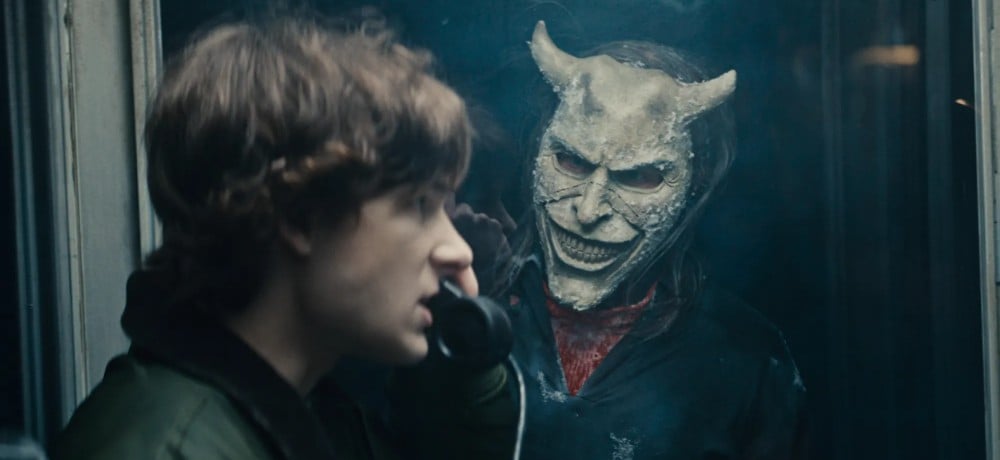
Following the success of The Black Phone, filmmaker Scott Derrickson didn’t play it safe when it came to the sequel. The Blake family faces off against the Grabber (Ethan Hawke) in a story with spiritual consequences, not just physical. More than limbs are breakable in Black Phone 2—a sequel that deepens and tests Gwen’s (Madeleine McGraw) faith in the face of terror.
Derrickson and co-writer C. Robert Cargill made a sequel with vitality. “It’s a brilliant example of how horror sequels don’t have to be copy-and-paste, promoting originality within a franchise-building model,” Matt Donato wrote in his favorites of 2025 list. “Kudos to Derrickson and Cargill for showing how sequels can become their own beasts.”
For our favorites of 2025 coverage, Derrickson spoke with Daily Dead about McGraw’s authentic performance, keeping the mystery alive, and the sequel's sinister production design and Super 8 footage.
Were there any albums you were listening to while writing Black Phone 2?
Scott Derrickson: Oh man, great question. I always listen to music while I write. Top three albums while writing Black Phone 2 would be the It Follows score by Disasterpeace, All Fall Down by The 77s, The Wall by Pink Floyd, and Who Killed Sgt Pepper? by The Brian Jonestown Massacre.
How much inspiration do you draw from your own nightmares when working on a film?
Scott Derrickson: I don’t much remember my actual dreams and nightmares, but I do try to always draw on things that I am actually afraid of. Looking back, I think filmmaking has been a pretty healthy way for me to confront and work through my own fears.
You’ve spoken before about growing up in the ’80s watching slasher sequels. Was there a particular feeling from that time in your life watching horror that you wanted to tap into, maybe even recreate for younger horror fans?
Scott Derrickson: Horror in the early ’80s was mostly a communal, home video experience. There were countless late-night (or even all-night) get-togethers with my friends to watch three or four VHS horror films in a row. There is a collective feeling I have about horror films from that era—a kind of joy and excitement that came from watching things that were transgressive at the time. Something about the combination of violent shock and youthful joy came directly from that era of early ’80s horror into the making of Black Phone 2.
In the first film, it was important to you not to explain the Grabber explicitly. As much as we learn about him in the sequel, what did you and Cargill want to preserve as mystery?
Scott Derrickson: We still didn’t want to explain why he is a sadistic child killer. We expanded his earlier homicidal history, but the source of his derangement is still a mystery.
What conversations did you have with Ethan Hawke about the Grabber’s body language? How did the two of you want him to move in the sequel?
Scott Derrickson: I don’t recall talking to him about that, as the script makes it self-evident that he's more physically active and aggressive in the sequel. Ethan has his own understanding of how the Grabber talks and moves—it's something he just knows how to do. I’ve never had to give him much direction about it.
As you look back and reflect while making these movies, what rings especially authentic about Madeleine McGraw’s performance as a young person struggling with the weight on her shoulders?
Scott Derrickson: It’s hard for Maddy to do those highly emotional scenes where she’s crying or even screaming and crying. She has to know they are coming, and she arrives on set with a real heaviness. Then after, it can take her more than a day sometimes to fully recover. She’s only 15 and she can access those extreme feelings, but at a real cost I think. Those moments are always so truthful. She’s a big emotional engine for her age. She thoroughly understands and feels what she portrays. She’s never just pretending.
Cargill has talked about how, when you’re writing horror in a fantasy space, you don’t have to explain everything to death. Did the two of you still establish internal rules, what you might not spell out but that were essential to you both?
Scott Derrickson: We mostly relied on the rules established in the first film, and only clarified what was critical for the audience to understand the central plot. The scenes I cut had more explanation than we needed. I think if an audience is going to buy into a ghost story, most of them aren’t analyzing it logically. The internal logic is always there, it just rarely needs much explanation.
When you and [cinematographer] Pär [M. Ekberg] discussed shooting so much on Super 8, how did you approach making those sequences feel as cinematic as possible?
Scott Derrickson: We did a lot of testing of Super 8 stocks and cameras, as well as 8mm extractions from 16mm stocks and cameras which gave us more lensing choices. We had to reshoot a few scenes because of camera and lab malfunctions, which was painful but not unexpected given the instability of that medium. I’m very happy with the sheer volume of 8mm footage in the film. On the big screen, the grain is so amazing—nothing else looks like it.
There are shapes and compositions in the background that, whether intentional or not, echo the Grabber. When designing spaces, how did you and [production designer] Patti Podesta work to subconsciously unnerve the audience?
Scott Derrickson: This was my third show with Patti, and she is always pushing for things like that. She consistently gives me everything I ask for, plus some major surprises. She works as hard on these films as I do, and the subconscious elements come from that: how deeply immersed she is in the story.
Working with your VFX team—and anyone else you’d like to credit—how was the lost boy’s half-face effect achieved?
Scott Derrickson: My VFX supervisor Ivan Moran is a wizard. He drove the process for the creation of the ice lake finale sequence by traveling to Colorado in February and tiling a real lake and surrounding mountains. That sequence was shot on a stage but looks real because it was real—we didn’t create CGI mountains, we stitched real mountains to a physical set. The half head was a real makeup FX puppet with some slight VFX enhancement—namely the brain matter sliding inside the half-skull.
You’ve described these films as horror stories that come from a place of love. After completing a project like this, what do you take away from the Black Phone experience, both as a filmmaker and as a person?
Scott Derrickson: I think that the audience really appreciated the extremity of emotion and hope at the end of this movie. Not many horror films push for such an uplift, but I learned that if you give that to them in a way that is honest and effective, most of them will feel it and be glad that you did.
Lastly, what about Pink Floyd goes hand in hand with the Black Phone films?
Scott Derrickson: I think they are simultaneously the defining sound of that era, and highly cinematic music. They’ve been great in allowing me to use their music at an affordable rate. For me and my own experience in the late ’70s and early ’80s, those albums are the soundtrack of that era.
---
Go here to catch up on all of Daily Dead's Favorites of 2025 lists and interviews!
A film journalist with over a decade of experience writing for Slash Film, The Credits, and High Times Magazine.
A film journalist with over a decade of experience writing for Slash Film, The Credits, and High Times Magazine.











![[Editorial] AI of the Living Dead: Why Have So Many Already Accepted the Simulation?](https://dailydead.com/wp-content/uploads/2025/09/M3GAN-180x83.jpg)

![[Comic-Con 2025] Interview: Michael Giacchino Talks Marvel’s WEREWOLF BY NIGHT: BLOOD MOON and Why He Loves Classic Monsters](https://dailydead.com/wp-content/uploads/2025/07/Werewolf-1000-b-180x83.jpg)
![[Editorial] ANNIHILATION (2018): The Algorithm of Natural Selection Just Unfollowed You](https://dailydead.com/wp-content/uploads/2025/07/Annihilation-1000-180x83.jpg)