




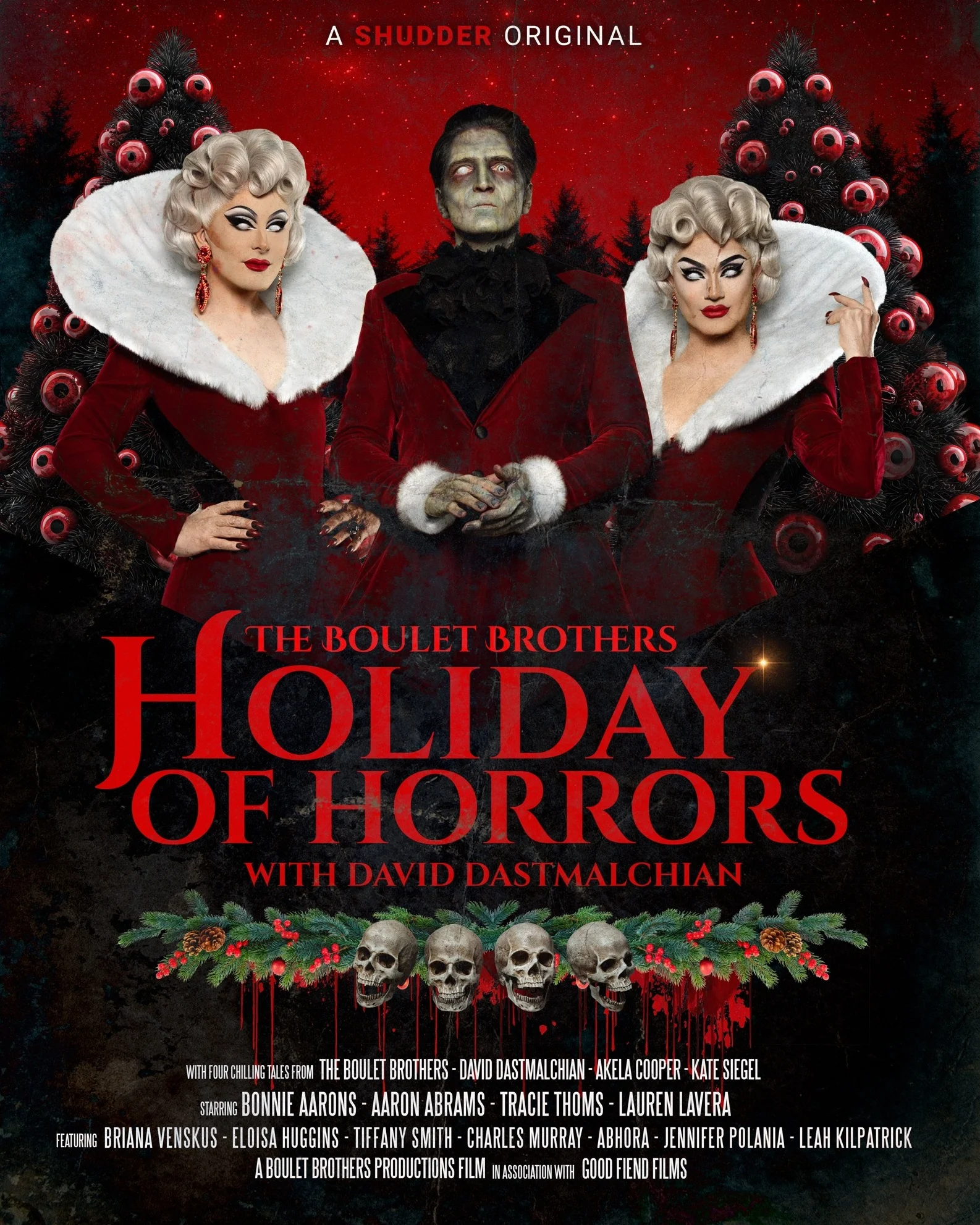
Akela Cooper finally steps behind the camera with The Boulet Brothers' Holiday of Horrors. Cooper is the screenwriter behind M3GAN and Malignant, plus she co-wrote The Nun II in addition to developing two horror projects with Janelle Monáe at the moment. The more horror from Cooper, the better— including her new short film, Old Acquaintance.
It’s one of the horror stories in the Boulet Brothers’ holiday special, featuring shorts from David Dastmalchian, The Boulet Brothers, and Kate Siegel. Cooper’s Old Acquaintance stars acting and musical powerhouse Tracie Thoms, playing a woman returning home on New Year’s Eve. Grief, an answering machine, and an evil spirit haunt her.
Cooper recently spoke with Daily Dead about her transition into directing, her favorite horror novels and movies, and a whole lot about Tobe Hooper’s Lifeforce.
Congratulations on your directorial debut. It turned out really well. How’d it come about?
Akela Cooper: The Boulets came to me with this opportunity because I'd been a guest judge for them before, and I was really appreciative that they thought of me. I was like, "Hell yeah, I will jump at the opportunity to direct a short.” It was a really safe—not easy, but a safe—natural way to put my toe into the directing waters.
I was able to call up my actor friends and say, "Hey, I want to cast you. I wrote this part for you." Everyone said yes: Tracie Thoms, Tiffany Smith, and even my friend Charles Murray, who's a fellow writer. They all made time for me, which is really touching.
I'm really happy to hear that it turned out great for a regular viewer because my friends are like, "It's awesome." I showed it to my mom, and she's like, "I loved it.” But as John Waters said, it's like, “Someone besides your mom and the person you're fucking has to like what you do.”
[Laughs] Great quote. New Year’s Eve, too, is kind of a perfect time for a horror story. How’d you land on that date for the story?
Akela Cooper: My first idea was going to be Christmas. It was going to be a bunch of roommates around people-eating Christmas trees. I didn’t think we'd have the budget to do that. And then I knew Kate Siegel's was going to be Christmas-related, and then I knew David Dastmalchian's was the Yeti, but it was also roughly Christmasy. Okay, well, what other holiday? New Year's. What if it's this woman returning home and her father has passed away?
Last time we spoke, we talked a lot about writing fear. How is it directing fear when working with Tracie Thoms?
Akela Cooper: The beautiful thing about Tracie Thoms is that you give her a minimal directing note, and she will run with it. Honestly, I did at one point have to tell her, "I need you to pull the emotion back just a little bit," because she went from zero to 60 with it.
But it was basically just like, “This is what you're feeling.” It's the creepy part of the environment and more the emotion of what is going on. I think the biggest emotional thing between us was the first time she heard her father's voice on the answering machine. I did walk her through step by step what that was, but she was incredible. She was a very generous actor, listened to me, and adjusted when I asked. She made directing a breeze.
You’re working entirely in one location in the character’s childhood home. How’d you want to make the space cinematic?
Akela Cooper: I had a really good cinematographer who also works with the Boulets on their show. That was another collaboration that was incredibly fulfilling and collaborative. She had an incredible idea: the overhead shot of Tracie as she's going through the box was her idea. Yes, cool ideas and making what I thought in my head all the better. You only have so many angles. You only have so many places the camera can look. How do you make that setup scary? Initially, in my head when I wrote it, the room where the demon was in was going to be down a dark hallway, but in the houses that we could get, no one had a long, dark hallway.
When we got to this house, it's like, "Oh, the dining room would be cool." It was talking it through with the cinematographer on what we could do with the lighting and putting the demon in the corner and all of that. All right, this is what directing and production is. You can't exactly get what you want in your head; you have to adjust sometimes on the fly.
Another thing was, Tracie is a busy, in-demand actress, and she had to fly to New York for The Devil Wears Prada 2. We initially had two days. It was a Thursday and a Friday to film everything, but then that went from two days to one day because she had to fly out Friday.
You got this done in one day?
Akela Cooper: Yes. I made my day.
You must feel very proud that you got your directorial debut done in one day.
Akela Cooper: Yes. I didn't go over budget as far as I know, and I got everything in a day. I was very, very proud. Looking back at it, there were little things when we were going through notes with David and the Boulets, where they're like, "Do we have this? Do we have that?" And I'm like, "We don't." We only had so much time. Maybe if we'd had that second day, but for the timeframe and what we were able to do, it turned out as a pretty good short, I would say. We got it done.
Years ago, you started getting asked more about directing, but you saw yourself as a writer first and foremost. What brought you around to finally directing?
Akela Cooper: It's been a long time coming. Even now in pitch meetings, it's like, "Would you direct this?" And I'm just like, "No." Now it’s, "Should I?" When the Boulets made this offer, I at least needed to see if I could do it. I didn't know if I'd be good at it.
I'm that millennial kid—like an elderly millennial, actually, I'm part of a pocket generation—where if I don't think I'll be good at something immediately, it's very hard for me to want to try it. It's that fear. This was a way for me to be like, "If I fuck up, it's not like I fucked up on a feature." You know what I'm saying? So let me see if I can do it, and I did it. I have been bitten by the directing bug, so we'll see what comes next. Again, I am grateful for the Boulets and David Dastmalchian for giving me this opportunity.
Now, what circumstances would it take to say yes to directing a feature?
Akela Cooper: It's probably going to happen. I want to get back into writing my own original stuff. There are a couple of ideas now where, if I took this out to pitch it or if we sent it around as a spec, yeah, I want to direct.
Do you have any scripts in your digital drawers that maybe one day you’d want to revisit and direct?
Akela Cooper: There is one in particular that I know would need to be made for a budget because it is fucking weird. It's fucking weird and it's gross. The two subgenres of horror that I haven't done yet that I want to do are body horror and cosmic horror. And this one is very much body horror. I've written a draft, and it was years and years ago, so I obviously need to pull it out of the drawer, dust it off, and rewrite it now to where I am in my career and my talent ability. Sometimes I do think about that one. I need to dust that off again.
You wanted to be a novelist when you were growing up. What were the books you were reading that were foundational for who you are as a storyteller?
Akela Cooper: Obviously Stephen King. Stephen King was huge. Nancy A. Collins, who wrote an incredible vampire series called “Sonja Blue.” I fell in love with it. Another is Bentley Little, who kind of in the ’90s became the new Stephen King. Like the King, he could crank out books.
My dad actually got me my first Bentley Little book. He stopped off at a truck stop with a little bookstore area. He knew I liked horror, the cover looked cool, and then he read the description. I don't think it was Bentley Little's The Summoning, it might've been, but it was the description of these bodies underwater that were discovered walking around the bottom of this kind of Lake Michigan. My dad thought, My daughter would like that.
That's really sweet.
Akela Cooper: Yeah. He brought it home and was like, "Hey, I think you might like this book." He was very much right. And so, that kicked me off with my Bentley Little run. Early on though, even before Stephen King, the gateway horror was R.L. Stine, Goosebumps, and “Fear Street,” loved all of that.
When you're working on a horror script, do you still find a lot of inspiration from horror novels?
Akela Cooper: Yeah. I read something recently, Dead Silence. It's good. It's one of those things where it starts off strong because it's basically a ghost ship in space: a Titanic ocean liner–esque thing is lost. Event Horizon basically meets a haunted house, which was kind of what Event Horizon was, but people see the dead relatives. The protagonist is, I think, kind of psychic.
In the end, it doesn't really stick with the landing because then it becomes a scientific explanation for why all of this stuff was happening. I'm like, "Then why do you have a character who's psychic? If there's an actual scientific explanation, what was that about?" But up to that point, it’s pretty cool. There's also a book series that I'm really interested in called The Hatching series, which is about giant spiders.
On the movie side, Pumpkinhead was life-changing for you. What other horror movies set you on your path?
Akela Cooper: A Nightmare on Elm Street, most definitely, and Hellraiser II. Friday the 13th to a certain degree, but John Carpenter's The Thing and The Lost Boys. My parents took me to theaters to see The Lost Boys. I didn't see it in theaters, but Fright Night.
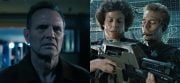
I love Child’s Play. When I was maybe four or five, we had a Beta machine. I couldn't read well yet, but the way my dad did the labeling on the Beta tapes, I recognized them. And so, the two movies that I would watch repeatedly when I was left to my own devices were Child’s Play and Terminator. Another later influence, for various reasons, is Lifeforce, which is another Tobe Hooper film.
Oh, the movie's crazy.
Akela Cooper: It is insane. I think that's the influence. Beyond the nudity, which was like, "She's naked again? Does this lady not have clothes?" And then it's like, "Ooh, space bats. Okay, now there's a corpse that's melted. Okay. She's naked again. Okay. And now it's the apocalypse. How many plots are in this movie? What is happening in this film?" I think early on it was like, "Oh, hey, horror can do batshit things."
And it does it with great effects and production value. It’s so nutty. As a writer, what goes through your mind when you experience the audacity of Lifeforce?
Akela Cooper: I'm sure there's some through-line of rules and stuff in that film, but it's a space movie, then it's naked people. The naked people are vampires who suck energy and not blood. Okay. They are space bats. Captain Picard is here. It is one thing after another. But yeah, that was another huge influence.
Looking ahead to the new year, what do you hope to accomplish? Do you think you’ll write any horror novels in the future?
Akela Cooper: I don't know if I have a novel in me. I know what I would write if I could, but I don't know if I have the time or the discipline to write a horror novel. We'll see. My goal for 2026, depending on my professional obligations, I have four original horror ideas. We're going to see how many I can write next year.
---
Go here to catch up on all of Daily Dead's Favorites of 2025 lists and interviews!
A film journalist with over a decade of experience writing for Slash Film, The Credits, and High Times Magazine.
A film journalist with over a decade of experience writing for Slash Film, The Credits, and High Times Magazine.
![[Guest Article] Maggots On Your Body Of Work: Clay McLeod Chapman On Finding His Own Muses](https://dailydead.com/wp-content/uploads/2026/03/Bodies-of-work-1000-180x83.jpg)
![[Editorial] AI of the Living Dead: Why Have So Many Already Accepted the Simulation?](https://dailydead.com/wp-content/uploads/2025/09/M3GAN-180x83.jpg)