



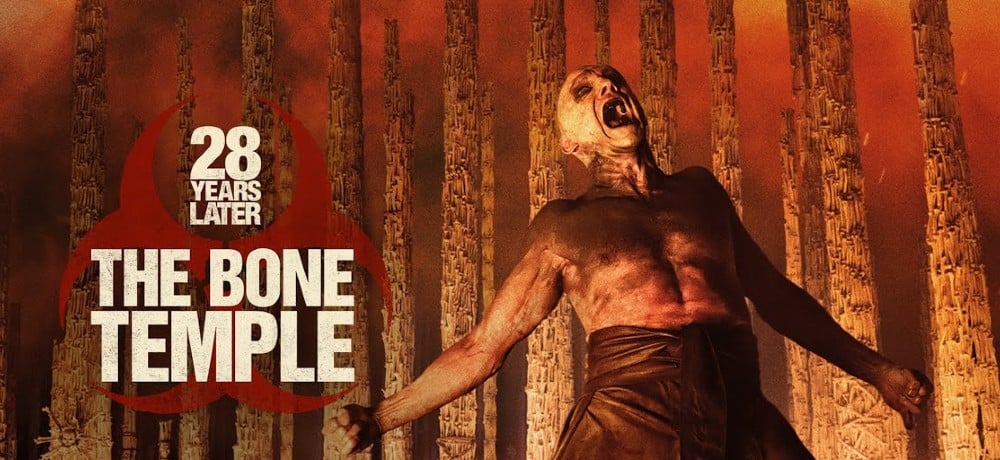
Nia DaCosta can, and continues to, do it all. Months ago, she released Prime Video’s elegant awards-season hopeful, Hedda. Before that, she entered the Marvelverse. Now, she makes Danny Boyle and Alex Garland proud with 28 Years Later: The Bone Temple. It's impressively concise—a more stable continuation of last year's all-the-rage return—ditching the thematic bloat that weighed down 28 Years Later. DaCosta's in control of her punk-rock viral thriller that runs with material introduced by Boyle and Garland, making for one doozy of a trilogy midpoint that could easily be the peak once 28 Years Later 3 releases.
Our cliffhanger prayers are answered in 28 Years Later: The Bone Temple, which focuses heavily on Jack O'Connell as the psychopath cult leader Sir Lord Jimmy Crystal (modeled after true-to-life monster Jimmy Savile). Poor Spike (Alfie Williams) is the latest of his "fingers," how the self-anointed “Lord” refers to his minions (strong fingers make a mighty fist). Jimmy Crystal's flock roams the U.K.’s quarantined wasteland as intruders and abusers, on a collision course with Dr. Ian Kelson (Ralph Fiennes) and his astonishing "Bone Temple." However, Dr. Kelson has no idea what's on the horizon—he's too busy befriending the hulking Alpha "Samson" (Chi Lewis-Parry), the distractingly well-endowed berserker who became the talk of 28 Years Later.
Garland's screenplay is healthily decluttered this time around. Where 28 Years Later felt like a see-what-sticks beginning, 28 Years Later: The Bone Temple examines the root of unpredictable evils. Jimmy Crystal is the tracksuit mafioso who rules like a kingpin from The Warriors, while Dr. Kelson jabs Samson with morphine-tipped needles in an attempt to study the savage beast's condition. There's less teeth-gnashing action and fewer infected threats, but DaCosta doesn't make that a problem. Despicably dark humor brings more comedy into the fold, while Jimmy Crystal's "charities"—how he refers to the tortures his soldiers inflict upon innocents—are a queasy brand of sick brutality. It's a more idiosyncratic take on the franchise's doomsday landscape, finding intrigue in the outlandish ways survivors (and Alphas) manipulate an outbreak apocalypse to serve their interests.
O'Connell is delightfully disturbed and infallibly charming as Jimmy Crystal, who represents Spike's worst nightmare. He's Negan without getting his hands dirty, dependent on his "Jimmy" ranks like Erin Kellyman's badass Jimmy Ink (everyone in the Jimmys gets a Jimmy name). As O'Connell displayed in Sinners, he's so proficient at blending notes of devilishness, ruthlessness, and fake hospitality as a king who values not the lives of his underlings. There's a compelling sense of unknowns about Jimmy Crystal that keeps us on the edge of suspense whenever he speaks, because we don't know if we're about to hear another Teletubbies anecdote, or a grotesque threat that becomes a very real punishment. He's a top-tier villain who hides his cruelty behind heaps of personality, but he's never a joke. O'Connell spotlights the horribleness of egomaniacs in times of uncontested incivility.
For how good O'Connell is, Ralph Fiennes is on another level. Dr. Kelson's arc as Samson's unexpected bestie veers into Land of the Dead territory, comparing where George A. Romero evolved his X of the Dead franchise to that point. Fiennes is asked to participate in sequences that, by horror standards, are out of left field—and he crushes every instance. Dr. Kelson's chummy relationship with Samson sees them dancing shirtless to Duran Duran or sitting peacefully amid calcified pillars, staring together at nature's serene beauty. It's very "Bub" in Day of the Dead, but more compassionate and enthralling because a virus can be treated. Fiennes presents as the kooky, iodine-soaked mad scientist who can be mistaken for Lucifer, but he's never as cold and heartless as meaner interpretations of Dr. Frankenstein. In fact, he's a beacon of hope in 28 Years Later: The Bone Temple with impeccable music taste. One particular Iron Maiden needle drop in the third act unleashes Dr. Kelson's inner 80s metalhead in what can only be described as must-see showmanship, speaking to the uniqueness of DaCosta's conceptualizations. I watched the sequence with a smile plastered ear to ear, addicted to the flamboyant blasphemy of Dr. Kelson's entire choreographed performance from Hell.
There's a daffiness to 28 Years Later: The Bone Temple, yet DaCosta never chases away audiences with absurd yucks. Characters are forced to confront unstomachable realities, but it's not just for shock value. Everyone grows, whether Spike continues to eat crow under Jimmy Crystal's tutelage, or we sneak away on sidequests with Samson as he tries to unlock memories from his pre-infection days. DaCosta doesn't waver in telling a horror story that isn't aiming for nonstop scares or fast-paced, mutilation-heavy beats. 28 Years Later is a more inquisitive and pensive take on outbreak paranoia, driven by DaCosta's morbid intrigue in the human mini-bosses you'd encounter on travels across zombie-ridden territories—the real monsters out there.
It's nice to see 28 Years Later: The Bone Temple ditch Boyle's 20-lens iPhone camera rig in favor of cleaner shot selection. Cinematographer Sean Bobbitt uses a single-lens rig for intimate close-ups on infecteds without all those distracting cuts between different iPhone angles. He's also able to recreate the same stunning swirls of cosmic perfection above Dr. Kelson's architectural wonder, bones piled high, with the bonus of blazing fires to make amber-torched visuals even more appealing. DaCosta crafts a high-art horror experience set in these picturesque North Yorkshire locales, benefitting from inherited production value. Credit to Bobbitt for feeling the energy of every scene and meeting the vibe, as well as composer Hildur Guðnadóttir, who reunited with DaCosta a third time (Candyman, Hedda).
28 Years Later: The Bone Temple is a splendid step-up from its predecessor. Where I was nervous to see how the "jumble" of subplots would come together after 28 Years Later, the opposite now holds true. DaCosta proves my point that 28 Years Later spread itself too thin by opting for a less-is-more approach, giving her actors more room to breathe in their character development. It's a steadier, more impactful, and all-around polished sequel that outshines its original. That's the DaCosta effect!
Movie Score: 4/5
Matt Donato is a Los Angeles-based film critic currently published on SlashFilm, Fangoria, Bloody Disgusting, and anywhere else he’s allowed to spread the gospel of Demon Wind. He is also a member of the Critics Choice Association. Definitely don’t feed him after midnight.
Matt Donato is a Los Angeles-based film critic currently published on SlashFilm, Fangoria, Bloody Disgusting, and anywhere else he’s allowed to spread the gospel of Demon Wind. He is also a member of the Critics Choice Association. Definitely don’t feed him after midnight.










![[Guest Article] Maggots On Your Body Of Work: Clay McLeod Chapman On Finding His Own Muses](https://dailydead.com/wp-content/uploads/2026/03/Bodies-of-work-1000-180x83.jpg)
![[Editorial] AI of the Living Dead: Why Have So Many Already Accepted the Simulation?](https://dailydead.com/wp-content/uploads/2025/09/M3GAN-180x83.jpg)