

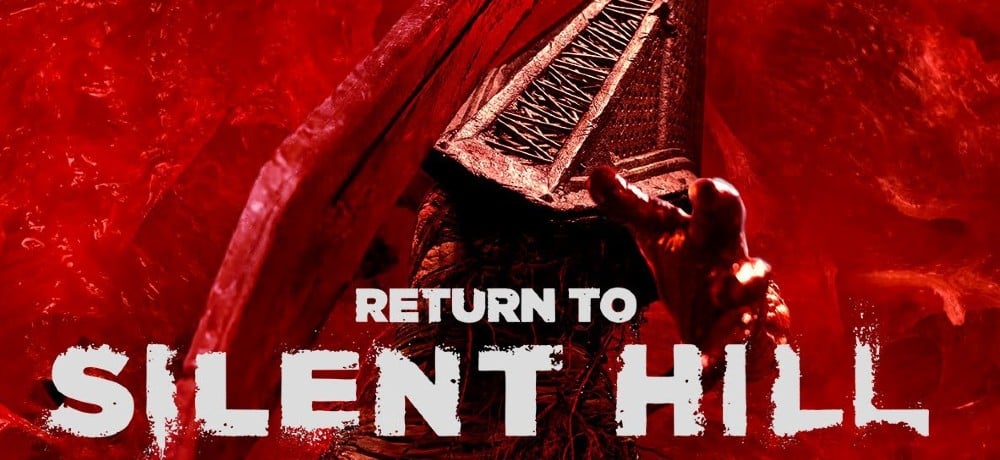
Well, Return to Silent Hill isn’t beating the (overblown) video game adaptation curse allegations. Director and co-writer Christophe Gans brings Konami’s Silent Hill 2 to life in a hacked-apart way that serves familiar characters and locales, but undercuts almost every element. It’s scary in bursts, choking the screen with thick fogs and acidic goos, but also visually compromised, as “Armless Man” shamblers and “Creeper” hordes are tainted by lackluster animation. The ethos, fogginess, and Clive Barker-ian grotesqueries are all there, yet overall, Return to Silent Hill barely musters enough enthusiasm to answer why, in fact, we’re returning to this film franchise.
Jeremy Irvine stars as video game protagonist James Sunderland, who receives a letter from his soulmate Mary Crane (Hannah Emily Anderson), beckoning him back to the ominously haunting town of Silent Hill. James is drowning in grief and agony due to his beloved’s separation, and wastes no time returning to where they once fell in love. Upon arrival, James does not recognize Silent Hill—it’s enveloped in a thick mist, and almost everyone has vanished. Nonetheless, Mary’s message mentions their “special place,” believed to be inside the Lakeview Hotel. If there’s a chance she’s there, James is willing to risk it all—even if he must endure the nightmares that now inhabit Silent Hill.
Gans’ intentions to copy-and-paste Silent Hill 2’s code are well-intentioned. Still, it’s a hobbled speedrun at ninetyish minutes versus the, conservatively speaking, eight-to-ten hours of gameplay in the original game. Fans of Silent Hill 2 will already know what fresh hells await James, but specific tweaks that romanticize James’ mission soften its bleakness and detract from what makes the game so insatiably horrific. Supporting players like Laura (Evie Templeton, the game remake’s motion-capture and voice actor for Laura), Angela Orosco (Eve Macklin), and Eddie Dombrowski (Pearse Egan) all pop up, but they’re throwaway callbacks to the game, barely treated to even half-assed arcs. Return to Silent Hill is about James and Mary in a tunnel-vision way, failing to explore the psychological possession that lures other characters into the fold. Gans does an awful job of bringing new fans into the game’s world, since the screenplay leaves so much expositional material off screen.
It’s frustrating because Return to Silent Hill isn’t devoid of demonic attacks or nasty monster designs famous in Silent Hill 2. According to Gans, “Every monster in the film was portrayed by a professional dancer in prosthetic makeup,” which is a godsend when the “Buble Head Nurses” move with rigor mortis-y jerkiness. Pyramid Head (Robert Strange) lumbers with ferocity, dragging his “Great Knife” like an enraged dog with an oversized stick. Even the little details, like the flipped-over Creepers and those terrible, humanoid mouths they expose, prove that Gans wants to terrify his audience. The problem is, other special effects can’t match this level of under-your-skin terror, especially when James is running around devastation and destruction that’s jankily animated without any realism or draw-you-in captivation.
Worse still, Return to Silent Hill appears too synthetic as a movie, with performances forced out like the last glob of toothpaste from a flattened tube. Gans never secures a tonal anchor for his actors to follow, which might work in video games that can get away with sudden changes in tone or pacing, but not in cinematic language, which begs for a semblance of consistency. Irvine’s tortured artist is a farce of the stereotype, while Hannah Emily Anderson’s ghostly damsel is nothing more than porcelain eyes that pierce through your head. There’s no symmetry to the town’s indescribable evils and James’ lovesick lullaby of a dynamic motivation. The game is rife with themes of self-disgust, repentance, and melancholy, presented in a glitzier, less devastating way (none of which benefit the actors). It’s a Hallmark Channel take on survival horror meanness that whiffs on its narrative’s unholy union, stumbling through story beats that, as already stated, unfold without rhythm or deeper definition beyond, “It’s in the game, trust us!”
That, ultimately, is the adaptation’s biggest sin. Return to Silent Hill stays too rigid within video game logic without understanding the structural differences between the mediums. Something like Johannes Roberts’ Resident Evil: Welcome to Raccoon City proves you can be both canonically faithful and cinematic, whereas Gans opts for confounding replications rather than a fluent translation. That, on top of the countless issues in technique and approach, makes the experience a stupendous bore. James becomes a dimwitted protagonist, and Gans cannot articulate why he’s that way. That’s less noticeable when you’re controlling the pixelated version of James, trying to escape Silent Hill’s army of ghouls and denizens—but not here, where it’s the movie’s ultimate downfall.
Return to Silent Hill is a pale, emaciated comparison to one of the best survival horror video games of all time. Gans unsuccessfully re-architects Silent Hill as a filmic purgatory where one man must face the manifestations of his tempestuous guilt, and wastes the juiciest parts of Silent Hill 2’s experience. Authenticity seems to be the strive here—down to games franchise composer Akira Yamaoka stepping in to score—but Gans gets too obsessed with imitation over embellishment. Choice scenes feel torn directly from the video game but with worse execution, and that’s a detriment. Between the poor performances, dismally edited storytelling, and fumbled fright-night entertainment, Return to Silent Hill is anything but a warm welcome home for horror movie and video game fans.
Movie Score: 2/5
Matt Donato is a Los Angeles-based film critic currently published on SlashFilm, Fangoria, Bloody Disgusting, and anywhere else he’s allowed to spread the gospel of Demon Wind. He is also a member of the Critics Choice Association. Definitely don’t feed him after midnight.
Matt Donato is a Los Angeles-based film critic currently published on SlashFilm, Fangoria, Bloody Disgusting, and anywhere else he’s allowed to spread the gospel of Demon Wind. He is also a member of the Critics Choice Association. Definitely don’t feed him after midnight.





![[Guest Article] Maggots On Your Body Of Work: Clay McLeod Chapman On Finding His Own Muses](https://dailydead.com/wp-content/uploads/2026/03/Bodies-of-work-1000-180x83.jpg)
![[Editorial] AI of the Living Dead: Why Have So Many Already Accepted the Simulation?](https://dailydead.com/wp-content/uploads/2025/09/M3GAN-180x83.jpg)