





If Adult Swim is your jam, or you worship the Cheddar Goblin commercial in Mandy, chances are you've seen Casper Kelly's work. The maniac behind Too Many Cooks, the Adult Swim Yule Log series, and the outrageous V/H/S/Halloween segment "Fun Sized," turns his meta-horror sensibilities on the bastardized innocence of children's programming. In Buddy, Kelly reimagines an amalgamation of Barney & Friends, Pee-Wee's Playhouse, and The Wizard of Oz as a bizarre fever dream ruled by a fuzzy, happy-go-lucky television tyrant. It's a bizarro riff on PBS programming that goes maximalist with the concept. For as far as Kelly's pushed his audiences prior, Buddy is his cleanest execution yet.
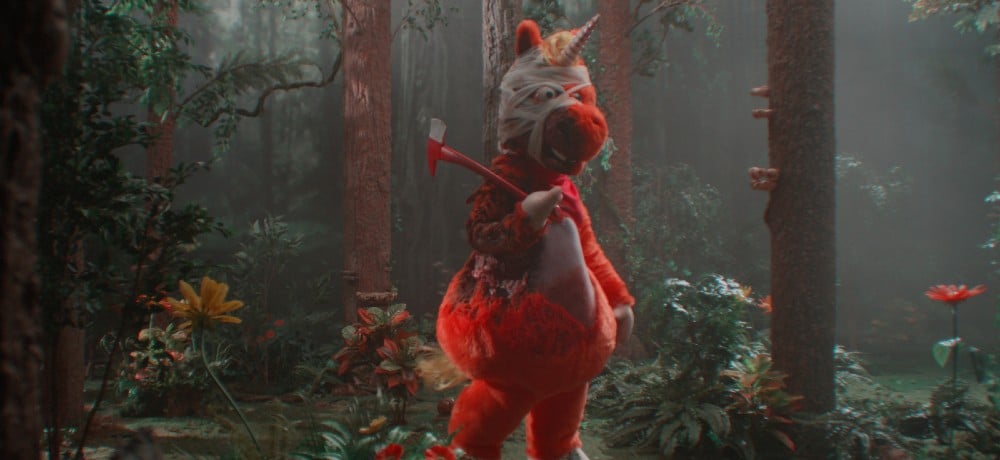
The film takes place in Buddy's deceptively hostile world. He's this orange-and-yellow unicorn mascot with a pot belly who feeds off the love of his pre-teen cast. Everything in Buddy's playground TV set plays by Buddy's rules. If you don't ask questions and shower him with affection, the credits will eventually roll, and he's resurrected at full health for the next episode. But when one of Buddy's playmates refuses to dance, the boy suspiciously goes missing. This causes Freddy (Delaney Quinn) to investigate the disappearance of her friend / castmate, but what she discovers shatters the sunshine-and-sing-along facade Buddy's built, like a public-access purgatory.
Kelly's in league with Krazy House and Mr. Crockett as of late, films that imagine what would happen if wacky TV shows turned sinister on a dime. Kelly and co-writer Jamie King don't waste time introducing pitch-black humor. The first act restarts like a loop—we see full episodes of Buddy's show that grow progressively more concerning. In the first few minutes, Buddy ushers his first victim off-screen as we hear the violence narrated, the camera holding steady on an anthropomorphic mailbox that is now a murder witness. It's as if Barney invaded Pee-Wee's territory and held all the talking furniture hostage, forcing everyone to sing his rendition of "I Love You," lest his beastly side be shown.
From here, Kelly's imagination runs wild. While the episodic portions have an almost VCR-recorded feel, mimicking fuzzy television set visuals, Buddy eventually breaks free into more traditional lensing. Enter Cristin Milioti as Grace, a disturbed mother who can't understand why she feels an icy hole in her heart. She's the key to understanding how Buddy replenishes his ranks of underage companions, in a Ring-like twist. Or there are stretches of Buddy in the playground's surrounding forest, seen without rose-colored glasses. The duality between light and dark is paramount to the film's sense of danger, as everything outside Buddy's domain has a different flavor of despair.
Kudos to Kelly's production design team, because the style of Buddy recalls fond memories of daytime kids' programming on a budget. The costumes are oversized, puppetry is arts-and-crafts-y, and the playground is bursting with colors like a kindergartener spilled the 96-count crayon box. Adolescence is represented in the imaginative ways Buddy's universe comes to life, whether that be "Diamond City"—an Emerald City knockoff—or any of the other fantastical elements. Homages are not subtle, but they're recreated with a practicality that makes them so fun to experience. From Patton Oswalt's "Strappy" the backpack to the Wild West psychedelics trip-out, it's easy to melt into Kelly's absurdist dimension.
But Buddy is more about the performances, starting with Keegan-Michael Key's voice acting as Buddy himself. It pairs wonderfully with Sergey Zhuravsky's in-suit mannerisms, as his demeanor and behaviors change in the slightest when his instructions are challenged. Key nails the yuck-yuck attitude and nauseating positivity that these shows promoted, while indulging the festering evils under his supernatural kidnapper's skin. It's all about how characters interact with Buddy, since his doofy grin and googly eyes never change. The expressions of terror when seeing him commit murders, the sneaking behind his back, and the hopeless playcation when there's no option but to endure his huggable wrath.
That all said, there's an unevenness to Buddy that juggles ideas that are, in Adult Swim terms, better suited for shorter infomercial slots. Kelly's oddball tendencies lead to some hilariously uncouth moments as Buddy stabs jolly Mailman Miles (Bennie Taylor) Michael Myers style or skewers bodies on his unicorn horn, but some material is harder to sustain for an entire feature-length (even at 95 minutes). As the presentation morphs from syndicated recordings to real-life domestic disputes and beyond, that whole "kitchen sink" methodology that's gotten Kelly as far as he's come is still with its home runs and whiffs. However, the ratio is very much in his favor this time.
Buddy is pure madness born from the minds of Mr. Rogers and Charles Manson. There's everything from cult-of-personality horribleness to outright hilarious roastings of childhood innocence. It takes our snuggliest memories and feeds them through a meat grinder, never playing it safe or caring about the ages of those in danger. If you've loved Kelly's oeuvre so far, this one's a slam dunk. If you haven't, it's a wild and crazy place to start that'll have you howling with laughter at the very least.
Movie Score: 3.5/5

Matt Donato is a Los Angeles-based film critic currently published on SlashFilm, Fangoria, Bloody Disgusting, and anywhere else he’s allowed to spread the gospel of Demon Wind. He is also a member of the Critics Choice Association. Definitely don’t feed him after midnight.
Matt Donato is a Los Angeles-based film critic currently published on SlashFilm, Fangoria, Bloody Disgusting, and anywhere else he’s allowed to spread the gospel of Demon Wind. He is also a member of the Critics Choice Association. Definitely don’t feed him after midnight.














![[Guest Article] Maggots On Your Body Of Work: Clay McLeod Chapman On Finding His Own Muses](https://dailydead.com/wp-content/uploads/2026/03/Bodies-of-work-1000-180x83.jpg)

![[Editorial] AI of the Living Dead: Why Have So Many Already Accepted the Simulation?](https://dailydead.com/wp-content/uploads/2025/09/M3GAN-180x83.jpg)