



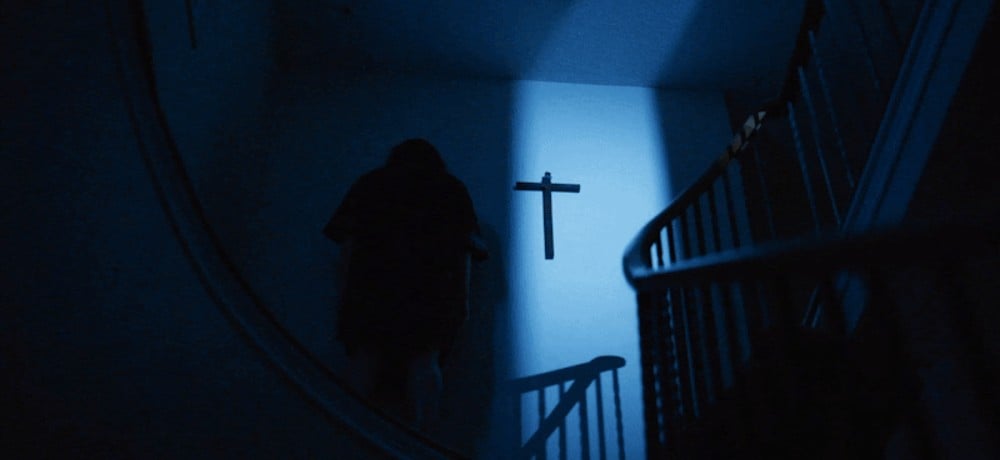
In undertone (lowercase stylized), sound is a monster. First-time feature writer and director Ian Tuason tests the limits of nerve-shredding tension by tweaking an old adage: hearing is believing. Like 2022's Monolith or, to a lesser degree, Pontypool, Tuason utilizes audio clips and over-the-phone conversations to unlock what hopes to be fresher, sonically frightening realms. It's a genre experiment that exposes the nightmarish qualities of alternate sensations, but it's a gamble in bucking traditional haunted-house architectures. How scary can podcasters and auditory bites be, after all?
Nina Kiri stars as Evy, a stress-riddled daughter who's currently living at home, providing end-of-life care to her dying mother (Michèle Duquet). Her only escape is a horror-focused podcast she co-hosts with her bestie Justin (Adam DiMarco) called "The Underdone." Every episode, they listen to creepy audio files: Evy is the skeptic, Justin is the believer. In character, they play up their roles—but a new set of ten audio clips tests Evy's reliance on logic, unable to shake what’s entering her ears.
Tuason relies heavily on atmosphere and mood, given how Evy is the only conscious character seen on screen, mostly sitting at a dining room table, in podcast mode. Cinematographer Graham Beasley indulges the emptiness around Evy, mainly because she records at the witching hour of 3 AM to accommodate Justin's GMT time zone. It's nifty; we only hear what Evy can. When the noise-canceling headphones go on, there's zero background clatter. This becomes a terrifying weapon as Beasley refuses to frame Evy straight-on, instead always keeping a blacked-out hallway or a shadow-drenched staircase in view, where anything could be scampering out of earshot.
What we hear, instead, is the in-episode audio and laptop programs. We know these co-hosts are in trouble when Justin opens an email from a "random" source, and then clips containing a couple's conversations—Mike and Jessa—highlight increasingly disturbing subject matter. The existence of audio "artifacts"—accidental sounds in recordings—becomes a suspenseful mystery, and a heavy emphasis on children's lullabies played backwards to reveal threatening warnings sends shivers up spines. Tuason keeps us on edge by jacking up the volume on these disquieting clues, and has us jumping at the ring of a phone call interruption or the pop of hidden audio that ends with blood-curdling screams.
That said, the question becomes, for how long can undertone sustain its methodologies without sacrificing thrills and entertainment? There's an inherent eeriness to Evy's surroundings, adorned with religious trinkets like porcelain prayer statues and hanging crucifixes, but supernatural action doesn't intensify until late in the third act. For most of undertone, we're private listeners to "The Undertone" with behind-the-scenes access. Don't get me wrong, there are despicable earworms that quicken your heart rate—but the duration of Tuason's manipulation of isolation and sound blocking might drag for some.
It's the same problem I have with other slower-boiling A24 flicks like Saint Maud and It Comes at Night. The buildup-to-payoff ratio is essential, and undertone pushes that formula as far as possible with its demonic whispers and delirious … well, undertones.
Thankfully, the climactic unleashing of the film's ultimate ferocity is both ingenious and terrifying. Kiri shoulders the burden of carrying undertone's only focal performance as a realist who slowly learns how to fear the unknown. Malevolence erupts during their final recording session, when evil escapes the soundwaves. It's a shorter burst than I'd hoped, but what exists is inescapably insidious and terrible (compliment). Plus, he still manages to reinvent traditional genre payoff models, with a final sequence that supports his audio-first thesis.
In concept, undertone is a stimulating whisper of terror that reimagines how filmmakers can approach such a storied genre. In execution, there are menacingly sublime flourishes—but pacing is not bulletproof as an audio-forward experience. It's good and gnarly, albeit somewhat uneven. Absolutely worth the price of admission, especially if you're already a podcast aficionado who's given the narrative-style shows a chance. Or, if you're a horror fan who favors sizable risks chasing pie-in-the-sky rewards.
Movie Score: 3/5
Matt Donato is a Los Angeles-based film critic currently published on SlashFilm, Fangoria, Bloody Disgusting, and anywhere else he’s allowed to spread the gospel of Demon Wind. He is also a member of the Critics Choice Association. Definitely don’t feed him after midnight.
Matt Donato is a Los Angeles-based film critic currently published on SlashFilm, Fangoria, Bloody Disgusting, and anywhere else he’s allowed to spread the gospel of Demon Wind. He is also a member of the Critics Choice Association. Definitely don’t feed him after midnight.




![[Guest Article] Maggots On Your Body Of Work: Clay McLeod Chapman On Finding His Own Muses](https://dailydead.com/wp-content/uploads/2026/03/Bodies-of-work-1000-180x83.jpg)
![[Editorial] AI of the Living Dead: Why Have So Many Already Accepted the Simulation?](https://dailydead.com/wp-content/uploads/2025/09/M3GAN-180x83.jpg)