




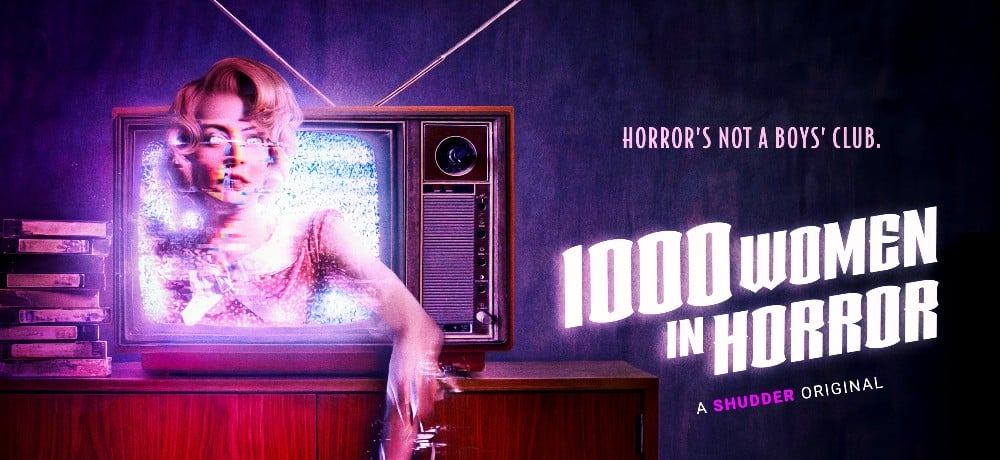
“I didn’t need a fucking dick to hold a camera.” That’s a poignant quote from multitalented filmmaker Mattie Do (Dearest Sister), one of the interviewees in Donna Davies’s (Creepy Cape Breton) 1000 Women in Horror. The documentary is written by and based on author Alexandra Heller-Nicholas’ 2020 book, 1000 Women in Horror: 1895-2018. It’s the kind of documentary that presents enough information that I feel satisfied when it’s over, but makes me excited to continue learning more about it on my own.
Set to Teleportal’s “Pull the Trigger,” the opening credits sequence has traditional 1950s-looking characters surrounded by random horror iconography like skulls, pentagrams, and the flames of hell. The music and blend of blue and pink lighting really set the tone for the rest of the film, which is all about women in horror subverting expectations and rejecting societal norms. 1000 Women begins with a handful of women and femme-identifying creatives introducing one of the key points raised in its 96-minute runtime: the outdated idea that women don’t like horror, yet they’ve played an integral role in the genre both in front of and behind the camera.
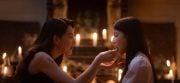
The source material is an A to Z index of actors, writers, and filmmakers who’ve made a significant, lasting impact on the genre. Unlike its encyclopedic composition, Davies and Heller-Nicholas structured the documentary in six chapters, each discussing how being female is its own horror story at every stage of life, from deceptively innocent little girls to adult women forced to play old hags. The Girlhood section is about young girls as victims and as sneaky perpetrators, and creepy dolls in notable movies like The Exorcist, The Bad Seed, and M3GAN. In the School Years section, the film focuses on all the biological horrors of being a teenage girl coming-of-age (Carrie, Ginger Snaps), the co-dependency and toxicity of intense female friendships (Jennifer’s Body), and, of course, iconic final girls from various slasher flicks.
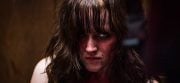
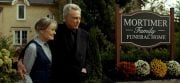
The Adulthood chapter discusses sexual autonomy, the everyday threats of sexual violence, and the catharsis of assault-revenge movies like I Spit On Your Grave and Revenge. When we get to maternal horror (Rosemary’s Baby, The Babadook), actress Kate Siegel, wife and collaborator of horror auteur Mike Flanagan (Midnight Mass), describes an unplanned c-section in excruciating detail. The final section on Aging goes into the ageism women face in the industry, how it affects what roles they’re “allowed” to play in horror, and why aging female bodies are considered horrifying (The Shining).
1000 Women goes the talking heads route, featuring a diverse group of female filmmakers, writers, actors, and critics, including Roxanne Benjamin, Cerise Howard, Kier-La Janisse, Roseanne Liang, Annalise Lockhart, Toby Poser, Sara Risher, Gigi Saul Guerrero, Jenn Wexler, Nikyatu Jusu, and others. They not only discuss iconic horror films and the artists who make them, but a few of them talk about what horror means to them personally as women.
Writer-director Chelsea Stardust (Satanic Panic) talks about her excitement when she realized there were female horror directors, namely Mary Harron (American Psycho) and Kathryn Bigelow (Near Dark). Stardust also names Mary Lambert (Pet Sematary), who might be the first female horror director I’d ever heard of at a young age. Screenwriter Akela Cooper (M3GAN) looks back at The Craft and talks about seeing herself in Rochelle (Rachel True) and how her natural curly hair was mocked by white classmates (another experience I relate to).
1000 Women in Horror is an entertaining deep dive into horror history, but also highlights some of the newer voices in the genre: both writer-directors Ana Lily Amirpour (A Girl Walks Home Alone at Night) and Julia Ducournau (Raw, Titane) and their influential films are mentioned in the adulthood chapter. The list of creatives being interviewed is already pretty long, and honestly, there were so many creators and titles spanning decades that I didn’t recognize, even through cultural osmosis. But as two of my favorite horror filmmakers, I would’ve enjoyed hearing about their experiences with the genre. I’d love to see a follow-up with more female interviewees in other areas of filmmaking, like SFX, cinematography, and music, sharing when, how, and by whom they were inspired to start a career in horror. But as it stands, this documentary is engaging and informative, and it motivated me to check out the obscure but influential horror films presented.
Movie Score: 4.5/5
Cassondra Feltus is a St. Louis-based freelance writer, critic, and Critics Choice member best known for film, television, and pop culture analysis which has appeared on Black Girl Nerds, WatchMojo, and The Take. She loves horror, naps, Paul Rudd, and binge-watching the latest series with her two gorgeous pups – Harry and DeVito.
Cassondra Feltus is a St. Louis-based freelance writer, critic, and Critics Choice member best known for film, television, and pop culture analysis which has appeared on Black Girl Nerds, WatchMojo, and The Take. She loves horror, naps, Paul Rudd, and binge-watching the latest series with her two gorgeous pups – Harry and DeVito.


![[Guest Article] Maggots On Your Body Of Work: Clay McLeod Chapman On Finding His Own Muses](https://dailydead.com/wp-content/uploads/2026/03/Bodies-of-work-1000-180x83.jpg)
![[Editorial] AI of the Living Dead: Why Have So Many Already Accepted the Simulation?](https://dailydead.com/wp-content/uploads/2025/09/M3GAN-180x83.jpg)