



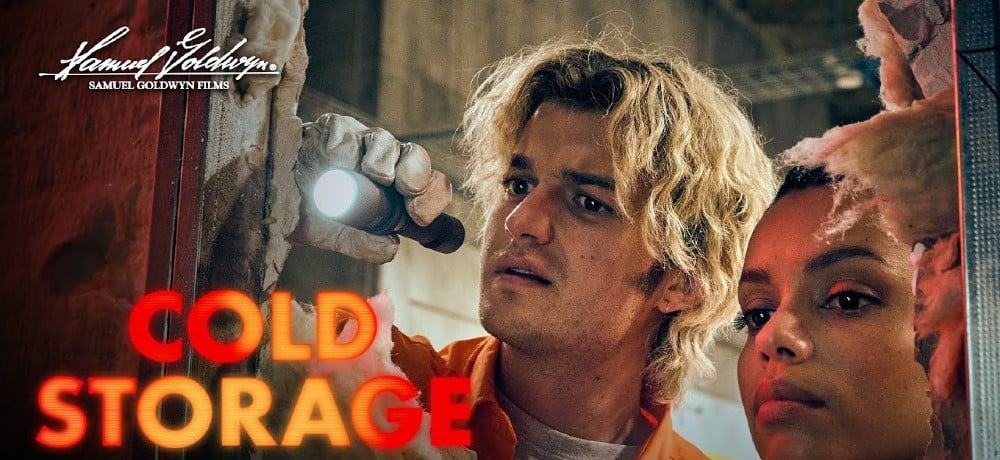
For a movie with exploding animals and people, not to mention a fungus that wants to consume and kill humanity, Cold Storage is pretty damn charming. From screenwriter David Koepp, who adapted his debut novel for the screen, the trick was his likeable heroes – Naomi (Georgina Campbell) and Teacake (Joe Keery). As Teacake says while running storage units under attack: “It's a shit job, but it's my shit job.”
For Koepp, that’s a noble quality he wants to see in a well-meaning hero.
The screenwriter behind Black Bag, Carlito’s Way, and Jurassic Park, to name a few, returns to horror with Cold Storage. It’s a genre he executes well, from Presence to Stir of Echoes to the body horror-comedy classic, Death Becomes Her. Recently, Koepp spoke with Daily Dead about horror, influences, and how composers Trent Reznor and Atticus Ross continuously help him write.
What are some especially satisfying moments when you're adapting your own work?
David Koepp: It's fun because I hadn't ever adapted my own work before because this was my first novel. When I was writing the novel, of course, in the back of your mind, you can't turn off 30 years of screenwriting. You're thinking, "Well, I could cut this. I could combine that." And then you try to say, "Shut up, shut up, shut up. It's a book. Don't think about that."
When you're adapting, you get to use all those ideas that were buried and sublimated. You also have a greater depth of knowledge of the characters. The characters in this film really work, especially Naomi and Teacake. I knew a lot about them, and I could tell that to the actors and I could layer in little bits and pieces, so you felt like they had real stories and a real background.
With the opening in Australia, which reveals the power of the fungus and infection, when you write a sequence like that for film, what is the sweet spot between information and suspense?
David Koepp: Well, never let them see you sweat, basically. It's the exposition; you can't have people telling each other things that they both know. You always have to slide it in a way that makes sense. Having a character come in who doesn't know what's going on is always helpful because they can drive the questioning and the information flow. Screenwriting's all about concision. How can I cut? Can I say this in six words instead of nine? And that just takes drafts.
How many words does it take to convey body horror? A lot of exploding bodies in this movie.
David Koepp: Screenplays are obviously very different from books: you're suggesting instead of detailing in specific. A reader of a screenplay has to have the experience of watching the movie. You need to say what they see and what they hear, because all you've got when you're watching a movie is what you see and what you hear.
Sometimes in a script, it’s saying, “The mangling of bones inside the thing, and it sounds like a bedsheet tearing in half inside the deer; it explodes and the antlers hit the wall with a thud.” That's pretty descriptive. The trick is to not get carried away with doing too much of it because it slows down the reading and that's not how movies flow. Movies go by pretty fast.
Did you ever consider directing Cold Storage?
David Koepp: I didn't. I didn't for a second want to do it for two reasons. One being when you write a novel, you spend a lot of time with the story, then you write a screenplay, and you spend a lot of time with the story. And to then direct it is like, I don't know what I have to bring to this that might be fresh.
It's helpful to get someone else's perspective on it. Also, the kinds of movies I like to direct tend to be people in rooms talking in thrillers. Visual effects directing is really hard and not my area of expertise or interest. I didn't want to spend that much time with the barf.
When you adapt your own work, what do you discover about your work?
David Koepp: I wound up seeing how I was getting around certain story points with some finesse or craft, and I would curse that because I couldn't do it in a screenplay. It was plenty of time inside my own head, so I was ready to get out. Also, you think of other stories that you'd rather tell and you're like, well, I could continue to spend years on this or I could write something else.
Have you been writing any novels lately?
David Koepp: I'm working on one now. It'll either take a few months or 10 years or never, but it's coming along.
Excellent. The beginning of Cold Storage makes it clear: “Pay attention. This shit is real.” Was writing the book and movie almost a terrifying reminder of how fragile we are as a species?
David Koepp: I'm not particularly a germaphobe, but you're sort of crazy if you're not. After COVID, I don't know if you brought this with you, but I had a much greater awareness of when my hands were dirty. Coming home, I just always have a sense of, wow, these are filthy. Or if I've been on the subway and holding the pole, I'm holding my hand at a distance until I get home to wash it. It's not the big threats that'll get us; it's the little ones.
What is your day-to-day like when you’re immersing yourself in a world and research? How many people do you talk to? How far do you go?
David Koepp: Pretty deep. I don't talk to that many people until after I've done a couple of drafts, but you can find out a lot on the internet and by reading books and magazine articles. Most of that was where my research went.
Also, it's a work of imagination. What I would do is think of a story turn that I wanted and then I would go out in search of research to justify it. How do I make that work? Because to me, the primary value of the story is going to be entertainment. I want it to flow like an entertaining product. It's not a documentary about microbiology.
Then again, I do like a higher level of reality that makes people enjoy the story more. So what I did is I did as much research as I could on my own, wrote a draft, and then I sought out a microbiologist and said, "Will you read this book and have a good laugh? And then if you're interested, I pay you a consultant's fee to tell me everything that's wrong. Help me figure out how to make it right in ways that don't completely upend my story."
Do you find the bar for accuracy is very different for a novel versus a film?
David Koepp: It depends on the situation. It could go both ways. In a book, there's nowhere to hide. Why aren't you saying something? In a movie, you can cut and go to another scene and move on, but in a book, you sort of have to explain everything.
I was writing a scene once in prose that was set in 1860, and I had somebody wake up to make coffee, which is the most normal thing in the world. And I was like, okay, I got to research. How did you make coffee in 1860? Where did you get the beans? How did you grind them? What did the thing look like? And I have a lot of respect for people who write period novels because you've got to know everything. You can get away with more in a movie.
After “Aurora” and “Cold Storage,” do you consider yourself a horror novelist?
David Koepp: No, it's just the stories that come to you. I don't think the second book is horror. “Aurora” is a thriller, which is a little bit what made it difficult to shelf. What felt like a science fiction premise – it's not. It's really very real and it played out like a thriller. The thing I'm noodling with now is squarely horror.
I thought the concept of “Aurora” alone was scary – a global blackout.
David Koepp: I know there's a big one coming. We have a rickety grid, and I'm not sure turning large chunks of it over to AI control is the right solution.
Which Atticus Ross and Trent Reznor scores were you listening to while writing Cold Storage?
David Koepp: [Laughs] Well, I always listen to Social Network, chunks of Girl with the Dragon Tattoo, and chunks of The Vietnam War, which is really good.
What other composers do you find really cinematic that help you write?
David Koepp: Dunkirk, of course. There's a very good score that I'm listening to now. I almost never listened to scores from my own movies because I find it distracting. But the score for Presence – the ghost story that I wrote that Soderbergh directed last year – Zach Ryan has a beautiful and very haunting score. What else am I listening to these days?
Are you looking at your playlist?
David Koepp: Yeah, I was looking at the list I made for the thing I'm working on now. There's a bit of The Dead Texan in there. And Selected Ambient Works of Aphex Twin. Those are some of what I'm listening to.
Do you find yourself in a flow state a lot when writing?
David Koepp: When it's just going well and time flies from time to time? I mean, that's what we hope for every day. Some days it's pulling teeth, some days it's just coming out. Normally, if I'm writing a sequence where X follows Y, if the idea is to write someone following someone and then they witness a murder and then they jump in a car and try to get away, that scene is great for that because it's vivid, it's pictorial, your mind is in it. The steps are clear, so you just are free to improvise.
Which scenes in Cold Storage were pulling teeth?
David Koepp: There's always a scene, Hitchcock said this, there's a scene in every thriller, the Why Don't They Call the Cops? moment. And the quality of the thriller often hinges on how well you answer it, because, of course, they can't call the cops or you have no movie. So it’s the scenes when they're locked in the storage unit, Naomi and Teacake, deciding what to do next. They decide to leave the unit.
How do I do that in a way that makes people not throw things at the screen? Those are always hard to do, because I need them to leave the storage unit; otherwise, they're going to sit in here for the rest of the movie and it's pretty boring. How do I do it in a way that's believable for the characters? And the audience member would say, "Yeah, I'd do that too."
When your job is writing a horror script, do you have a gold standard of horror storytellers in mind?
David Koepp: Well, obviously King. “The Dead Zone” is one of my favorite books ever. It's a perfect novel. I really, really admire Richard Matheson. He was just a giant, and he did everything. He did TV shows, he did movies, he did novels, but what King and Matheson both had in common is a fondness for the common man hero and the ordinary person in extraordinary circumstances. That's the writing I really admire.
A film journalist with over a decade of experience writing for Slash Film, The Credits, and High Times Magazine.
A film journalist with over a decade of experience writing for Slash Film, The Credits, and High Times Magazine.










![[Guest Article] Maggots On Your Body Of Work: Clay McLeod Chapman On Finding His Own Muses](https://dailydead.com/wp-content/uploads/2026/03/Bodies-of-work-1000-180x83.jpg)
![[Editorial] AI of the Living Dead: Why Have So Many Already Accepted the Simulation?](https://dailydead.com/wp-content/uploads/2025/09/M3GAN-180x83.jpg)