



My track record with Jane Schoenbrun's features thus far has been spotty. We're All Going to the World's Fair left me cold; I Saw the TV Glow tickled my suburban malaise. Their third film, the tiebreaker, Teenage Sex and Death at Camp Miasma? Its concept is a siren’s call: a metatextual slasher that comments on Hollywood's I.P. obsession as translated into an awakening romance. And yet, Teenage Sex and Death at Camp Miasma is a film internally at odds. A stunning love story encased by a choppy movie-within-a-movie shell that feels reverent, and yet Schoenbrun's conversation around reassessing problematic media, along with the film’s slippery shapeshifter of a screenplay, gets somewhat lost in translation.
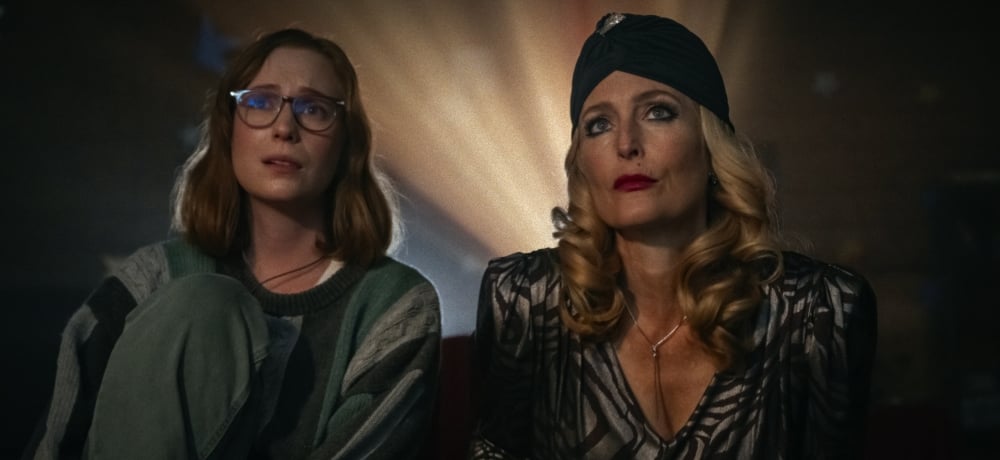
Hannah Einbinder stars as Kris, a queer filmmaker fresh off acclaim from her arthouse horror flick shot from the shower curtain in Psycho's perspective. She's hired to reboot the Camp Miasma slasher franchise—an intentional mimic of Friday the 13th, down to the box art font and sequel in space. Kris is the prototypical "woke" hire (in clueless producer terms) who can infuse Camp Miasma with "elevated horror" prestige, who must pitch the perfect origin blueprint. But Kris is a Camp Miasma superfan and desperately wants the original final girl—Billy Presley (Gillian Anderson)—to return. So, she meets the reclusive Billy to find her living at the original Camp Miasma filming location, where she intends to convince the actress to return … but flesh and lust get in the way.
The draw here is Einbinder as the repressed, self-discovering representation of modern hipster cinephile culture, and Anderson as the old-school, battle-worn veteran who shrugs off offenses. Their chemistry, two generations of women stuck in an archaic industry, could melt the snow outside Billy's winter-wonderland cabin. Schoenbrun's playful gaze as Kris and Billy embrace flirtation is as steamy as it is delightfully quirky—how does one sensualize the dunking of Kentucky Fried Chicken into sauce cups? Anderson's Southern belle-ish accent only loudens Billy's evolution from hospitable idol to erotic mentor, while Einbinder nails the plucky energy of a late-stage bloomer confronting her darkest, deepest desires. They are fantastic; Schoenbrun's comps to Portrait of a Lady on Fire are apt as Anderson and Einbinder light the screen ablaze.
Throughout Kris' journey, Teenage Sex and Death at Camp Miasma becomes a commentary on the moral panic against slasher films, and the lasting effects of desensitization at a young age. Camp Miasma's villain is named "Little Death" (Jack Haven)—a Jason Voorhees type, except swap the mask for an air conditioning vent, and sprinkle on Angela Baker's backstory. Little Death refers to post-orgasm "unconsciousness," which ties to the phallic and often money-shot nature of slasher deaths, and informs Kris' unusual arousal. Billy doesn't judge Kris' connection of carnal pleasure to Little Death's brutal kill scenes, nor cite shame. Tenderly and with compassion, Schoenbrun uses Billy and Kris to explore the hopefulness of finding acceptance at any age—where outsiders see Little Death as a thing to fear, those who understand horror and commit themselves to the genre's themes discover the opposite of fear: comfort.
Yes, Teenage Sex and Death at Camp Miasma is comforting. While Kris crunches white powder under her boots, hiking into the original Camp Miasma, Schoenbrun opts for the traditional bliss of glass matte landscapes almost as a protest of LED screen technology. As Kris munches on gummy candies, surrounded by packs upon packs of squishy treats as she digests another Camp Miasma sequel in bed, Schoenbrun wants us to appreciate the sugar-high of her picture, as we devour each scene like our favorite junk food. When surrealness intensifies, the beauty of Schoenbrun's technical choices shines, juxtaposed against the dulcet tones of Alex G's lull-you-to-safety score. The monstrous reputation of horror cinema is softened, explained, and stripped down for the audience to nuzzle, as a means of explaining Kris' obsession with Little Death.
But then there's the meta-horror satirization of it all. Camp Miasma is a franchise, but it's also a living, breathing universe within Teenage Sex and Death at Camp Miasma. We're lifted from Kris and Billy's arc and plopped in front of Camp Miasma, watching entire scenes play out, only for Schoenbrun to redefine what even is Camp Miasma, à la The Final Girls. Kris' desire to honor Billy's legacy is met with disapproval by her money-hungry agent (Sarah Sherman) and market-friendly studio heads (Dylan Baker), then spins out of control when Little Death breaks free from a celluloid prison. Wires begin to cross, and while Schoenbrun's metaphors are blunt, their messages overt, the film's narrative begins to fracture.
This isn't Frightmaster Wes Craven's New Nightmare or Behind the Mask: The Rise of Leslie Vernon. This is a punk-rock French New Wave slasher. This is Michel Gondry rejecting the traditions of campfire horror. This is auteurism outside the studio machine, which as a concept is admirable—but instead of Schoenbrun's cerebral loftiness having bite, it's like an arrow that can't find the bullseye.
At times, Teenage Sex and Death at Camp Miasma is like an academic investigation put in lighter, yet still thought-provoking terms for uninitiated audiences. Slashes endured decades of rampant misogyny, gender deviance, and queer-panic, and Schoenbrun's screenplay reacts with dialogue jabs to its hot-topic discussions as the genre evolves with society. Although, to a detriment, Teenage Sex and Death at Camp Miasma feels "Horror Twitter" brained, aimed at a certain subset of discourse jockeys that pop up every other week. Its roasts are a little too on the nose, everything from Blumhouse to Sleepaway Camp, and while wholly valid when calling out issues like transphobia, asserts its wokey-in-jest repetitions like they're brand new discoveries—which detracts from impact.
Teenage Sex and Death at Camp Miasma will top many a "Best Of" list come December, fueled by Schoenbrun's spark of pointed psychosexual originality. What works definitely works, down to the geysers of blood when Little Death disgustingly hacks Camp Miasma's stereotypical characters apart to an indie shoegazer track (oh hey, a Trash from The Return of the Living Dead lookalike). There's such a lovely bond between Einbinder and Anderson that not only delivers buttery popcorn entertainment, but boasts sultry magnetism as they choose pleasure over pain. However, there's a spider's web of storytelling that becomes too sticky for its own good, and the humor of the film—holding the entire horror ecosystem over flames—feels like rereading old internet forum threads. Teenage Sex and Death at Camp Miasma may get away from Schoenbrun at times, but there's no argument that they've created something commendably fearless.
Movie Score: 3/5
Matt Donato is a Los Angeles-based film critic currently published on SlashFilm, Fangoria, Bloody Disgusting, and anywhere else he’s allowed to spread the gospel of Demon Wind. He is also a member of the Critics Choice Association. Definitely don’t feed him after midnight.
Matt Donato is a Los Angeles-based film critic currently published on SlashFilm, Fangoria, Bloody Disgusting, and anywhere else he’s allowed to spread the gospel of Demon Wind. He is also a member of the Critics Choice Association. Definitely don’t feed him after midnight.









![[Guest Article] Maggots On Your Body Of Work: Clay McLeod Chapman On Finding His Own Muses](https://dailydead.com/wp-content/uploads/2026/03/Bodies-of-work-1000-180x83.jpg)

![[Editorial] AI of the Living Dead: Why Have So Many Already Accepted the Simulation?](https://dailydead.com/wp-content/uploads/2025/09/M3GAN-180x83.jpg)