

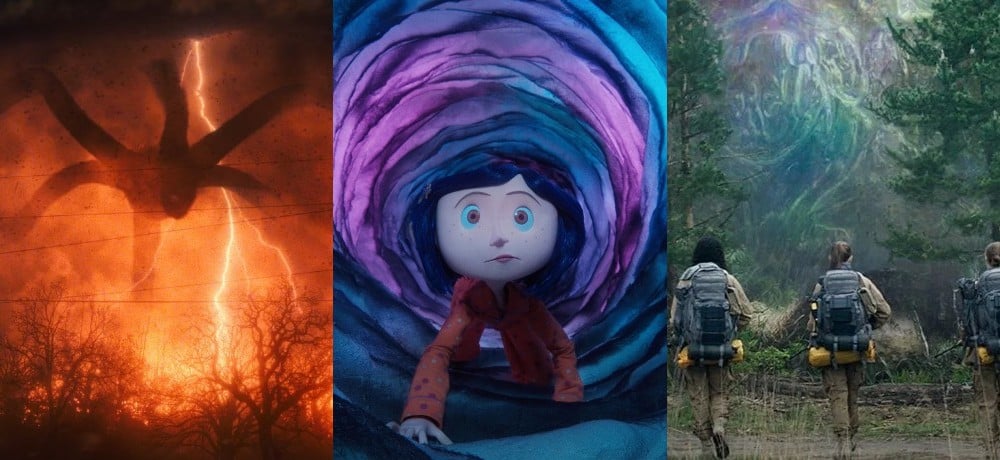
Horror's other dimensions almost never arrive with spectacle. They arrive with a visual error. Something drifts through the air that shouldn’t be there. Light bends as if it's forgotten its job. A room appears to be a room until the camera lingers long enough for the geometry to confess. Before a single character explains what's wrong, the image already knows. Dimensional horror does not scare us by announcing the impossible. It scares us by letting the possible malfunction.
This is why other dimensions in horror are, above all else, a cinematographic problem. They are not narrative twists or world-building exercises. They are violations of visual law. When horror imagines alternate realities, it isn't asking the audience to believe in portals or rifts or parallel worlds; it’s asking them to endure a breakdown in how light, space, colour, and movement are supposed to behave. Our brains are exquisitely trained to read these cues. We know, instinctively, how far away something should be, how shadows should fall, how bodies move through air. Dimensional horror works because cinematography corrupts these instincts without ever fully abandoning them. The world still looks legible. It just stops obeying.
A dimension, in this context, is not a place. It is a visual rulebook. Every reality teaches us how to see it. Classical cinematography reinforces those rules through continuity, stable camera movement, coherent lighting, and predictable spatial relationships. Horror’s other dimensions rewrite that grammar. They don’t replace realism with abstraction; they bend realism until it feels hostile. The fear emerges not from unfamiliarity, but from near-recognition. This is our world, slightly misprinted.
Consider how consistently dimensional horror privileges perception over exposition. Characters may argue about science or fate or trauma, but the image does the real labour. Light behaves incorrectly. Air thickens. Colour stops describing objects and starts describing intent. Camera movement begins to suggest that gravity, orientation, or even time has become unreliable. These aren’t stylistic flourishes. They are how the dimension announces its authority. Dialogue can lie. The image cannot.
The Upside Down in Stranger Things is a masterclass in this principle because of how disciplined its visual language is. It isn’t chaotic; it’s decayed. The most important choice the series makes is not monsters or vines or ruined architecture, but atmosphere. The air itself is wrong. Floating particulates fill the frame constantly, creating a sense of perpetual motion even in stillness. From a perceptual standpoint, this is deeply unsettling. The human visual system treats peripheral movement as a potential threat. The Upside Down exploits that reflex relentlessly. Nothing ever rests. The world cannot go quiet.
Lighting completes the effect. Where the “real” world is bathed in nostalgic warmth, the Upside Down drains colour until only cold blues and greys remain, punctuated by diseased organic reds. It’s not simply desaturated; it’s anemic. Light sources don’t spread naturally. They carve space in narrow, high-contrast beams that feel fragile against the darkness. Flashlights don’t illuminate the world so much as negotiate with it. Visibility becomes temporary, earned, and always revocable.
Crossing into the Upside Down is staged as a sensory collapse. Exposure drops. Subjects become silhouettes. Camera movement slows, as if dragged through resistance. Sound dampens, losing clarity. The camera doesn’t observe the transition from a safe distance; it undergoes it. The image teaches us that this dimension is not just elsewhere, it is heavier, thicker, harder to survive. Physics itself seems tired.
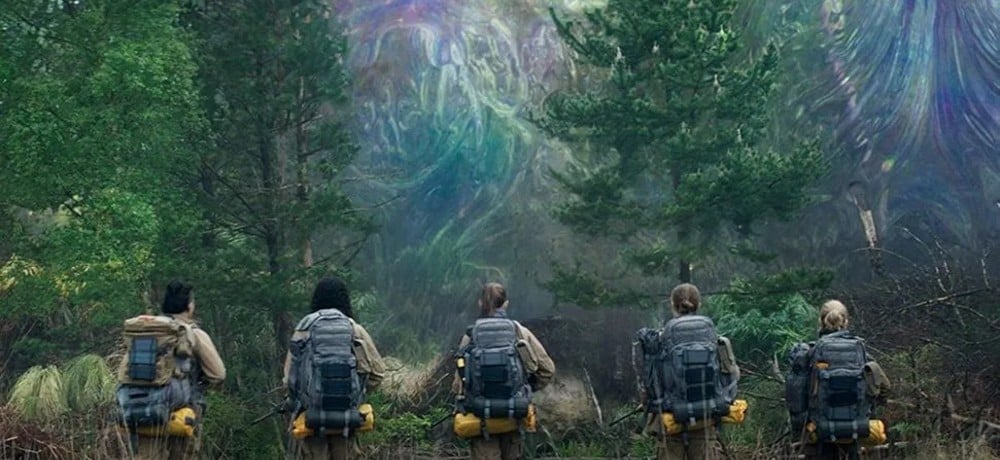
Annihilation takes a different route entirely, and in doing so reveals how flexible dimensional cinematography can be. The Shimmer is not a mirror world or a decayed twin. It is a refractive system. Light inside it behaves as if it’s being copied, bent, and misfiled. Lens flares bloom unnaturally. Highlights smear. Rainbow diffraction fractures the image in ways that feel biological rather than optical. The implication is devastatingly subtle: light, the very mechanism by which we perceive reality, can no longer be trusted to report accurately.
What makes the Shimmer truly unsettling is that it does not impose rigid geometry. Instead, it softens the world until distinctions blur. Trees resemble nervous systems. Bodies echo plant structures. Landscapes fold inward on themselves without clear rupture. The camera seems to struggle not with chaos, but with categorisation. It can see everything; it just can’t name it. This is horror not of destruction, but of recomposition.
Camera movement reinforces this instability. As the characters move deeper into the Shimmer, the frame becomes increasingly handheld, not frenetic, but unsettled. The image refuses to lock into certainty. There is no stable vantage point from which to master the space. The dimension does not attack. It absorbs. Colour follows suit. Iridescent palettes do not signal mood so much as mutation. Pink bleeds into green, skin tones lose their boundaries, natural hues become alien. Colour stops expressing emotion and starts documenting change.
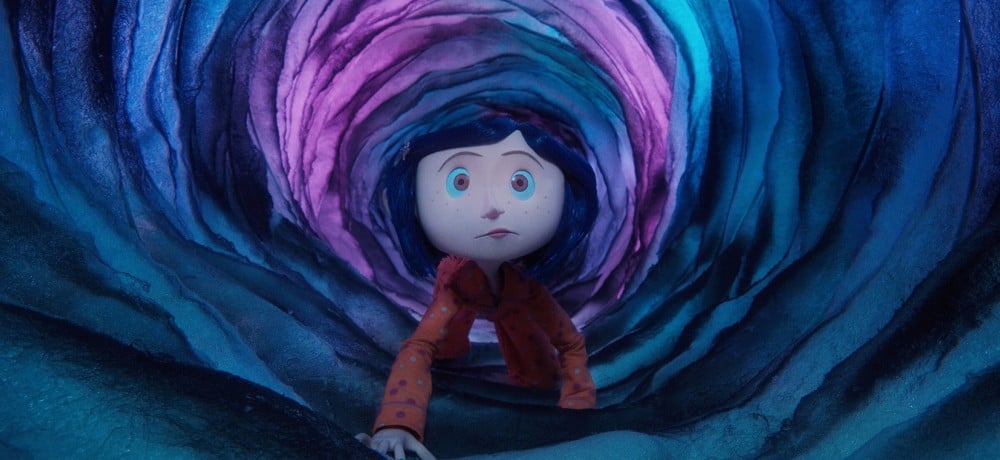
If Annihilation is about dissolution, Coraline is about seduction. Its Other World is one of the most insidious dimensional spaces in horror precisely because it is engineered to be desirable. Everything about it is hyperreal. Colours are richer, shadows softer, compositions more balanced. It looks like a world designed for consumption. The camera indulges it, at first.
Crucially, Coraline herself is often visually separated from this lushness. While the Other World glows, she remains grounded, her eyes consistently foregrounded. The emphasis is not on her belonging, but on her perception. Depth of field plays a quiet but crucial role here. The real world is flat, dull, visually uninviting. The Other World is deep, layered, full of visual promise. Exploration is encouraged. Until it isn’t.
As Coraline’s agency erodes, that depth becomes predatory. Lushness turns into concealment. Visual pleasure becomes a mechanism of control. The stop-motion medium amplifies this effect. The textures are tactile, the seams faintly visible, the movement just slightly off. This is a world assembled from desire, not grown organically. Its perfection is manufactured, and the camera’s precision exposes the artifice even while the narrative pretends otherwise.
When the Other World finally reveals its violence, nothing fundamentally changes. Lighting hardens. Saturation drains. Geometry sharpens. The same space enforces different rules. The lie collapses, and the camera lets us see what was always there.
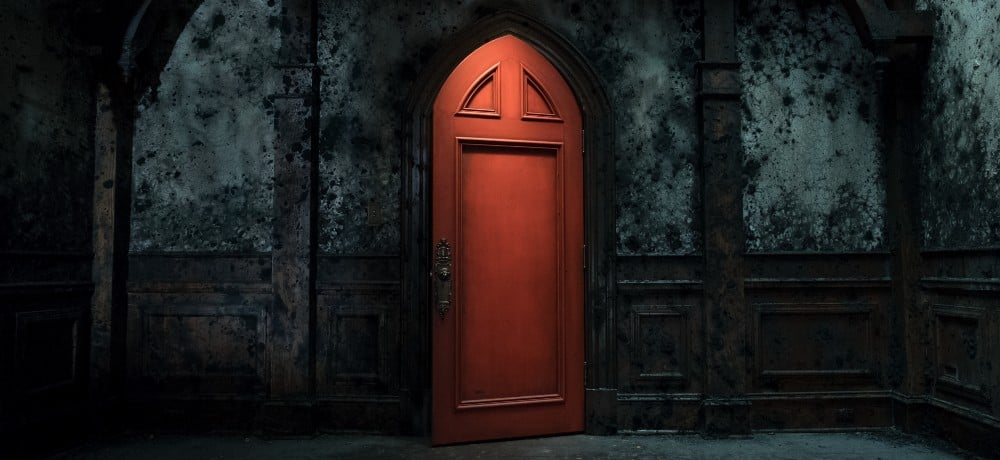
Perhaps the most devastating dimensional horror of the last decade, however, is one that barely looks like a dimension at all. The Red Room in The Haunting of Hill House is not alien, refractive, or decayed. It is domestic. It is warm. It is familiar. And that is precisely the problem.
The Red Room works because it doesn’t rupture reality; it camouflages itself within it. Cinematography signals this through restraint. Framing shifts are subtle. Doorways align too neatly. Windows appear where memory insists they shouldn’t. The camera does not underline these impossibilities. It trusts familiarity long enough for that trust to become betrayal.
Long takes drift through Hill House, passing through spaces that should not connect. Spatial continuity dissolves quietly. The camera behaves as if nothing is wrong, which makes everything wrong. The dimension does not announce itself as dangerous. Warmth becomes a visual weapon. The room doesn’t trap by force; it invites.
When the truth of the Red Room finally emerges, the shift is claustrophobic rather than spectacular. Framing tightens. Camera placement turns inward. The warmth suffocates. The dimension reveals itself not by expanding into something monstrous, but by closing in until there is no room left to doubt.
Across these texts, a coherent visual philosophy emerges. Dimensional horror does not rely on explanation. It relies on consistency. Light always behaves wrong, but in a way specific to that world. Space always rejects logic, but according to internal rules. Camera movement signals failure of gravity, of orientation, of trust. These dimensions are not explained into existence; they are photographed into authority.
The fear they provoke is deeply human. Our brains depend on stable spatial cues to survive. We trust light, depth, motion. When those systems fail while still appearing functional, paranoia sets in. The world looks like the world, but it behaves like something else. The camera becomes both witness and accomplice, transmitting uncertainty directly into the viewer’s body.
As horror cinema continues to experiment with new technologies; LED volumes, analog distortion, in-camera effects, the temptation will be to chase novelty. But dimensional horror has never been about spectacle. It has always been about precision. About knowing exactly which visual law to break, and how gently, so the audience doesn’t realise they’ve crossed into the impossible until it’s far too late.
Other dimensions don’t scare us because they are unfamiliar. They scare us because the camera insists they make sense.

Vinnie C. is a researcher, writer, and media shapeshifter exploring how stories mirror, distort, and mask reality. Armed with a BA in Liberal Arts from CHRIST (Deemed to be University), they examine media as both architect and artifact: one that shapes how we process the world and what we choose to ignore. Every belief we hold festers, mutates, and survives in our stories, letting us confront ideas through a screen, only to walk away when the credits roll.
Vinnie's work thrives at the intersection where cold analysis meets burning curiosity, dissecting how form, technology, and narrative shape perception. From analyzing horror cinema to designing interactive content for games, their work is driven by a fascination with how media codes us into its language while we rewrite it into ours.
Vinnie C. is a researcher, writer, and media shapeshifter exploring how stories mirror, distort, and mask reality. Armed with a BA in Liberal Arts from CHRIST (Deemed to be University), they examine media as both architect and artifact: one that shapes how we process the world and what we choose to ignore. Every belief we hold festers, mutates, and survives in our stories, letting us confront ideas through a screen, only to walk away when the credits roll.
Vinnie's work thrives at the intersection where cold analysis meets burning curiosity, dissecting how form, technology, and narrative shape perception. From analyzing horror cinema to designing interactive content for games, their work is driven by a fascination with how media codes us into its language while we rewrite it into ours.






![[Guest Article] Maggots On Your Body Of Work: Clay McLeod Chapman On Finding His Own Muses](https://dailydead.com/wp-content/uploads/2026/03/Bodies-of-work-1000-326x150.jpg)
![[Editorial] AI of the Living Dead: Why Have So Many Already Accepted the Simulation?](https://dailydead.com/wp-content/uploads/2025/09/M3GAN-180x83.jpg)

![[Comic-Con 2025] Interview: Michael Giacchino Talks Marvel’s WEREWOLF BY NIGHT: BLOOD MOON and Why He Loves Classic Monsters](https://dailydead.com/wp-content/uploads/2025/07/Werewolf-1000-b-180x83.jpg)