


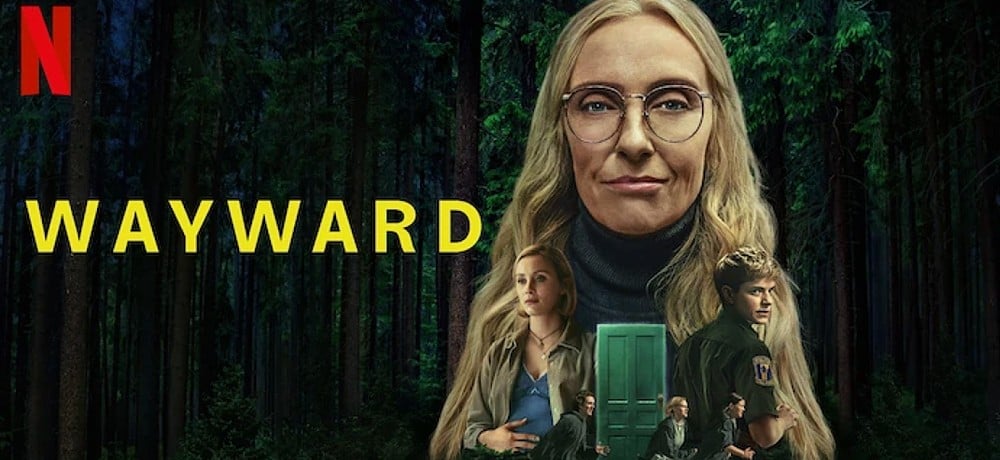
Mae Martin’s Wayward opens with a kind of horror that doesn’t announce itself. There are no phantoms creeping down hallways, no dramatic stingers on the soundtrack; just the slow, suffocating dread of being perceived. From the pristine menace of Tall Pines Academy to the too-perfect small town that hosts it, everything looks ordinary enough to pass inspection. But the real danger in Wayward is never the setting; it’s the gaze that saturates it. The show understands that the most enduring queer terror isn’t supernatural at all, but social: the constant pressure to be visible, palatable, legible. Horror here doesn’t hide in dark corners; it glints off polite smiles, slipping into conversations disguised as concern, and settling into the quiet expectation that you will perform a version of yourself that reassures everyone but you.
Alex, a trans police officer played by Martin, embodies the exhausted labor of visibility. Outwardly, they are “successful”: married, employed, domesticated, performing all the roles society demands. Yet the series destabilises this image, revealing the perils beneath the curated front. The rooms are quiet, smiles wide, words soft. But Alex’s presence is measured, catalogued, and evaluated. Every gesture, every glance, becomes performance. The terror is not in what is said, but in what is expected.
This tension exemplifies Judith Butler’s notion of performativity. Gender and identity are not innate essences but repeated acts that appear natural only through iteration. In Wayward, Alex’s identity is legible only in versions sanctioned by the town, the Academy, and even their own family. When Alex hesitates, missteps, or refuses to perform, it is not madness; it is clarity, a self asserting itself after prolonged observation and pressure. These “instabilities” are honest, embodied refusals to be rewritten, resisting the constant editorialising of identity that queer people know all too well. Alex’s so-called failures become acts of unfiltered truth, reminders that refusing to simplify yourself can feel like madness only because the world prefers you in a single, digestible shape.
The cost of being legible hits the body before the brain can catch up. Alex doesn’t “struggle”; they glitch. A tremor here, a swallowed word there, a full-body flinch. Nothing about this reads as madness; it’s the physics of overexposure. Every glance could become an assessment, every question a debrief, every moment of vulnerability an entry in someone else’s file. Visibility is only ever one breath away from surveillance, and Alex’s body knows it before they do. In Tall Pines, they live in that liminal ache, inside enough to be monitored, outside enough to be misunderstood. Legible enough to survive, but never safe enough to rest.
Wayward’s next heartbreak is in how it understands family, the original haunting and the brutal arithmetic queer people perform when love and survival collide. Alex doesn’t stay in Tall Pines because they’re afraid to leave; they stay because that’s where their family is. And family, even when it wounds you, is still a kind of gravity. Love is scarce, recognition more so, and Alex hangs on not out of naivety but because presence, flawed, inconsistent, human; still feels better than the void. While Leila’s version of staying is its own tragedy: she stays because she has no one to return to. The Academy, with all its indoctrination and soft-lit coercion, is still the closest thing she has to care. It’s surveillance with a warm blanket, captivity with the faintest echo of belonging.
This kind of negotiation is painfully familiar to queer life. Kinship isn’t just comfort, it’s infrastructure. It holds you upright when the places that were supposed to love you don’t, but it can also warp under the weight of its own intentions. Chosen families can recreate the very hierarchies they were meant to burn down; biological families can bruise and still remain the only door you know how to knock on. Alex stays tethered because attachment is both longing and logistics. Leila stays because scarcity has carved her options down to one: better the institution that hurts you but sees you than a world that refuses to see you at all. In Wayward, staying isn’t passivity. It’s endurance. It’s the kind of survival that requires a moral flexibility and emotional fluency that comes from learning early that love and harm can be delivered by the same hand.
Mae Martin threads this difference like a knife: queer people don’t cling to imperfect bonds because they’re weak, they cling because connection is oxygen, and the world has a habit of rationing it. Love and visibility twist together until you can’t tell where affection ends and fear begins. The horror isn’t just being watched; it’s needing the watchers. And sometimes the bravest thing a queer person can do is keep breathing under someone else’s gaze, knowing it could validate them or undo them with equal ease.
Alex’s supposed instability can’t be separated from the terror of being visible. Queer culture often frames visibility as victory; step into the light, claim your truth, announce yourself. Wayward cracks that narrative open and studies the rot inside it. Visible to whom? On whose terms? Alex’s marriage, career, and steady facade function as a kind of social camouflage, a performance calibrated precisely to avoid becoming someone’s cautionary tale. They are clear enough to be read, respectable enough to be permitted, but always in someone else’s frame, under someone else’s lighting. The show exposes visibility as a spotlight with a temperament: generous one moment, punitive the next.
In the end, Wayward leaves us with a truth that’s equal parts brutal and oddly consoling: sometimes survival looks nothing like escape. Sometimes it looks like staying in the room that scares you because leaving would mean losing the only witnesses to your life. Alex endures Tall Pines not out of devotion but because the alternative is erasure. Leila stays because the world has given her no doorway but this one. The series doesn’t romanticise this, but it doesn’t condemn it either. Horror and care keep colliding, and the collision is where life happens.
Mae Martin ends not with triumph but with a pulse, a reminder that sometimes the bravest thing a queer person can do is keep going in a place designed to misread them. Wayward insists that the self, however shaky, is still alive under all that scrutiny. And if it’s alive, it can change. It can resist. If the world insists on watching, then let it; the miracle is that Alex is still here to look back.
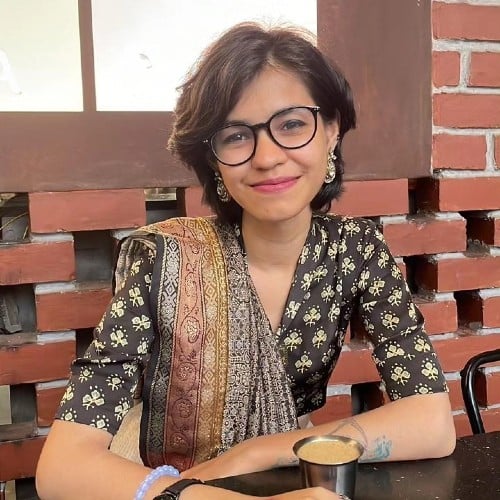
Vinnie C. is a researcher, writer, and media shapeshifter exploring how stories mirror, distort, and mask reality. Armed with a BA in Liberal Arts from CHRIST (Deemed to be University), they examine media as both architect and artifact: one that shapes how we process the world and what we choose to ignore. Every belief we hold festers, mutates, and survives in our stories, letting us confront ideas through a screen, only to walk away when the credits roll.
Vinnie's work thrives at the intersection where cold analysis meets burning curiosity, dissecting how form, technology, and narrative shape perception. From analyzing horror cinema to designing interactive content for games, their work is driven by a fascination with how media codes us into its language while we rewrite it into ours.
Vinnie C. is a researcher, writer, and media shapeshifter exploring how stories mirror, distort, and mask reality. Armed with a BA in Liberal Arts from CHRIST (Deemed to be University), they examine media as both architect and artifact: one that shapes how we process the world and what we choose to ignore. Every belief we hold festers, mutates, and survives in our stories, letting us confront ideas through a screen, only to walk away when the credits roll.
Vinnie's work thrives at the intersection where cold analysis meets burning curiosity, dissecting how form, technology, and narrative shape perception. From analyzing horror cinema to designing interactive content for games, their work is driven by a fascination with how media codes us into its language while we rewrite it into ours.









![[Editorial] AI of the Living Dead: Why Have So Many Already Accepted the Simulation?](https://dailydead.com/wp-content/uploads/2025/09/M3GAN-180x83.jpg)

![[Comic-Con 2025] Interview: Michael Giacchino Talks Marvel’s WEREWOLF BY NIGHT: BLOOD MOON and Why He Loves Classic Monsters](https://dailydead.com/wp-content/uploads/2025/07/Werewolf-1000-b-180x83.jpg)