

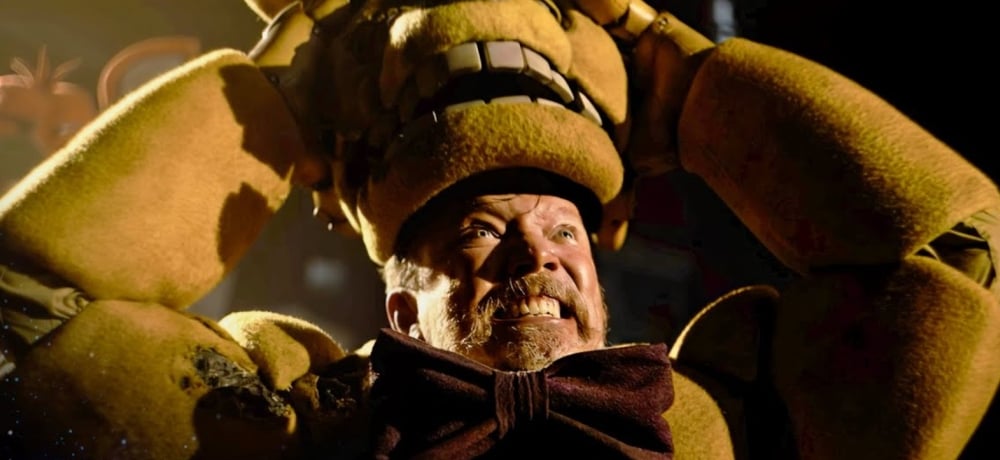
Matthew Lillard is proud of where he’s at today. When Daily Dead spoke with him, he had recently wrapped filming Carrie with Mike Flanagan as well as season two of Daredevil: Born Again. On top of that success, an announcement came that he'd star in Tony Gilroy’s (Andor) next film. More good news in time for the release of Five Nights at Freddy’s 2, in which he plays the villainous William Afton.
“It's been a crazy, crazy revitalization of a career that has been around for a long time,” Lillard notes. “It's been very exciting.”
Lillard, who’s also a favorite among horror convention attendees and a maker of horror-themed tequila, continues to regularly light up scenes. Soon we’ll see him return to the Scream franchise as well with Kevin Williamson at the helm. For now, he continues to build up Afton as the main big bad of the Five Nights at Freddy’s franchise.
Whenever you promote your projects, gratitude is a word that comes up a lot. How does that drive you whenever you go to set, whether it's Five Nights at Freddy’s or any other project?
Matthew Lillard: I think that as you get older, you start to appreciate things on a different level. When I was young, it was really just about, "What else can I get? How high can I achieve? I want to be a lead in a movie. I want to make money." All these things that feel important as you’re a young buck coming up.
The reality is that as you get older, in a really authentic way, you start to realize it is really about the people you meet, the experiences you have, the mass of experience rather than the job. It's about the duration and the time spent, which is a really lovely place to be.
It just gives you a different perspective on things, and it's not necessarily about being number one on the call sheet or making a lot of money. It's really about continuing to collect experiences and memories.
Was there a certain moment in your career where you had that lightbulb moment of, “That is what matters to me when I go on a set”?
Matthew Lillard: Well, nothing like that. I think that in time you grow. Listen, I think that wisdom’s a word that people don't use very often. It feels douchey to use the word wisdom, but as you get older, you start to wise into the ideas of what's important and you start to experience things like, “Oh, what I love about being an actor is not the money. What I love about being an actor is not how many lines you have.”
I became an actor when I was 13 because I love the people. I love being in the theater. I love building sets. I love the fellowship of it all. There are people that become famous—they’re beautiful with perfect chins. There are people that become successful in this industry because this is all we've ever done.
All I've ever done has been an actor, and my first passion is the thing I love, and I love the creative journey. And that's really about being surrounded by people that share that same energy, that same sort of connection to the community. And so the older you get, the more you realize what got you into it is the thing that still pulls you back.
There's a horror legacy there now. How do you think your past work plays into how fans or audiences watch you today?
Matthew Lillard: That's not for me to judge. Reality is, I don't really… people are saying that my thing keeps changing. People say that a lot. When you get to be 55 years old and you've been around 30 years, people are like, "Oh, that's not for me. It's just not in my lexicon. It's not how I operate. It's not how I approach anything." It's not something I carry with me: “Oh, I mean this to this community.”
The reality is that I have a job. I like my job. I've been doing my job a long time, and with that comes a legacy, but it doesn't inform me in any way, shape, or form right now. It does when you do a sequel. When you do a sequel like this, you're sort of being pulled back into a world. And so yeah, that's a totally different thing.
When you go into a sequel, what does that creative prep look like: “I didn't get to do this last time, but this time I really want to do this”?
Matthew Lillard: I mean, this whole Five Nights cycle is supposed to be about a trilogy. Everyone really wants to do a trilogy, by the way. As in Harry Potter, we build up Voldemort. We eventually get to a showdown with Voldemort. Like Star Wars, we build up Darth Vader. We eventually get to an interaction with Darth Vader. The reality is that William Afton and Springtrap represent evil in this universe.
So the second movie, I get to do some fun stuff. I get to sort of add to who William Afton is on film, which I'm excited about. But the reality is that this character comes to life in the third film, and only if people go see the second movie and it's successful will we get to do a third one. God knows nothing’s written in stone.
There are great things that happen physically when you put on that suit. All kinds of information comes into you as an actor. So being able to explore that, work within the suit, work within the world, all of those things seem pretty exciting. Again, we're a long way from that happening. We just hope people go out and see 2.
You’ve gotten to work a lot with great digital and makeup effects artists throughout your career. When you’re on set, not even just as an actor but film fan, how much do you want to dig into how they accomplish their work?
Matthew Lillard: You look at 2022 or 2002, what was happening in CG back then? It was really advanced. It's one thing to run from a CG monster. It's another thing to have your best friend, number one on the call sheet, be a complete CG element. So the challenge of Shaggy, the challenge of making that two-dimensional character a three-dimensional person across from a dog that's not there, that talks and is your best friend, that was a crazy challenge as an actor, as a movie. That whole thing was a lot. This is a little different. I mean, the Jim Henson team—the puppet team—is incredible.
What does their work do for you?
Matthew Lillard: What they've built informs me, informs the entire world. Jack [Kendall] and Andrea [Gilletti], the two of them are with me every day on set in terms of when I put this monster on. And they're really useful in terms of my comfort, in making me safe, making sure I'm comfortable. But on top of that, they're valuable assets in telling me how I'm moving. That was cool. They're sort of watching me in different ways than anyone else is, and I couldn't be more grateful for their fellowship.
How do you move uncomfortably and comfortably in a suit like that?
Matthew Lillard: It's funny, I've told this story before, but it is fun to tell again. I auditioned for Planet of the Apes, and I thought, "I worked on this stupid scene for so long." I was doing all these ape things.
And then the crazy thing is that I put the suit on once for a fitting months before we started to shoot [Five Nights at Freddy's], but then the day we shot that first sequence where I walk into Pizza Fazbear’s, into the pizzeria, and that was the first time I actually put the suit to work. And so I'm like, “Oh, how do I walk?” I literally put this thing on and I'm like, “Oh my God, I can't just walk.”
For some reason, I never really thought about what that suit would feel like. I had never put it on. So I put it on and I started to make these sounds like the ape that I had worked on from Planet of the Apes, and that didn't go my way. And so it ended up being a happy coincidence that I had just done something that was super physical.
The reality is when you put the suit on, it informs your body. I was like, “Hold up, somebody with a camera, just hold it up so I can see what I look like.” I didn't even know what I looked like. So at the end of the day, it was a good confluence of things that had happened in the past to make the present whole and new and exciting.
With Thirteen Ghosts, you got to work with Greg Nicotero and Howard Berger’s fantastic work. How much does that help you as an actor when you're seeing all that artistry and practicality right there?
Matthew Lillard: Yeah, I mean, you take it for granted. You see a person before they get makeup. You're in the makeup room with them. You see them afterwards. So it is informative, but I think our gifts as actors are that you can pretend harder than most of the people around you. So whether somebody is there or not, it doesn't really matter that much, because that's our job, dude. We pretend hard.
Sometimes having somebody in full latex is worse because they need touch-ups. They get tired. It's hard. There's things like the woman walking around topless the entire time, that's confusing. There's just some things that aren't great about practicality. I would rather have practical than CG elements for sure, because there’s energy that's coming off of people.
I actually talked to one of your earlier collaborators the other day: John Waters.
Matthew Lillard: Oh, sure.
You’ve said that was one of the most formative experiences for you. Anything about your time with Waters that you still carry with you?
Matthew Lillard: He found me, right? I was an actor at school at Circle in the Square in New York. He changed my life. He came in, gave me a job [playing Chip in Serial Mom], and plucked me out of obscurity. I've never gone back to waiting tables. I owe John Waters everything. John was just honored at the Motion Picture Academy Museum, and they had a huge retrospective on his work.
It was great.
Matthew Lillard: The thing that inspires me the most about John Waters is his endurance, his ability to persevere, his ability to still be relevant, still tell stories, still be in the zeitgeist of people, and still have a place in this industry.
He hasn't done a movie in a while, but he's still finding ways to entertain and to be a part of the zeitgeist. He is also a pioneer. He was so profound and he changed what it is to be an independent filmmaker, and for that, we are all eternally grateful. I adore the man.
A film journalist with over a decade of experience writing for Slash Film, The Credits, and High Times Magazine.
A film journalist with over a decade of experience writing for Slash Film, The Credits, and High Times Magazine.









![[Editorial] AI of the Living Dead: Why Have So Many Already Accepted the Simulation?](https://dailydead.com/wp-content/uploads/2025/09/M3GAN-180x83.jpg)

![[Comic-Con 2025] Interview: Michael Giacchino Talks Marvel’s WEREWOLF BY NIGHT: BLOOD MOON and Why He Loves Classic Monsters](https://dailydead.com/wp-content/uploads/2025/07/Werewolf-1000-b-180x83.jpg)
![[Editorial] ANNIHILATION (2018): The Algorithm of Natural Selection Just Unfollowed You](https://dailydead.com/wp-content/uploads/2025/07/Annihilation-1000-180x83.jpg)