
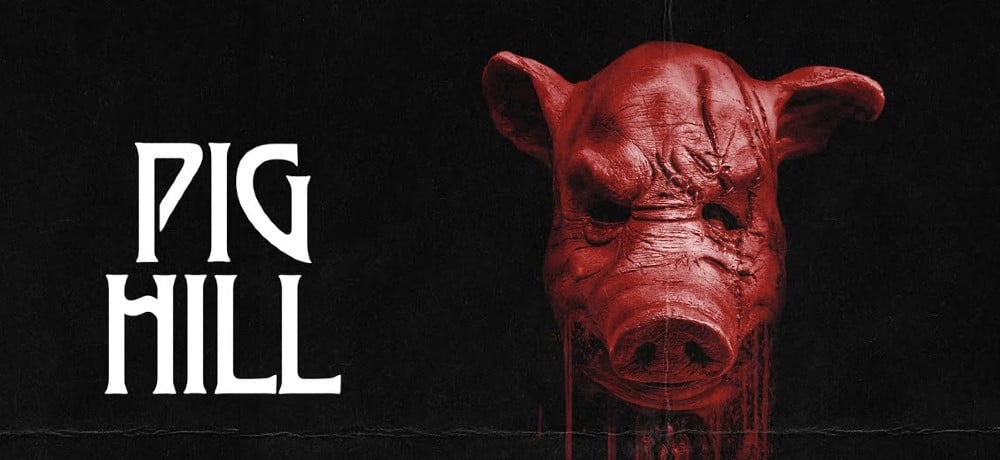
As far as local legends go, pig people are a pretty good one. In Meadville, Pennsylvania, the creatures haunt locals. Near a radio tower on a hill overlooking the town, if you overstay your welcome, the pig people will come for you. Making the creatures even more suitable for a horror story, they’ll also attack lovers' lane. Supposedly the pig people were born from lepers, too.
These are a few of the kinds of stories retold in Kevin Lewis’ latest film, Pig Hill. Based on the novel by Nancy Williams, the brutal story follows a local aspiring author, Carrie (Rainey Qualley), searching for the truth behind missing women and the local legend.
Lewis is the busy director behind Willy’s Wonderland and The Accursed. He’s currently in post-production on two movies, including a crime thriller and another horror movie, The Driver, with a “Willy’s Wonderland vibe.” After surviving COVID-19, which almost took his life, the filmmaker is enjoying the moment and making movies.
When you got into Pig Hill, the mythology around pig people, how deep does research go?
Kevin Lewis: When I got there, Meadville is a small town. All the bars had pictures of missing women, real-life milk carton pictures of missing women. It was like, Whoa, this is a thing. And this is a really small town, so that legend of the pig people—everyone has their ideas of what it was.
When you're dealing with a local legend, it's kind of hard to just pick a lane or a side, all these different things. So, that's what I tried to do in the movie, to give all these different sides of it. And then of course, with a third act, you realize it wasn't what you pictured at all.
How’d you land on what the story is really about?
Kevin Lewis: We live in a gaslighting culture. We live in a place where people have the internet and can build your own world for somebody. And it's like, Well, that's not what really happened.
And so, all that stuff helped me expose the pig people. Okay, whatever pig person that you're thinking of, I probably can't do it because I don't have the budget. That being said, I can create this thing. I like the mystique of it. I like the mystery of it. That's what drew me to it, is all these different legends and all these different ideas and what people have in their head.
In that town, they have a beer. I mean, that [pig people–themed] beer in the scene is real.
Is it any good?
Kevin Lewis: It's very good.
So have you thought already, How is this movie going to contribute to the pig people narrative?
Kevin Lewis: I think they're excited about it at Meadville because it's like, Wow, this folklore has been talked about for decades. Now there's a movie about it. I think it's going to definitely push it along, for sure.
What kind of atmosphere did you want to create for Meadville? What look and sound did you and your crew want for the horror?
Kevin Lewis: David Lynch was my creative star. David Lynch and The Cure because I love their music. I was listening to a lot of The Cure. Giallo, Italian horror, that vibe too. I played Goblin from Suspiria on set. Those are things that inspired me.
Let’s talk about the film’s dream sequences. How do you get as creative as possible with the resources you have?
Kevin Lewis: When you're taking a movie about pig people—I think every movie could be this way too—you're walking a balance. This could be really funny and not intended to be funny. And so, how do you do it? With Carrie's point of view, that's what she's going through in the movie. It's what she sees. As you know, in the third act, we find out what happened to her. Okay, now that makes sense. So, now how do we do it? That’s how we built those sequences—her point of view.
With those dream sequences, we try to do something different every time, not monotony. Then the audience gets bored, like, Oh, here comes another thing. I want to do something eye-catching and push the narrative forward, [so] that it all makes sense, that we're not just doing it to do cool shots. I love that, but I wanted something to have a punch narrative-wise, story-wise.
We won’t spoil the third act, but there are a lot of bold choices. Whether it’s the silent protagonist in Willy’s Wonderland or Pig Hill’s reveal, as a filmmaker, do you actively want to walk fine lines?
Kevin Lewis: Absolutely. I do always walk the fine line of these movies, even what we just said about how it could be real corny. Willy's Wonderland, I wanted everyone to play it real. The story is batshit insane, crazy, but if you play it real and the characters believe it, now you can have fun. I've straddled that line, but I haven't dipped over to making it where I'm not supposed to be funny. Or it's like, Wait a minute, this is just terrible for terrible's sake, kind of a wink and a nod.
It was so funny, when we were setting up a shot for Willy’s, my cameraman asked, “Is this too much?” I was like, “No, we're talking about an eight-foot, giant-horn weasel. Nothing's off the table.” And so that was kind of what Pig Hill was about too.
You're talking about pig creatures, so you could do a lot of things, but again, when you think about pig creatures and pig people, that was the MacGuffin of it, right? You think it's a pig creature movie, but it's a lot more. The third act is what enticed me to make this movie. When I read that, that's why I wanted to make the film. It means something.
What did you think when you read the birthing of the pig baby sequence?
Kevin Lewis: How am I going to pull that off? Jason Baker did that, and he did the masks for Black Phone. He's an amazing special effects makeup artist and worked with Tom Savini. It's funny, you make these films and things keep you up at night. The pig baby scene kept me up at night. How are we going to get the pig baby? I don't have money for those digital effects.
I really love practical effects. Willy's was practical effects, for the most part. I grew up with that. I still want to make it grounded and have weight to it. And so, how do you do it? With the pig baby, we did a puppet. It was really cool what Jason created.
I appreciate the grime you bring to your movies. They feel dirty. What is it about that aesthetic you like?
Kevin Lewis: I love the grime. Evil Dead is one of my favorite movies. I dirty it up. Think about 2001, and it was clean in space, and that's one of my favorite movies of all time. But then you have Star Wars with [George] Lucas and what he did with the spaceships: old, weathered, and beat-down. It just gives a reality to it because things aren't pristine.
I think sometimes when you do something that's pristine, it becomes kind of cold. I like my movies to have emotion. I like, in Willy’s, when the janitor is kicking ass on the animatronics for the audience to get involved. For Pig Hill, I want people to get involved with Carrie. When you grime it up and you dirty it up, it’s more realistic, lived-in.
With a Kevin Lewis film, I think horror fans have some idea of what it might be, but was there a certain point in your career where you realized, This is what I like and these are the types of horror movies I want to make?
Kevin Lewis: Yeah, I love drama. I've always loved drama. Peter Weir is one of my favorite directors. So in my early movies, when I went to film school, I made a drama with a Scorsese-vibe to it. So with Pig Hill, I always saw it as a drama. But like you said, I like the dirty world. I like the aesthetics. I like the wild and far out.
Life is sometimes depressing and tough to get through, so I like making movies that let you escape, even though they're dark and serious subject matter, but aesthetically, they're otherworldly, because I love color.
Michael Mann, Ridley Scott, Darren Aronofsky, Danny Boyle—those are the filmmakers I love. I love still photography, and I like playing around with color and mood because I think that really, we talk about the dirty—that already gives you that vibe when you go in and watch a film, so you kind of know what you're getting into.
I'm happy to hear Peter Weir's name, because The Last Wave terrified me as a kid. That horror movie isn’t referenced enough.
Kevin Lewis: Horror is a great space where you can mix genres. The Shining is a great horror film, but it's a psychological horror. But then you can have body horror and you can have sci-fi horror like Alien.
But to me, horror is just a great drama, but you can do it aesthetically differently. You can't shoot Dead Poets Society like we did Pig Hill, right? It just doesn't call for it. That script, that story does not call for that.
It would be pretty cool if it was.
Kevin Lewis: [Laughs] Yeah, it would be interesting. The thing is, What does the script call for? What does the world call for? I am attracted to those kinds of movies like The Last Wave. It's putting people on that roller coaster, getting ’em strapped up for that ride.
You make midnight movies. You could easily imagine VHS covers for Pig Hill or Willy's Wonderland. How much do you think of satisfying midnight audiences when you’re making movies?
Kevin Lewis: Hundred percent. Even on Willy's, I was like, This is a movie. It's a midnight movie you see at the drive-in. Back in the day, I drove two hours to the little podunk theater to go see Evil Dead. I still have that vintage nostalgia in me.
I love the idea of everybody going into a crowded theater. I know it's different now with streaming and everything, and I get it, but I still hold on to that. That's why I say it's “a Kevin Lewis film,” it's really not a film. I shoot these movies digitally. I haven't shot a film for a long time, but to me, it's a film. That's what got me into making movies.
So when I make these movies, yes, I'm thinking about the audience, because filmmaking costs so much money and everything. If I didn't think about the audience, I might as well write poetry and stick it in a drawer. No one's going to see it.
Moviemaking is for the audience. You always have to think about your audience. You're asking them to take two hours out of their life. Especially now, everybody's busy and has so many things to do to sit down and watch your film. It's got to be good.
---
Now on Digital and VOD, Physical Release Coming January 13th, Streaming on SCREAMBOX Beginning March 10th
A film journalist with over a decade of experience writing for Slash Film, The Credits, and High Times Magazine.
A film journalist with over a decade of experience writing for Slash Film, The Credits, and High Times Magazine.
![[Editorial] AI of the Living Dead: Why Have So Many Already Accepted the Simulation?](https://dailydead.com/wp-content/uploads/2025/09/M3GAN-326x150.jpg)
![[Comic-Con 2025] Interview: Michael Giacchino Talks Marvel’s WEREWOLF BY NIGHT: BLOOD MOON and Why He Loves Classic Monsters](https://dailydead.com/wp-content/uploads/2025/07/Werewolf-1000-b-180x83.jpg)
![[Editorial] ANNIHILATION (2018): The Algorithm of Natural Selection Just Unfollowed You](https://dailydead.com/wp-content/uploads/2025/07/Annihilation-1000-180x83.jpg)