



Since the rise of military warfare franchises like Medal of Honor, Battlefield, or Call of Duty, the first-person shooter (FPS) genre has become a battlefield of homogenous sights and sounds. Another soldier tasked to fight international or domestic threats as part of an elite squadron … yadda yadda. It’s a genre that’s begging for innovation, yet free-to-play games like Warzone, Valorant, and Apex dominate the field (even as current interest wanes). All that said, the FPS genre could use a fresh approach—like Crisol: Theater of Idols.
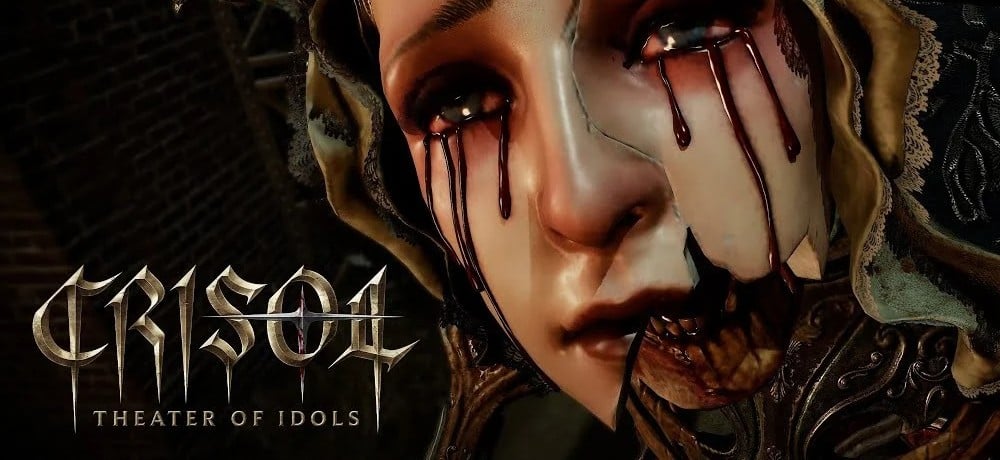
From Spanish company Vermila Studios and Blumhouse Games comes a single-player FPS that redefines point-and-shoot mechanics. Crisol: Theater of Idols has you controlling a hero who must blast an array of ghoulish baddies, but there’s a twist. You see, blood is everything. It’s not just your health, or morbid set decorations—it’s your ammunition as well. The more health you have, the more sanguine blasts you can pump into possessed mannequins and porcelain angel-dolls from Hell. No blood left? Say your prayers.
CEO and co-founder of Vermila Studios, David Carrasco, reveals their blood lore was inspired by the religious connotations of sacrifice. “You sacrifice yourself for your God. You sacrifice yourself to expel your sins. In [our] case, you are sacrificing your life, quite literally, to defeat your enemies.”
In the game, you’ll play as Gabriel. He’s a soldier sent to fulfill a divine mission by the Sun God, confronting the cultic horrors that wait on the malevolent island of Tormentosa. It’s supernaturally influenced and rich with Spanish folklore as Gabriel’s story unfolds. As you progress through levels that reflect 20th-century set pieces, Gabriel’s “Blood Memories” manifest as red-and-black figures who reveal backstory exposition in a cinematic and unique way. Instead of cutscenes, Crisol: Theater of Idols integrates artful narrative development directly into gameplay. But that’s been done before, and you’re here for the sacrificial mechanics.
I was lucky enough to play Crisol: Theater of Idols for roughly an hour, which was plenty of time to get a handle on how best to fight and survive on Tormentosa. Carrasco was generous (and patient) enough to sit in and guide me through the second chapter of his virtual creation.
There are clear inspirations taken from Resident Evil, non-derogatory. Puzzles, shambling monsters, moody atmospheres, the works. Carrasco references not only Resident Evil, but “big survival horror games like Resident Evil, Dino Crisis, Silent Hill—those games that left [a lifelong] imprint.” Gabriel isn’t slide-cancelling around the map; his molassesy movements require skill and accuracy during combat, and ammo can be considered sparse depending on how you fare. You’re going to die, but that’s OK. Crisol: Theater of Idols will replenish your lifeforce, beyond the save-point orbs you’ll find. There’s a sense of gratification in conquering a challenge or foe that ended your last run, not frustration.
But, if you ever find yourself cursing Crisol: Theater of Idols for being too hard, Carrasco confirms there will be a custom difficulty setting you can tweak to your desire. “[You can adjust] things like the damage that you get, the blood that your weapons will need, or whether you will die from reloading, for example.” This isn’t meant to be a Soulslike experience. Vermila Studios’ team of barely twenty employees want you to enjoy yourself, and will allow for customizable experiences. That includes a heavy emphasis on accessibility functionality, so “anyone can enjoy the game.”
Visually, Carrasco cites Bioshock and Dishonored as influences on Tormentosa’s architecture. The area I traversed resembled that of a brick-built industrial facility, with eerie warehouses and abandoned plants, but what elevates the game’s illustrations is how the blood mechanic influences designs. When Gabriel first sees a discarded marksman rifle, it looks like a standard-issue model. When he lifts the gun, it suddenly redesigns with a magical animation that adorns the weapon with blood-coded plating and a more gilded appearance. The game is dark, dank, and dreary, but its idiosyncrasies pop with originality. The blood changes all.
Now, the “blood sacrifice” mechanics. Honestly? I dig ‘em. It adds an element of strategy beyond the basic goal of avoiding death. My arsenal included a pistol, a shotgun, and the rifle, which all require different quantities of blood to reload. Gabriel stabs himself with his steampunky weapons as they drain his crimson juices, adding as many bullets as you’ll let him endure. That’s a crucial aspect—how much life can you spare? I found myself calculating how many enemies I had to defeat and how many shots that would take, sometimes forced to only budget for a single shotgun blast to hopefully land a killshot, because if not, I’d have nothing left. And then, well, panic ensues.
It’s such a clever problem to solve—weighing your health bar against incoming threats and your ammo count. I worried the task would feel like a drag, complicating what would otherwise be straightforward action beats, but Crisol: Theater of Idols is no chore. Adrenaline spiked when I’d have one shot at a long-range elimination. Miss, and I’d be left with only a sliver of health. The risk-reward payoffs are so much more than the typical run-and-gun fervor Call of Duty promotes. Blood is everything in this game, and if you mismanage your supply—even by a single reload—you’ll suffer the consequences. Hope your aim is on point!
Oh, and be sure to drain any corpses seen on the ground. The game isn’t THAT mean. Consider the deceased livestock as your medkits.
Crisol: Theater of Idols offers a failsafe if your guns are bone-dry: a trusty knife (with parry functionality). But you’ll have to monitor the blade’s sharpness. The more you cut through Tormentosa’s footsoldiers, the duller it gets. There’s a symbol you can track that will display your blade’s “health,” to say, before it’s blunt and useless. Once depleted, you’ll have to find a grindstone to sharpen it back to effectiveness—if you can find the gas canister to power said sharpener.
The wear-and-tear element of Crisol: Theater of Idols is a thoughtful choice, but it’s not just implemented for Gabriel’s melee weapon. As you blast away at the game’s baddies, you’ll notice that hit location matters. My first enemy was this Baroquean, full-sized marionette that creepily stalked toward my direction, so I hit it with a headshot—but, without a head, it kept coming. I blew its torso off … the legs got back up. If there was a piece left of this murderous Pinocchio, it was trying to take me down. Every encounter requires your full attention, because the enemy you think you defeated might still be crawling behind you, and can swipe away much-needed health points that could have been used on another few rounds.
As for the gameplay flow, it takes a hot minute to get used to. Gabriel’s hardly an Olympic gymnast, so agility isn’t his forte. I found myself bothered by proximity mines I kept accidentally triggering, unable to dodge or tuck-and-roll out of the way. There’s no sprinting from danger if you aren’t already in run mode. I’d just push forward as Gabriel took a few lumbering steps, then endured the blast. But that’s the kind of game Crisol: Theater of Idols is. You can't just chew bubblegum and unleash bulletstorms until waves of braindead grunts are decimated. Your actions matter, and any wrong choice will come with dire consequences. The more reckless and unfocused you are, the quicker you’ll be stressing over how to defeat four separate threats with only one pistol round, a droplet of blood, and a butter knife.
All said, I only experienced a snippet of gameplay. The game is far more robust, and will include both buyable weapon upgrades and “divine” abilities that you can unlock by collecting the souls of your vanquished foes. There’s an exploration element to Crisol: Theater of Idols that rewards those who scour every inch of maps for collectibles, breakable crates, and riches, almost Diablo-esque. Carrasco estimates a general playthrough will take about “10-15 hours,” but emphasizes how his team built the game with replayability in mind, and urges treasure-hunting completionists not to leave any stone unturned. It’ll be worth the extra few hours spent on Tormentosa.
As for the tone, well, Blumhouse was Carrasco’s dream partner for a reason. “We were looking for a publisher and we thought [Blumouse] would be a great match because [of their] view of the horror genre.” While Carrasco admits he sought filmic inspiration from the likes of Gremlins or Killer Klowns from Outer Space, citing their “mix of horror, but also some glimpses of comedy and lighthearted moments,” the game’s scare factor is real. I can point to a few instances during my demo where I jumped in my seat, startled by a massive, undefeatable boss breathing down my neck, or even a commonplace enemy popping into view from a shadowy corner. Crisol: Theater of Idols has no multiplayer because, in Carrasco’s words, “If you go [play] with someone else, you will not feel as scared or you will not have the same sense of tension and danger.” As a solo gamer, I can confirm the fear is real.
Most importantly, Carrasco is passionate about storytelling and longevity over all else. “Everything we added to [the game]—the puzzles, the action, the weapons—that’s only to make the story interesting to play through. [We want the game to be] fun and captivating [enough] to go back [into].” Crisol: Theater of Idols is an alternative FPS in the way of Metal Hellsinger, swapping rhythmic, DDR-meets-gunsling for bloody importance. It’ll take some getting used to, but that just means you can try different tactics on a second attempt. “When you go through the story again, you may get more information, and you’ll defeat enemies in a different way.” In a world of pay-to-play, rushed-to-market games that are happy being cash-in copycats, Carrasco’s words are music to our ears.
-
Crisol: Theater of Idols will be available February 10, 2026 on PlayStation 5, Xbox Series X|S and PC via Steam for $17.99 USD with a 10% launch discount active on Steam (not PlayStation or Xbox).

Matt Donato is a Los Angeles-based film critic currently published on SlashFilm, Fangoria, Bloody Disgusting, and anywhere else he’s allowed to spread the gospel of Demon Wind. He is also a member of the Critics Choice Association. Definitely don’t feed him after midnight.
Matt Donato is a Los Angeles-based film critic currently published on SlashFilm, Fangoria, Bloody Disgusting, and anywhere else he’s allowed to spread the gospel of Demon Wind. He is also a member of the Critics Choice Association. Definitely don’t feed him after midnight.












![[Editorial] AI of the Living Dead: Why Have So Many Already Accepted the Simulation?](https://dailydead.com/wp-content/uploads/2025/09/M3GAN-180x83.jpg)

![[Comic-Con 2025] Interview: Michael Giacchino Talks Marvel’s WEREWOLF BY NIGHT: BLOOD MOON and Why He Loves Classic Monsters](https://dailydead.com/wp-content/uploads/2025/07/Werewolf-1000-b-180x83.jpg)
![[Editorial] ANNIHILATION (2018): The Algorithm of Natural Selection Just Unfollowed You](https://dailydead.com/wp-content/uploads/2025/07/Annihilation-1000-180x83.jpg)