

Damian McCarthy's Hokum is many things. It's his most accessible tale to date, his scariest horror onslaught yet, and his boldest vision in a growing canon of devastating Irish spine-chillers. McCarthy adapts the textbook definition of "horror cinema," delivering a creepy-as-all-hell karmic tale that lands haymaker scares. From the very first scene, you'll be peering through interlocked fingers trying to save yourself from sleepless nights, but resistance is futile. Hokum thrills on all cylinders; an early and eerie frontrunner for best horror movie of the year.
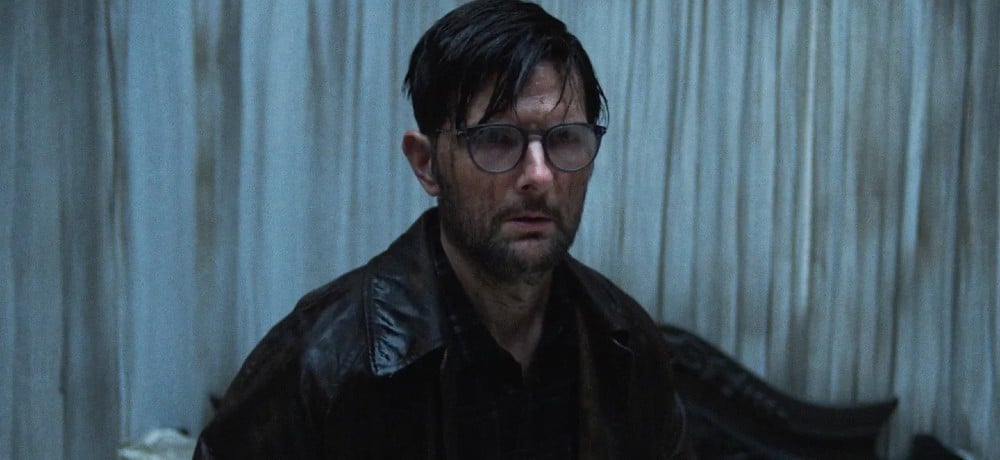
Adam Scott stars as Ohm Bauman, a troubled, whiskey-soaked, quite rude author of a successful conquistador series (represented colorfully on screen by Austin Amelio in 16th-century gear). One night, he's urged by an insistent force to visit the Bilberry Woods Hotel in Ireland. It's a family vacation of sorts, since his parents' ashes are packed to be spread by a tree they once happily were photographed under. Ohm's mother passed away at a young age, which caused his father to turn into a drunken monster of a man—it’s Ohm’s only evidence of their affection. He hopes to find peace in their untimely deaths by laying them to rest somewhere they enjoyed, but instead, he encounters a possibly haunted inn and a terrible mystery hidden away by the hotel's ornery owner, Mr. Cobb (Brendan Conroy), in a condemned honeymoon suite.
Scott is phenomenal as Ohm, a pretentious, prickly writer who'd burn the hand of anyone brazen enough to offer him their manuscript to read. He's a tortured artist with a pickled soul, who heads to Bilberry with selfish intentions. There's a sadness that Ohm soaks with liquor, as Scott ditches his patented sense of shy snark and turns his wit into a weapon that stings with each insult. Ohm's hiding a horrible secret, eating away at his insides. Relief only comes with anti-social behaviors that fit Scott's wheelhouse, but demand something nastier than his stereotypical good-guy schtick. He's enveloped in darkness, fending off demons by pounding keystrokes that unleash his cold cynicism on his readers—and it's a splendid, heartbreaking performance that emerges every so often with these bright pops of healing redemption.
McCarthy's characterization of Bilberry Woods is elegantly accented by mahogany fixtures, roaring fireplaces, and striking red hallways that become a Kubrickian maze—but it's instantly horrifying. The concierge's ding-a-ling-ing bell system becomes a danger alert, while shadows hide whispers of a presence that gnaws away any comforts. It's all so richly dreadful before Ohm even enters closed-off areas where the lights burn out and bumps in the night become scream-hungry monsters. There's something homely and snug about the Bilberry's decor—the gaudy bedroom wallpaper and antique personality—that's welcoming at first, yet every floorboard creak or gated-off elevator makes your skin crawl. Colm Hogan's cinematography devours the lodge's meticulous architecture to lull us into a sense of safety, but also lingers on traditional jump-scare setups to the point where the tension is damn near unbearable.
I think of how Mike Flanagan hides his ghouls in The Haunting of Hill House, or how James Wan uses shadow concealment as a devastating trick in The Conjuring, both of which McCarthy might outshine. Ohm's investigation brings him face-to-face with bouts of witchcraft, magic mushrooms, and dumbwaiters that drop into the bowels of the Bilberry's rumbling belly, where what's most frightening is whatever's making noise out of sight. McCarthy's usage of supernatural sounds, the cackle of something Ohm best not encounter, is but an appetizer for the hide-and-seek horrors that unfold. In typical McCarthy fashion, sighted terrors are a collection of oddities, from a bug-eyed jackrabbit who hosts a black-and-white children's show, to the ghosts of unrested spirits captured within the Bilberry. Ohm's grieving unlocks a connection to whatever's spooked the building's owner, and McCarthy loves dangling his monsters just out of sight, overexposing the "lurks," then throttling us with a close-up "gotcha" knockout.
The supporting cast falls nicely into place around Scott's unfriendly tourist. Peter Coonan's front desk clerk, Mal, tries to accommodate Ohm, who's resistant to pleasantries. Poor Alby (Will O'Connell) is starstruck, but becomes an easy target for ridicule, much like the goat-hating handyman Fergal (Michael Patric). Ohm takes to bartender Fiona (Florence Ordesh) because she exchanges barbed wits about his "cynical" endings, and shares a few friendly chugs of moonshine with a tripping forest hermit named Jerry (David Wilmot). They're day players in his mystery, integral parts in making his stay feel welcome, until nightfall unleashes its unwanted guests.
Hokum is a full-bodied witch's brew of nightmarish conjurings that elevate McCarthy’s talents to a whole new level of horror achievements. This movie isn't just exquisitely scary; it's also delicately profound despite an unshakable bleakness. Scott isn't just a target to scare; he's a cautionary example of repressed trauma manifesting in dangerous ways. McCarthy opens the door to a textbook-definition haunted-house banger: the sights, the sounds, the details … the devil's in 'em all. Hokum is capital-H horror; McCarthy sets a sky-high bar for himself.
Movie Score: 4.5/5
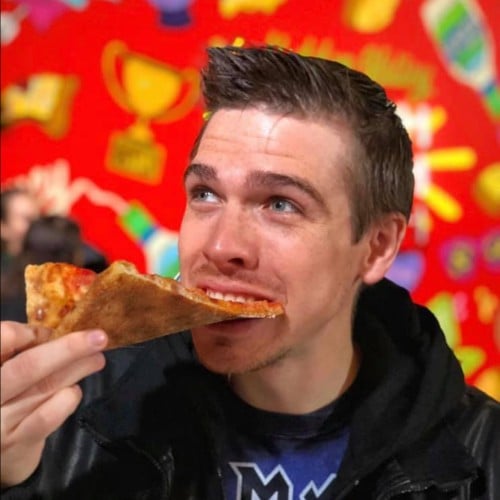
Matt Donato is a Los Angeles-based film critic currently published on SlashFilm, Fangoria, Bloody Disgusting, and anywhere else he’s allowed to spread the gospel of Demon Wind. He is also a member of the Critics Choice Association. Definitely don’t feed him after midnight.
Matt Donato is a Los Angeles-based film critic currently published on SlashFilm, Fangoria, Bloody Disgusting, and anywhere else he’s allowed to spread the gospel of Demon Wind. He is also a member of the Critics Choice Association. Definitely don’t feed him after midnight.






![[Editorial] AI of the Living Dead: Why Have So Many Already Accepted the Simulation?](https://dailydead.com/wp-content/uploads/2025/09/M3GAN-180x83.jpg)

![[Comic-Con 2025] Interview: Michael Giacchino Talks Marvel’s WEREWOLF BY NIGHT: BLOOD MOON and Why He Loves Classic Monsters](https://dailydead.com/wp-content/uploads/2025/07/Werewolf-1000-b-180x83.jpg)
![[Editorial] ANNIHILATION (2018): The Algorithm of Natural Selection Just Unfollowed You](https://dailydead.com/wp-content/uploads/2025/07/Annihilation-1000-180x83.jpg)