

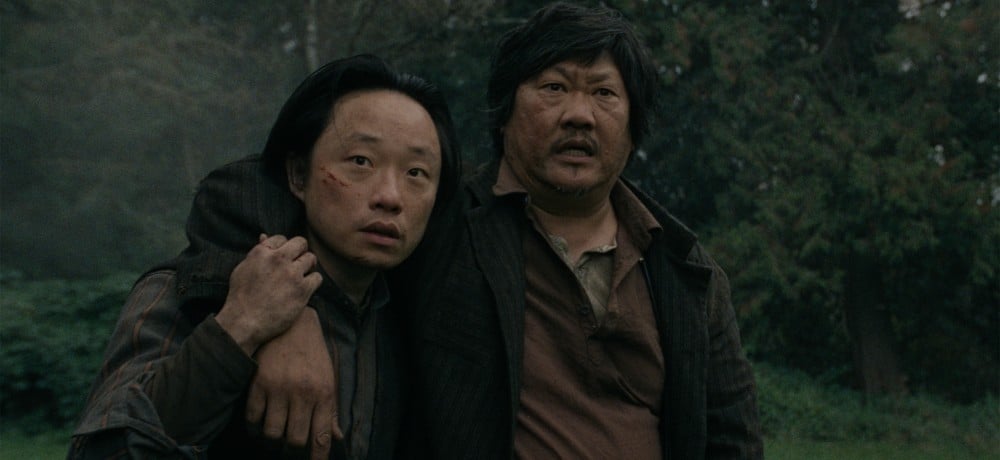
America's history is tainted and grim. It's a nation founded on colonization, after all, built by immigrants. Writer and director Vera Miao is not shy about the blood on our country's hands in her monstrous feature debut, Rock Springs. It's a "Trauma Horror" history lesson, based on the hateful 1885 execution of too many innocent Chinese miners in the Wyoming town of Rock Springs.
Miao's film is a multi-generational affair, starting in the now. Kelly Marie Tran stars as Emily, a Westernized Vietnamese single mother who is moving with her daughter, Gracie (Aria Kim), and Gracie's Chinese Nai Nai (Fiona Fu) to Rock Springs. Emily does not know the town's violent past, nor does she understand Nai Nai's warnings about "Ghost Month," where hungry, restless spirits spring from the gates of hell. Gracie's still grieving the loss of her father, as is Emily, behind closed doors. Emotional heaviness distracts from the strange happenings around their brand-new home, as Nai Nai's attempts to ward off evils go unhelped by Emily.
The first act, which focuses on Gracie, lays the groundwork for what wickedness comes later. She's this wayward child who hasn't quite accepted her father's death, slowly acclimating to her new surroundings. Gracie's the first character to acknowledge something in the bordering woods, and poof, she's ripped behind shrubs by a snarling creature, presumably. Then, the film cuts to the second chapter, in a whole new era.
Miao transports us to the late 1800s, where Jimmy O. Yang and Benedict Wong play Chinese miners on the day of the town's infamous massacre. The time-jump represents a significant portion of Rock Springs, led by Wong's Ah Tseng, as the longest-tenured American in the camp. It's a brutal, knife-in-your-heart chapter as White cowards murder the defenseless immigrants one by one, cracking their skulls open with axes, and scalping for trophies. To understand the lost souls stuck in today's world, Miao wants us to see how they got there by showing every gory detail.
Comprehensively, the move makes sense. Structurally, it's a tale of two different movies. Historical importance is laid bare, but it's a long while before we're back home.
The third act is dedicated to Emily, retreading earlier narrative footsteps, this time from her perspective. It's also where Rock Springs turns into an all-out creature feature, albeit sparse with details. You'll glimpse an abomination of a monster in full view, which adds context to Gracie's previous actions—but it's all a bit daunting. There's a lot of structural flip-flopping, paired with the need to go with the flow when Emily starts encountering the wretched thing lurking outside her windows. Sure, the meaning is easy to decipher, but the scripted ideas are either drawn out or underbaked, so it doesn't feel like a complete story.
And yet, there are plenty of technical aspects to applaud. Heyjin Jun's cinematography is a bright spot, making effective use of rotating cameras and upside-down shots to create this bizarro surrealism. There's this wild Under The Skin cavern realm, where supernatural scares hit hardest. Everything's so crisp and clean, while the darkness of night brings an eerie quality that Jun captures so well. Miao is confident and calculated with her visual language, which helps keep the film on track no matter how wobbly its axis. It's actually impressive, considering the wheels are threatening to fall off at any moment.
That's the conundrum of Rock Springs. Its parts, while well-oiled, don't always fit. Miao's intentions are straightforward, and the ending leaves us with a sense of relief, but it's a bumpier ride than necessary. Perhaps a different amalgamation of acts, at different attention levels, might even the experience. As is, Miao creates something perplexing and somewhat endearing, which will no doubt divide audiences as they try to hold on during every swerve and changeup.
Movie Score: 3/5
Matt Donato is a Los Angeles-based film critic currently published on SlashFilm, Fangoria, Bloody Disgusting, and anywhere else he’s allowed to spread the gospel of Demon Wind. He is also a member of the Critics Choice Association. Definitely don’t feed him after midnight.
Matt Donato is a Los Angeles-based film critic currently published on SlashFilm, Fangoria, Bloody Disgusting, and anywhere else he’s allowed to spread the gospel of Demon Wind. He is also a member of the Critics Choice Association. Definitely don’t feed him after midnight.






![[Guest Article] Maggots On Your Body Of Work: Clay McLeod Chapman On Finding His Own Muses](https://dailydead.com/wp-content/uploads/2026/03/Bodies-of-work-1000-326x150.jpg)
![[Editorial] AI of the Living Dead: Why Have So Many Already Accepted the Simulation?](https://dailydead.com/wp-content/uploads/2025/09/M3GAN-180x83.jpg)
![[Comic-Con 2025] Interview: Michael Giacchino Talks Marvel’s WEREWOLF BY NIGHT: BLOOD MOON and Why He Loves Classic Monsters](https://dailydead.com/wp-content/uploads/2025/07/Werewolf-1000-b-180x83.jpg)