





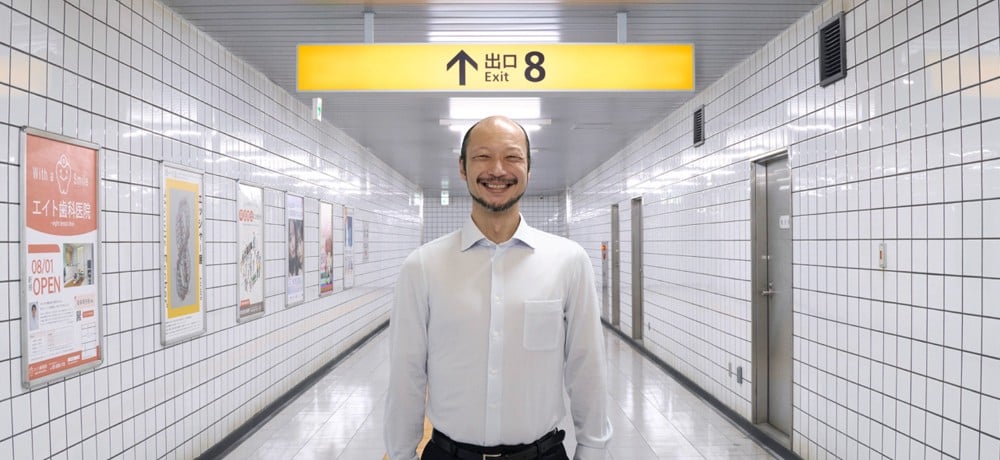
In US theaters this Friday is Exit 8, based on the popular Kotake Create-developed video game. A truly inventive concept with a deep, emotional character journey at its core, I really enjoyed the film, which was directed and co-written by Genki Kawamura. Ahead of the film's release, I spoke with Kawamura about adapting the game, building the set, inspirations, and more:
"Based on the eponymous video game from Kotake Create, a lost man trapped in an endless subway passage sets out to find the elusive and mysterious Exit 8. His way out is to identify anomalies within the recurring corridor; the rules of his quest are simple:
Do not overlook anything out of the ordinary…
If you discover an anomaly, turn back immediately…
If you don’t, proceed in the direction of Exit 8.
When even a single oversight sends the lost man back to the beginning of his quest, how can he escape this infinite corridor?"
Please find the full video interview below and enjoy these additional details from the press notes:
Exit 8 is your second directorial project. What drew you to this film?
In A Hundred Flowers, my directorial debut, I attempted, through the use of sound and imagery, to visualize the chaotic world seen through the eyes of a woman with dementia, connecting disparate elements of time, space, and sound to portray that fragmented reality within single takes.
Since then, I’ve been eager to make a horror movie set in modern Tokyo that blurs the boundaries between dreams and reality, time and space, much like Kenji Mizoguchi’s Ugetsu, a film I deeply admire. With these ideas in mind, I came across the indie game Exit 8, created by a young man in his twenties living in Kyoto. The game’s design — a sterile and orderly underground passage that feels distinctly Tokyo — becomes a recurring nightmare from which there is no escape.
Players must detect subtle “anomalies” within this endless corridor and aim to reach the elusive Exit 8.
What were some of your other influences on this project?
Though the game features highly localized Japanese aesthetics, it evokes primal, universally understood fears, reminding me of the purgatory in Dante’s Divine Comedy, a mechanism that reveals the hidden guilt and anxiety we all carry. I felt this premise could allow me to build upon the magical realism approach that characterized A Hundred Flowers.
Also, as a novelist, I saw great potential for crafting a cinematic narrative out of the game’s minimalist setting and simple rules. I grew up watching films by Mizoguchi and Stanley Kubrick with my father, who was a filmmaker himself. At the same time, I was deeply immersed in Japanese video games and animation. This background, rooted in classical cinema and contemporary visual culture, uniquely positioned me to create a one-of-a-kind thriller.
How did you find the right actor to portray The Lost Man?
We cast the film primarily through auditions. Kazunari Ninomiya, who plays The Lost Man, was discovered by Clint Eastwood, who cast him in Letters from Iwo Jima. In that film, he has almost no dialogue, just endless digging in the earth as a Japanese soldier. There was something magnetic about him, and I wanted to showcase that quality again, as it had been 20 years since he appeared in a globally distributed movie.
The Lost Man is the protagonist of Exit 8, yet he has no name and almost no dialogue, like a video game avatar or a symbol of society itself. I believed this role would allow Ninomiya’s unique screen presence to shine. Also, his deep love of video games helped him intuitively grasp the film’s tone.
How did you cast The Walking Man?
Yamato Kôchi has spent most of his career in theater, and his experience lent itself perfectly to the role, which required movement like that of a Noh performer — precise and emotionless, like a programmed entity. He also happened to be the spitting image of the character in the original game.
How did you cast The Woman?
Nana Komatsu was discovered by Martin Scorsese for Silence. Since then, she has mostly worked in Japan, balancing acting and modeling as a Chanel ambassador. Alongside Ninomiya, I wanted to introduce her to international audiences as a remarkable Japanese talent. She has a one-of-a-kind ethereal presence reminiscent of actresses in Mizoguchi’s films.
And finally, how did you cast The Boy?
Naru Asanuma was selected through an audition process that included over 300 children. He had never acted in a major role before — Exit 8 was essentially his debut — but his stunningly expressive eyes compelled us to cast him. His presence elevated the entire movie.
What do you hope audiences and fans of the video game take away from this movie?
The movie begins with the glow of a smartphone screen, because that’s the most familiar sight in our daily lives. Exit 8 starts grounded in reality, and before you know it, you’ve slipped inside a strange and disturbing world. When the film ends, I hope audiences feel their own “ordinary” lives are somehow a continuation of what they just saw — that the boundary between the film and everyday existence has blurred and seeped into their reality. In a world where people are constantly looking at their phones, I believe this kind of cinematic experience is the most meaningful gift the theatrical experience can offer.
After more than a decade as a consultant in the entertainment industry, Jonathan James launched Daily Dead in 2010 to share his passion for horror. He takes immense pride in Daily Dead's talented team of writers, who passionately explore and celebrate horror as a respected art form capable of telling complex, character-driven stories with deep emotional and cultural impact.
Over the course of his career, Jonathan has written more than 10,000 articles and hosted panels at major conventions, including New York Comic Con and San Diego Comic-Con. He is also consulted with as an expert on horror and pop culture, offering insights on horror history and the latest trends through media outlets, film festivals, and conventions.
After more than a decade as a consultant in the entertainment industry, Jonathan James launched Daily Dead in 2010 to share his passion for horror. He takes immense pride in Daily Dead's talented team of writers, who passionately explore and celebrate horror as a respected art form capable of telling complex, character-driven stories with deep emotional and cultural impact.
Over the course of his career, Jonathan has written more than 10,000 articles and hosted panels at major conventions, including New York Comic Con and San Diego Comic-Con. He is also consulted with as an expert on horror and pop culture, offering insights on horror history and the latest trends through media outlets, film festivals, and conventions.














![[Guest Article] Maggots On Your Body Of Work: Clay McLeod Chapman On Finding His Own Muses](https://dailydead.com/wp-content/uploads/2026/03/Bodies-of-work-1000-180x83.jpg)

![[Editorial] AI of the Living Dead: Why Have So Many Already Accepted the Simulation?](https://dailydead.com/wp-content/uploads/2025/09/M3GAN-180x83.jpg)