



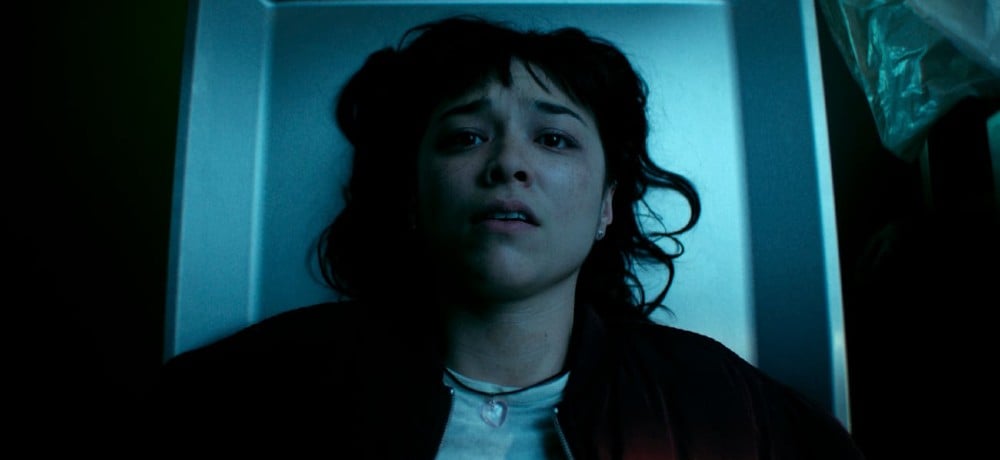
Filmmaker Natalie Erika James makes honest portraits of pain. With her showstopper of a debut, Relic, and her latest picture, Saccharine, James turns supernatural scares into relatable nightmares. There’s a beating, albeit perhaps charred and decayed, heart and spirit to her horror.
“What’s presented is jarring, troubling, and grotesque, all based around unhealthy conversations about society’s mirror-gazing obsession,” Matt Donato wrote in his review of the film. It stars Midori Francis (Unseen) as a medical student who consumes ash to lose weight. Her poor choice brings about an unwelcomed haunting.
Saccharine isn’t only scary but often a tongue-in-cheek – as James puts it – “ride.” Recently, the filmmaker spoke with Daily Dead about writing and directing her latest horror film:
It’s always refreshing when you see a horror movie with a very smart protagonist. How important was that to you?
Natalie Erika James: I was fascinated by this idea of a character who had a really scientific approach to the supernatural. Any scientist or scientifically focused person, if you started experiencing these things, you would prod at them and question them and do tests. It was something that we didn't see often in horror films. There's always that question of how a character is grappling with the supernatural encroaching into the real world.
Instead of having your character go to the library, she is the library.
Natalie Erika James: Completely. There's such a joy in the writing too, to put yourself in the character's shoes and be like, okay, what would I do? I like that she leans into it because of course there's this, I guess, duality of being very scientifically minded, but then also having these cultural beliefs. There’s a normalization of a world outside of our own as well and the idea of ancestral spirits that makes that character unique.
The contrast between science and the otherworldly is always rich thematic material. What questions did you want to explore there?
Natalie Erika James: For me, growing up, I had a very staunchly atheist view. As I've gotten older, I have recognized how little we know about the world, even about consciousness or what's outside our galaxy. I've definitely come to a more spiritual place, and I'm openly skeptical.
As an open skeptic who's in a now more spiritual place, how do you think that affects a film like this?
Natalie Erika James: What I've always believed in is the power of the human mind to create so much and how much it affects our reality. I don't know, I guess when you think of telling a story through a film character, so much of that is living within their mind. And so, I've never really shied away from having their psychological makeup bleed into that character's reality.
How did you want the camera to tap into the character’s psychological makeup?
Natalie Erika James: I'm drawn to subjective storytelling. In this film, we're very much in Hana's perspective throughout the whole film. A lot of our choices had to do with Hana, her perception of herself within a space as well. With our lens choices, we started with slightly longer lenses to feel that compression of her against a space. And then at the same time, as things progress and get a little bit more destabilized, we're working with slightly wider lenses. She then shrinks within a space as well.
How about how Hana hears things? How did you want the sound to tell her story?
Natalie Erika James: We had this real strong notion of food noise. It’s an incessant theme that keeps coming back, and that's very much tied to Bertha and the body. A lot of the soundscape had to do with her presence within the house. There's a lot of breath and a lot of heartbeat-like sounds that we've modulated as well. We were really drawing from organic, much like the rest of the film, textural, bodily sounds. We were making room for silence, as well, to really sit the character within a space and not overlay too much in those key horror moments.
There’s a full spectrum of body horror in Saccharine. It can be dramatic or tragic, but, at times, also beautiful. For you, what’s the beauty in body horror?
Natalie Erika James: Completely. I'm drawn to stories and imagery that sit between the beautiful and the grotesque. That's true of most things in life. I'm thinking of Relic and the idea of the horrors of grief, but grief is only so painful because of the love behind it. Those things become hand in hand, philosophically. I’m always drawn to that combo.
With this film in particular, we were trying to show the full spectrum of someone in the grips of an eating disorder. There are states of motion to Hana's experience, that sometimes it is this ecstatic rush of a sugar high. We want to show the pleasure of that alongside the pain, those moments of sluggishness and a sense of oppression as well. Both were just as important to show.
One of the best pieces I read about Relic was from a medical journal. A doctor wrote about the honesty of that movie. Since Saccharine follows a med student, did you develop any connections to the medical field that maybe influenced your latest?
Natalie Erika James: I definitely have friends who are doctors, but not to the point of it necessarily influencing me. When you talk about the medical field, it's so much about life and death and the body. It lent itself to being the right setting for this character. There's a sort of meticulousness to her and a perfectionism and that conditional love that she's developed for herself, which can be rife in areas where there's so much study and high achievement required to make it in a field. In some ways, Hana doesn't even want to be a doctor. It's what's expected of her and what she's always excelled at academically. It was a character choice, but it also spoke more broadly to the themes.
Who are some body horror artists, whether from film or other mediums, that you really appreciate?
Natalie Erika James: In terms of body horror specifically for this film, Raw is the most obvious comp in terms of consumption. There's a certain coming-of-age or a similar university setting. I was also inspired by films like May or Excision, these really unique, lonely central protagonists. There's a real yearning for connection that feels similar to Hana in a way.
I undoubtedly was inspired by all of the anatomical Venus sculptures from the 18th century. These figures sit between the scientific and the erotic. They are medical models, but, at the same time, they were sensationalist spectacles at the time because of the nudity of the human body or the female human body.
Beyond that, we looked at a lot of old medical journals from the time. There are gorgeous illustrations in those texts. They're pretty amazing. There's an artist called Vincent Olinet who does these incredible, excessive sculptural cakes. There's definitely a nod to him in the end credits.
When you were writing, how’d you land on the curse beginning with Hana eating a body’s ashes? Where did you begin with the logic behind it?
Natalie Erika James: I always wanted something that had the logic of “The Picture of Dorian Gray” in terms of the ghost getting larger as she gets smaller. I needed something that would tie the two together spiritually. Why has this thing latched onto her? Of course, consumption of something is the most relevant way to convey it.
If you're going to eat something, cannibalism is a little intense for the start of a film, maybe for this film. Whereas there's something about ash that feels very divorced from the person itself. To be honest, it didn't feel that out of reality, of what people would do. There is such pressure on everyone to look a certain way or to exist a certain way in the world that it didn't feel that out of the question that people would eat ash.
Every time I pitched it to people, they would be like, "Is this a real thing? Where can I get some?" kind of thing.
It does just feel a few steps removed from reality.
Natalie Erika James: Completely. I read that you can inject yourself with fat from cadavers now to achieve something.
It’s also a great bad choice for your protagonist to make.
Natalie Erika James: There's a thing where an audience can't help but root for a character who fully commits to a plan. Even if it's a bad plan, they'll be along for the ride. It's a testament to Midori and her incredible charm and how disarming she is. It is such a morally questionable thing to do clearly, but you're along for the ride.
You’ve spoken about how Saccharine was about wrestling with your childhood, maybe trying to exorcise a part of it. In the film, you’re clearly having fun. It is emotional and tough, but also very tongue-in-cheek. What did you want to achieve with the tone of the movie?
Natalie Erika James: I always knew I wanted to bring an absurd edge to it. It's not comedy, but horror and that kind of absurdity go hand in hand sometimes. I guess in horror films, you're really breaking reality. Something completely unnatural is generally happening in the supernatural sense or in whatever sense. And so, there's an inherent absurdness to it in a way.
Sometimes, of course, you approach it in a much more serious fashion. Relic is an example of that, where it's completely straight, and that felt right when talking about grief. But for Saccharine, I really wanted to convey the mania of how pent-up things can get inside of the mind of someone who's dealing with an eating disorder. I wanted to lean into some of that absurdity to the point where it hopefully works on the two levels. It's emotionally accurate, but then at the same time, you can laugh at it as well.
A film journalist with over a decade of experience writing for Slash Film, The Credits, and High Times Magazine.
A film journalist with over a decade of experience writing for Slash Film, The Credits, and High Times Magazine.


![[Guest Article] Maggots On Your Body Of Work: Clay McLeod Chapman On Finding His Own Muses](https://dailydead.com/wp-content/uploads/2026/03/Bodies-of-work-1000-180x83.jpg)
![[Editorial] AI of the Living Dead: Why Have So Many Already Accepted the Simulation?](https://dailydead.com/wp-content/uploads/2025/09/M3GAN-180x83.jpg)