


Lee Cronin’s The Mummy started with a question. Producer James Wan asked Cronin, “What about making a really terrifying mummy movie?” For the director of Evil Dead Rise, it was a challenge accepted.
With more questions came more ideas that shaped the final film, which is a patient yet wicked piece of horror. “What if there was a different purpose for mummification?” Cronin began asking. “What if it wasn't about your kings or queens or pharaohs as such? What if it was about somebody that you loved?”
What sold Cronin’s vision to the producers was, ultimately, the story of a child gone missing and then found in a 3,000-year-old sarcophagus. Where the story goes from there is full of unrestrained body horror with both character and scale. It’s a mummy movie unbeholden to any past staples and playing by its own rules.
Recently Lee Cronin spoke with Daily Dead about crafting a patient horror tale, its teeth-and feet-heavy scares, and what makes it Lee Cronin’s The Mummy. Spoilers ahead...
Knowing you wanted to make a truly terrifying mummy movie, how’d you want the prologue to set the tone and let the audience know what the movie is?
Lee Cronin: I'm a big prologue fan. It's fun with a horror movie—and not only a horror movie, but genre movies—to give people a taste of what's to come. I always think of the opening of Jurassic Park and just how awesome it is. You see very little, but you're given this primer of what's going to be a terrifying movie to come. I like to play around with the visceral, obviously. That's pretty apparent in this film, or at least that's what I wanted to do with this movie was to play around with that.
I wanted to establish the concept of the prologue was like... it's just Saturday. I kind of draw a line between that opening scene and the scene, another Saturday, when the family gets the phone call saying, "Katie's returned." Our first family, our Egyptian family, despite knowing about the secret beneath the surface, there's also just days that are just Saturday. It's not like they wander around worrying the entire time about the secret beneath their feet.
The whole purpose of burying and controlling this evil is to get on with your life. With the Cannon family, despite the grief they've suffered, in any situation where there's heavy grief or loss, you will just have days, as I said, that are just Saturday. And what I wanted to do again in both of those scenes, both the opening and mirroring that a little bit later, is then pull the rug. That's how life functions quite often. It can be any day of the week and one phone call can change anything.
The movie is uncompromising, not only in gore, but even the pace and patience. You let moments breathe that, in most horror movies, would get cut. The movie moves, but you don’t go fast. How’d you approach the pace in the edit?
Lee Cronin: It was definitely a big challenge in the edit. I know when people watch the movie, some people will have a response like you and go, "It's a long movie, but that's okay because we're rolling with it." Some people will say, "It's too long." And that's again, okay. What I felt was we had to tell quite a detailed story and make sure we didn't undersell anything.
One of my favorite scenes in the entire movie is that moment where we slow down and we have Larissa [at the wake] saying, "I don't want her here anymore." We assume she’s talking about the pressure of having her mother in an open casket in the room, but the reality is actually, no, Larissa has turned heel and doesn't want her daughter here anymore. Without that moment, then there is no character. And without those character reflections, then the horror to me is not particularly valuable.
I also feel those moments are quite true to life. Sometimes we do turn on our heel and change our perspective and opinion, especially when we're under emotional distress. We can act in ways that are out of character or not necessarily running with the greatest logic in terms of how we process and behave.
Trauma is such an overused word, but during a grand challenge in life within a family, it's amazing how everybody can react and go in different directions. Why does one person take up yoga and climb mountains and the other person becomes an alcoholic? Why is that? It's because we would respond differently as humans to these very catastrophic moments that we face.
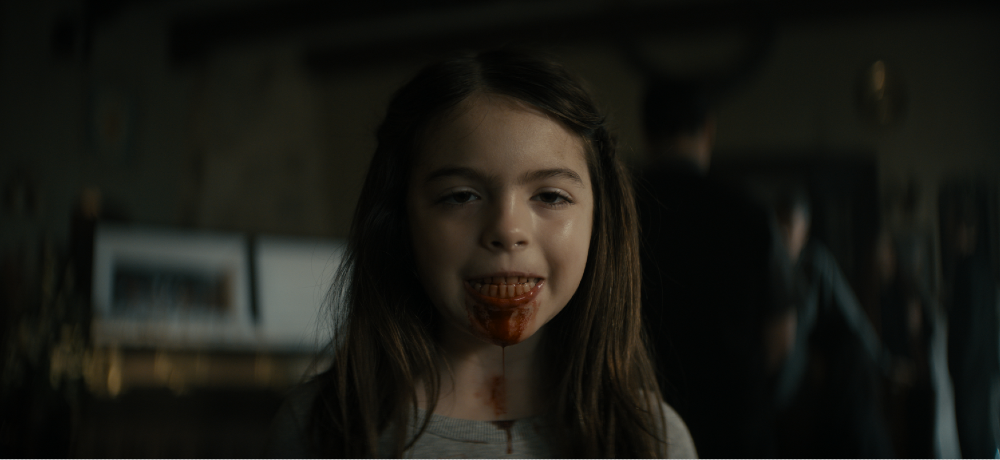
Where did the wake scene, and all of the horrors unfolding there, begin for you?
Lee Cronin: I'd experienced a wake that was a very traumatic one for me, as they often are, if you're extremely close to the person that's passed away. I needed to put that somewhere. But my way of processing isn't to try and make a documentary. If I'm going to put this on screen, my intent is to do so in an extremely lavish, dysfunctional, energetic, and shocking way. So, that as a sequence came together very quickly on the page, all of those specific moments that were in play with it.
Feet and teeth are not safe in this movie. They are such vulnerable parts of the body. How did you land on destroying both of those features in The Mummy?
Lee Cronin: Everything that makes the page and the screen with me always comes from some form of personal influence. I don't sit there and go, "Wouldn't it be cool if I pull somebody's teeth out?" I know that's not what you're saying, by the way, at all, but the teeth thing comes from my own experience of somebody who I knew who passed away. I had to make sure that the undertaker was aware that their teeth traveled from the hospital with them, and that's a very difficult phone call to make. The entire journey of the teeth just comes from that one phone call I had to make in my own real life where I was like, "Whoa, that's an intense thing to have to do in a very unusual time."
And then the foot aspect comes from my sister being a foot doctor. She has told me some heinous stories, and, as always, it clicked in my mind as something that could be quite expressive. These extremities, especially with the feet, it's not just about, again, pulling a toenail off to make everybody go, "That's gross." It's actually a layer into our mystery that's a big backbone of the story.
How’d the test audience react to it?
Lee Cronin: Loud and screamy.
Did it make you want to double down, though?
Lee Cronin: We already kind of had. Those sequences, when I designed them, they're pretty well organized on set. It's always different within the drama and the overall tempo of the movie, but those moments that I really want to raise you from your seat for a beat or spill your popcorn were pretty organized, especially with all these practical effects that we have. You have to be pretty well prepared for those as well.
Since a lot of the set pieces come from a personal place, what about the scorpion and the vocal cord sequence?
Lee Cronin: I haven't faced any major scorpion issues in my life. Really, that came from what I very much enjoy in finales and third acts – that you just want to have interesting complications there. I knew I wanted there to be some creepy crawlers in the movie that were reflective of iconography we might know from these environments or from mummy movies in the past.
I liked the idea that the detective, with her idiosyncratic focus, brings this information to the family. If you watch closely, you can see she's prepared. She's watching that video. There's a sense of rehearsal in her. The evil that exists in this story gets in the way of a straightforward reading of that incantation and then allows me to elevate these moments and not make it just about, "Let's say the magic words." I put some roadblocks in the way of easy solutions.
Very strong supporting cast with Detective Dalia and The Magician.
Lee Cronin: I'm very, very proud of the work that they did.
Your B-storyline lets you have this cool, supernatural procedural unfolding in Egypt. What did you want it to bring to the film?
Lee Cronin: It was definitely a challenge for everybody trying to weave this story together where we're going through the pressure that this family is under, but at the same time, some of the mystery is unraveling in the background. The authenticity that they bring to the role – it was very important to me to have Egyptian actors in these roles and speak Arabic.
I wanted there to be a grounded quality to this movie and to smash that up against all of these wild supernatural concepts. My belief always is, if there is evil in the world to punish and torture and feed on our innocence, it's going to be bad. It ain't going to be falling in the middle of the road. It's going to be badass.
You begin your stories with a marker and notecards. Which death or set piece evolved the most from what you initially imagined to what made it to screen?
Lee Cronin: The finale of the movie. Finales always grow and develop as you're working your way through. In my last two movies, we shot them in a relatively linear fashion. In this one, there were things that weren't in sequence because we went to Spain later. As you approach those finales, they can grow a little extravagant and sometimes you have to rein them in and try and find the right balance of what it is that is going on.
One of the interesting things I talked about with the cast was as much as there's the violent spectacle that's taking place and the demon that is now torturing full on, it's also about a little girl and her dad. It’s a dad that ran after a little girl in a sandstorm and couldn't catch her, and now, he’s crawling toward his little girl. It was a lot of just getting those elements right, some of the metaphorical weight that was behind it.
I wouldn't say it changed, but the scene where they first talked to Katie in the hospital. That was a scene I know I wrote a lot of times in a lot of different ways, always trying to get the necessary exposition. And then through a couple of drafts landed on this idea of the doctor looking right at us and saying, "You need to prepare yourself for what you're about to see." What could be a joyous reuniting is actually a major reality check as well.
You get to do something few filmmakers get to do: you get your name in the title. What does that mean to you?
Lee Cronin: It means there's a lot of trust in me from people that are smarter than me. That is the way that I would look at it. I didn't write that in the script. I still wrote, "The Mummy written by Lee Cronin," you know what I mean? When it was proposed to me, I was like, "You're going to have to give me the weekend to think about this because it is my name." Then it's speaking to the people around me that I trust and who care about me. Everybody was like, “Wear it as a badge of honor and do what you do with what this script is, which is try and terrify an audience and differentiate it from what people might expect from mummy movies in the past.”
---
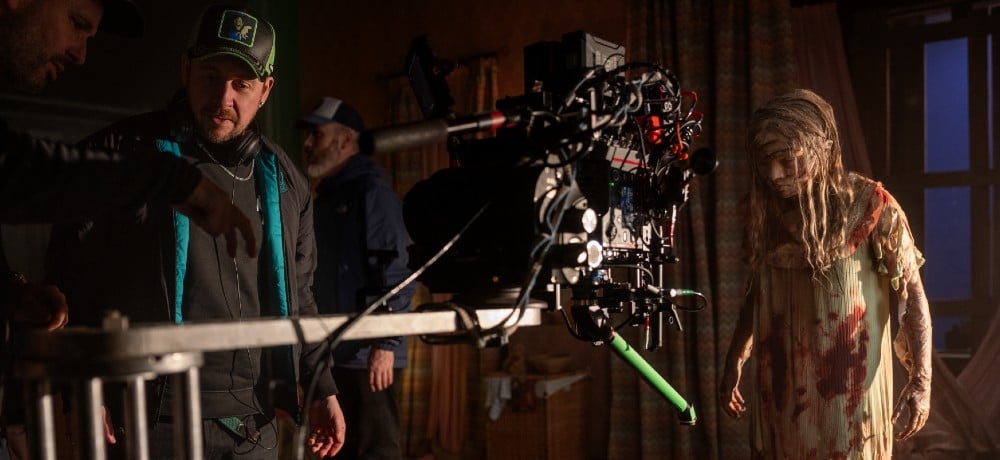
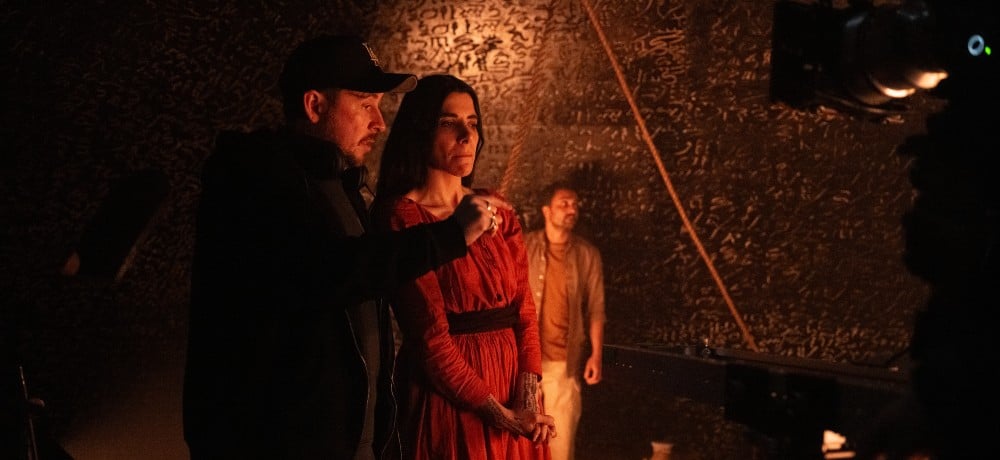
Photo Credits: Patrick Redmond / Warner Bros. [Director/Writer LEE CRONIN on the set of New Line Cinema’s, Atomic Monster’s and Blumhouse’s “LEE CRONIN’S THE MUMMY.” A Warner Bros. Pictures Release.]
A film journalist with over a decade of experience writing for Slash Film, The Credits, and High Times Magazine.
A film journalist with over a decade of experience writing for Slash Film, The Credits, and High Times Magazine.







![[Guest Article] Maggots On Your Body Of Work: Clay McLeod Chapman On Finding His Own Muses](https://dailydead.com/wp-content/uploads/2026/03/Bodies-of-work-1000-180x83.jpg)
![[Editorial] AI of the Living Dead: Why Have So Many Already Accepted the Simulation?](https://dailydead.com/wp-content/uploads/2025/09/M3GAN-180x83.jpg)