



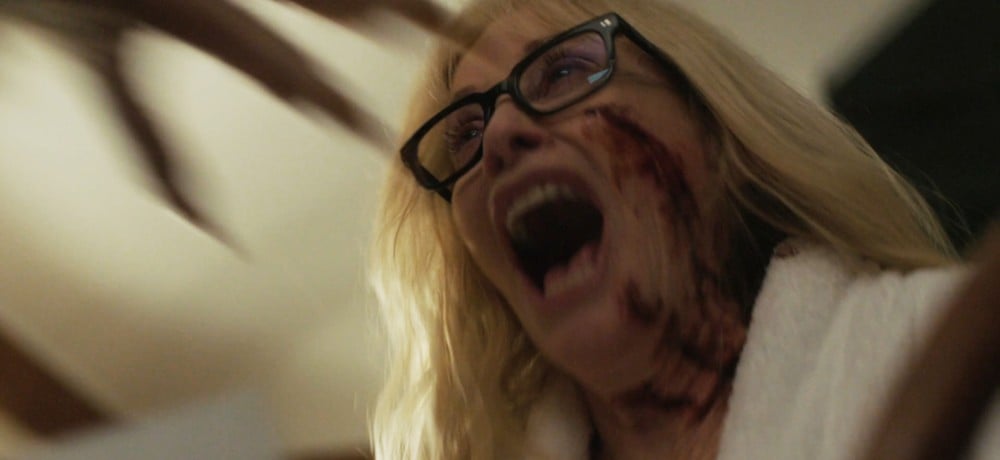
While Universal has failed to relaunch its shared horror universe for decades, Larry Fessenden’s beloved bloodsucker Habit was released in 1995 and laid the groundwork for his own successful Monsterverse. Quietly, out of the mainstream’s eye, Fessenden assembled his take on the Wolf Man, Dracula, and Frankenstein for a graveyard smash of a crossover that premiered at this year’s Overlook Film Festival: Trauma or, Monsters All. It’s Fessenden’s signatures in totalum: an emotionally torn, low-budget take on the horrors of humanity as guided by cursed creatures. Don’t expect Stephen Sommers’ Van Helsing; more the mumblecore-value, Glass Eye Pix version of a Universal multi-monster classic.
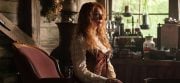
At the center of Trauma Or, Monsters All is Cassandra (The Pitt’s Laetitia Hollard), a writer who seeks isolation in Upper New York State’s Talbot Falls (where Fessenden’s werewolf picture Blackout is set). Alone, in an off-the-beaten-path rental, she chips away at a historical recounting about the life of George Washington Carver. But, outside her window, she spies something odd. A chained basement door and a strange man, who Depraved fans know as Adam (Alex Breaux), Henry’s creation. Cassandra, aka “Cassie,” decides to pen a news piece about strange supernatural cases around Talbot Falls and the possible lycan being held next door. All of a sudden, she’s the center of attention—unwanted attention—from humans and new-to-town drifters like Sam, Fessenden’s New York City vampire from Habit.
It’s a natural culmination of story arcs, hardly a shoehorned kitchen-sink gimmick. At the core of Fessenden’s shared universe is this tragic fatalism: all the monsters are victims of circumstances beyond their control. They crave normalcy and civility, yet must hide because of their “monstrous” behaviors. Adam swipes days-old leftovers from restaurant trash bins while Wolf Man Charley (Alex Hurt) stays locked away, painting murals under Adam’s care, when the full moon howls brightest. Sam’s the wild card of the group, beckoned to Talbot Falls by the prospect of forming his own Monster Squad, but even at that, Addison Timlin’s Sharon Hammond nudges empathy out of the slick-with-it vamp. They’re all monsters (er, monsters all), and yet, there’s hardly anything terrifying about their lives—they want to be left alone by a world that views them as freakshows and nightmares.
Fessenden shines a light on the warts marking Talbot Falls, visible in broad daylight. The booze-soaked sheriffs, or aggressive yokel thugs who become violent and territorial about the “evils” they perceive. Trauma or, Monsters All has a broken Americana vibe to its contemporary commentary, especially in how Cassie’s inquiries dredge up controversy rather than curiosity. In the vein of Frankenstein’s monster being chased by pitchforks and torches, Fessenden tests Talbot Falls’ moral compass against those characters who’ve failed such genre experiments. There’s anger in Charlie’s voice as he confronts Cassie, pre-transformation, and prods about whether she’s proud of her work in print, knowing he’ll have to ditch Adam and start over. There’s a melancholy to Trauma or, Monsters All that nails the title “trauma,” drawing a thin line that separates townsfolk and beasts.
So the catastrophe plays out, in true Fessenden fashion. There’s violence on a budget, as blade-sharp claws swipe over faces, leaving bloody wounds. Digital effects are unpolished, as animated flies buzz unconvincingly and characters dart away as strangely pixelated blurs to suggest superspeed. There’s no doubt a lack of polish to what Fessenden’s grotesque visuals can accomplish, but that’s partly the charm. This ain’t An American Werewolf In London; Charley’s cosmetic makeup and fur stuffed under flannel shirts.
Unfortunately, Blackout is my least favorite of this specific quadrilogy, because I’d argue it plays the largest part. Still, Fessenden’s indie experience helps him navigate budgetary restrictions and keep Trauma or, Monsters All on track. There’s power behind monologues as everyone tries to make sense of unbelievable circumstances, keying into the depth of sorrow and solemnity behind stinging lines of dialogue. I’d argue Fessenden’s screenplay packs more bite than his fanged foes, which might be difficult for some to stomach, but ultimately is the unique hook that overrides rough-around-the-edges executions.
The question is simple: did you like any combination of Habit, Depraved, or Blackout? Splendid, Trauma Or, Monsters All is for you! Fessenden’s iconic independent horror voice is on display, as his under-the-radar monster series reaches its crescendo. He creates a world any audience can slide into: a rural creature feature built on humble intentions and honest depictions. Fessenden’s read on Universal’s legendary monsters is his own, drawing on themes of vulnerability and ostracization into our modern hellscape. Luckily, despite its blemishes, Trauma Or, Monsters All is a minimalist take on fabled figures with plenty to say, and another notch in Fessenden’s ever-mounting legacy.
Movie Score: 3/5
Matt Donato is a Los Angeles-based film critic currently published on SlashFilm, Fangoria, Bloody Disgusting, and anywhere else he’s allowed to spread the gospel of Demon Wind. He is also a member of the Critics Choice Association. Definitely don’t feed him after midnight.
Matt Donato is a Los Angeles-based film critic currently published on SlashFilm, Fangoria, Bloody Disgusting, and anywhere else he’s allowed to spread the gospel of Demon Wind. He is also a member of the Critics Choice Association. Definitely don’t feed him after midnight.





![[Guest Article] Maggots On Your Body Of Work: Clay McLeod Chapman On Finding His Own Muses](https://dailydead.com/wp-content/uploads/2026/03/Bodies-of-work-1000-180x83.jpg)
![[Editorial] AI of the Living Dead: Why Have So Many Already Accepted the Simulation?](https://dailydead.com/wp-content/uploads/2025/09/M3GAN-180x83.jpg)