



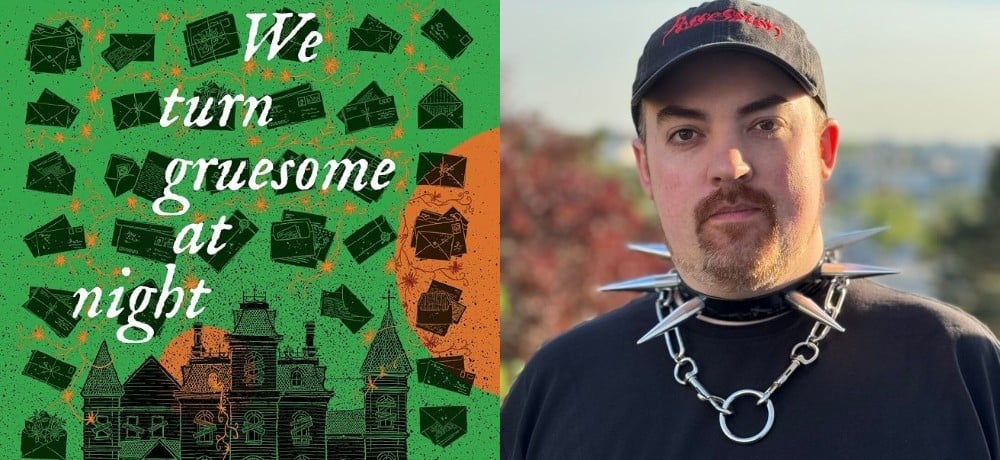
[Editor's Note: This week sees the release of Eric LaRocca's We Turn Gruesome At Night, "the nightmarish second installment of a new trilogy of provocative, disruptive and brutally poetic queer horror set in a small New England town." We're excited to have Eric LaRocca contributing a guest editorial for Daily Dead readers, discussing why horror fiction should never feel safe!]
Horror Fiction Should Never Feel Safe
By Eric LaRocca
Over the past few years, the horror genre has been completely revitalized due to a growing interest from the public and thanks to published works from up-and-coming talents who venerate and respect the sophistication of the genre. While many still dismiss horror as offering nothing more than edgelord shock value or cheap thrills, there are countless professionals in the literary landscape who see the exhilarating potential to analyze and dissect uncomfortable social truths through the lens of horror. Despite this much-needed abundance and the recent success of the horror genre, so many of the books that come across my desk feel neutered or declawed in some way. So many read as though the author is hesitant to be messy or unhinged. Of course, there are still plenty of authors operating in the literary landscape who write raw, unflinching, and alarmingly disturbing horror fiction. Regardless, it unsettles me to think that there are so many authors and large, prominent publishers fearful of offending readers, reluctant to address more complicated issues with their work, perhaps somewhat cautious to be ‘cancelled’ for showcasing the more depraved, the more batshit and unhinged.
There are many times when I’m asked to blurb a book and so much of its content feels redacted or, even worse, censored in some form. I find it increasingly difficult to locate truly depraved, unsettling works of horror fiction. I’m not explicitly talking about work that will frighten me or compel me to routinely check the locks on my doors during the nighttime. I’m quite desensitized to most scares, to be perfectly honest. However, the thrill I’m referring to has more to do with a certain level of discomfort, a pronounced feeling of uneasiness or dread that the horror genre accomplishes so well when executed at its best. I miss reading literature written by authors who I’m sure must be on some sort of government watchlist because of their browser history. Too much horror fiction published today feels disinfected and comfortable. I presume this is chiefly due to the fact that many publishers are hesitant to offend readers and, more worryingly, are fearful of the major book retailers not agreeing to stock the books.
Despite these distressing concerns, I find myself desperate to engage with problematic, messy, complicated art. Horror should never feel safe or comfortable for the reader. The horror genre truly thrives when it feels forbidden or off-limits in some way. There’s such a thrill to be savored when you’re reading a work of fiction and you feel unsafe, worried that you, yourself, have transgressed or committed some form of depravity just by reading this book. I’m currently reading a debut novel called Hedgehog by Maggie Koons and it is undoubtedly one of the most unflinching, difficult, and downright unpleasant books I’ve ever had the honor of savoring. Where’s this energy? Why aren’t more horror books eager to go for the jugular? Why does everything feel so sanitized and antiseptic?
If I’m being totally truthful, most of the authors I genuinely admire who are writing some of the most unhinged, depraved fiction only exist in the small press space. I can immediately think of two writers in particular who never shy away from messy, uncomfortable truths: Jess Hagemann and Emma E. Murray. Hagemann’s Mother-Eating is one of the most disturbing, nasty books I read last year. Additionally, Murray’s Shoot Me in the Face on a Beautiful Day is an uncompromising and truly disturbing examination of obsession and decay. Of course, that’s not to say that there aren’t literary mavericks writing subversive work at the larger presses. I immediately think of Alison Rumfitt and Alex Gonzalez. Rumfitt’s Brainwyrms is vile and grotesque while Gonzalez’s debut novel, Rekt, is overwhelmingly distasteful in the best way.
Despite the exciting work of these literary nonconformists, it’s only a small fraction of a larger publishing community where in so many books it feels like the true horror is happening offstage (or sometimes not at all). That’s not to say that I cannot appreciate the proverbial ‘what you don’t see is often scarier than what you do see;’ however, I typically find myself so starved for the confrontation, the emotional upheaval of a truly unhinged novel. As I look to the future of publishing in the realm of horror fiction, I hope artists feel more liberated to be as perverted, as kinky and problematic as they wish to be. I truly believe the horror genre only thrives when we’re allowed to be kinky little freaks.
---
About the Author:
"Eric LaRocca (he/they) is a three-time Bram Stoker Award finalist and Splatterpunk Award winner. He was named by Esquire as one of the “Writers Shaping Horror’s Next Golden Age” and praised by Locus as “one of the strongest and most unique voices in contemporary horror fiction.” LaRocca’s notable works include Things Have Gotten Worse Since We Last Spoke, Everything the Darkness Eats, and At Dark, I Become Loathsome. He currently resides in Boston, Massachusetts, with his partner."
About Burnt Sparrow Book 2: "We Turn Gruesome At Night":

![[Guest Article] Maggots On Your Body Of Work: Clay McLeod Chapman On Finding His Own Muses](https://dailydead.com/wp-content/uploads/2026/03/Bodies-of-work-1000-180x83.jpg)
![[Editorial] AI of the Living Dead: Why Have So Many Already Accepted the Simulation?](https://dailydead.com/wp-content/uploads/2025/09/M3GAN-180x83.jpg)