




It's easy for Aliens fans to gravitate toward the human characters of the film, but that's because James Cameron, Stan Winston, and many others behind-the-scenes did such an excellent job making the Xenomorphs look and move completely alien. While there were multiple people involved in bringing the Xenomorphs to life, including multiple people in suits during select scenes, there's only one credited "Alien Warrior," and that's Carl Toop. His story is incredible: from an audition where the odds were significantly against him to taking part in some of the movie's most iconic moments, Toop is the man in the monster suit, whose performance still thrills and terrifies audiences, and he shared his stories with me in celebration of Aliens' 40th anniversary:
I wanted to start at the beginning. When it came to auditioning for this role, did you know the part that you'd play, and were you familiar with Alien?
Carl Toop: Well, I'd seen Alien. I was at a dance college, and we'd all gone out for one evening to the cinema to see Alien, which I thought was fabulous. It was a real shocker. And then I'd gone all through college and started working in theatre [and] television in the West End in London. I was doing a play in the West End by Tom Stoppard, a playwright, and I was doing wire work in that, flying across the stage, doing this wire work as an astronaut. My agent phoned up and said, "Well, they're looking for someone who could do wire work for a film, Aliens."
But it just didn't click to me that it had anything to do with the first one... I'd just gone and forgotten [about it]. I thought, I'm a young dancer, needed the work, and got to pay the rent. So me and a friend of mine went along to the audition at Pinewood. We walked in and there are 200 other people there. Wow!
That must have been quite a competitive audition.
Carl Toop: It was nice to visit Pinewood. We just mucked in and they got us all together and they said, "We want you to move like an alien."
None of us had a clue what we were doing. It was chaos. Everyone's doing these weird moves, and I was a dancer, so it helps [being a bit more] agile. I actually got into the next group to go along for the next audition, and we did about four auditions in all.
We didn't really know what we were doing. We were just interpreting our idea of how an alien would move because we weren't doing it in costume. We were just doing it in our rehearsal gear. They weren't suggesting movements to us or anything; it was just putting us in situations, saying, "Soldiers are charging at you. What would your reaction be?"
So you're just ad-libbing most of the time, and it obviously worked. They did ask us to go up on wires really high on the scaffolding. We were told at the beginning they wanted about 13 of us, but we got to the last audition, and they said, "With the budget and everything, we only need one now."
So we all looked at each other and thought, "Well, that's it... It's not going to be me." They said, "You can go home now. We'll let you know." And I got home and, literally 10 minutes after I'd walked through the door, my agent phoned up, and he said, "The job's yours."
It was an amazing experience just to do the audition, but, then, to actually get it, was one of the best days in my career, being told I was going to be working on a Hollywood film in London.
What an amazing story, especially since they originally wanted to cast so many aliens and then it was down to just one. You must have really impressed them with your wire work.
Carl Toop: They're getting the main actors in, then they're getting the fees for the studios, and all [these expenses] were coming in... the budget was going down and down. And they obviously realized that they could do the alien scenes with one main one, which was me. I was the main single shot, and, if it was a group of us, it was a few of the stuntmen who were brought in... some of the people who were working with Stan Winston on the costumes. It was a great experience.
Can you talk about your first impression of the costume when you got a look at it? What was the process for becoming an "Alien Warrior"?
Carl Toop: I had my own dressing room. I walked in and there were about six bodysuit costumes hanging up. They were just limp Lycra costumes with rubber stuck on them and I wasn't very impressed. It just wasn't my idea of what the alien character was going to look like. But then they had other things: a strap-on backpack with the pipes out of my back, and then they had the feet, and the hands all hanging up. The head was impressive because it's over a meter-long and the detail work in it was amazing.
When they put the costume on, first [it was] just the Lycra body suit, then they strap on the back strap with the pipes, then the ribcage to see how I could get my movements in that. And then the feet would go on; the feet obviously had two feet bigger than my own feet, and the same with the hands.
And so you're learning what the movements were available to you [with those pieces], and then, eventually, they put the head on that. That just sets the whole thing off because I had a mirror in front of me, and, once the head went on, you just go straight into character. It just brought the whole thing together. Whereas before, I just had everything else on with just my head sticking out and it just wasn't working for me. But once I got the head on, it was magic.
Then I worked with the guys like Tom Woodruff, Jr., who was working with Stan Winston. We worked together and they were helping with some of the movements because they'd obviously been working with the costume when they were developing it. I suppose we spent about a week on the costume, learning how it moved, and Stan Winston would come in and check that there's no rubbing parts when I was moving. So they were always there to make sure that the costume was comfortable and movable.
Can you talk about the first time that you filmed on camera, and what was it like bringing the Alien Warrior to life?
Carl Toop: What really hit me was when I was in my costume, they walked me onto set, and they put the head on. Just before they put the head on, Sigourney Weaver comes onto the set as well, because they called us all at the same time. And [Weaver] is my boy school crush, and she has just walked on the set with me. I'm like, "This is just unbelievable." So I'm a bit dumbstruck, and no words even wanted to come out. So that for me was like, "Right. Okay. We're getting serious now. They're not playing around. This is the real thing."
She comes over and says, "Hi, I'm Sigourney Weaver. It's nice to be working with you and hope it all goes well." We spoke afterwards, but that was my first moment on set and she just happened to be there and we walked on at the same time.
And filming, you probably heard this a lot of time, it's long. It's a lot of setting up the scenes, and you've got the actors there rehearsing, and then they get me to do a few movements to see where James Cameron wanted me to end up. So the day's pretty laborious; it's not as exciting as it looks on screen. But it was an eye-opener because I'd worked in television, which is completely different from a film set. I was doing mostly live television and you had to get it right straight away. You did have to get it right straight away with James Cameron, so if there was a mistake made or something needed to be adjusted, it could be done. That was quite a luxury to have when you're doing the film sets.
I learned so much watching them all deal with each other. You got Sigourney Weaver, who you'd never have known she was a huge star the way she treated everyone. James Cameron just wanted the most from everyone and he managed to get people to give their best. So it was a whole learning experience for me, seeing how to get the best out of people, how to work with people, and how to make it all come together for everyone.
And I appreciate the people behind-the-scenes, the ones we don't see; they're the ones that are doing the crazy work. We just walk on and we're told what to do and we do it. They're having to improvise a lot of the time. I'd have costume failures and they would sort it out. Things on sets would fall down and they'd be straight there sorting it out. We're doing our job, but the work they do, the lighting and everything... without them, these films wouldn't mean anything. And when you're actually doing the film, you see how much time is spent preparing.
Yeah, we call it movie magic, but hundreds of people are making that "magic" happen.
Carl Toop: It's a machine, and this seemed to be a well-oiled machine because James Cameron was fairly new to it, and Stan Winston had been going a few years, but everyone just worked together and it just seemed to roll on. And maybe there were problems behind-the-scenes that we didn't know, but they didn't let us see that. There were a few problems, but they were things that sorted out straightaway.
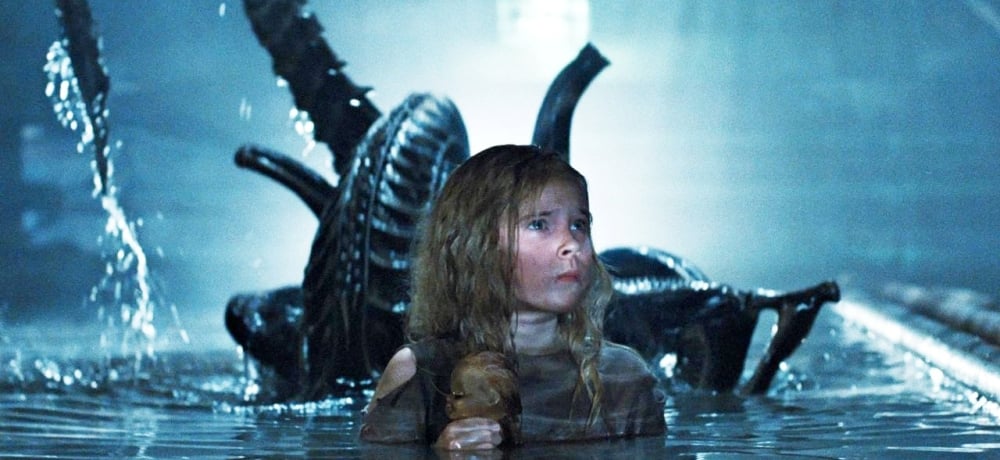
One of the most iconic Xenomorph shots in the franchise is when you get out of the water to grab Newt. Can you talk about filming that scene? I understand there were some technical challenges initially.
Carl Toop: That was a costume problem because we didn't rehearse. With my scenes, it was just, "I want you to go there and go here. Move how you think [you should], and if it's not right, we'll do it again." So for the water scene, everything was nice, heated water. I got into the pool, and was talking to Carrie, who played Newt, getting her used to the whole space and getting used to me being in the water with her. Then they'd be setting up the lighting, but they didn't actually practice me going down into the water.
So everything was set up and they said, "We want you to go down and, when James Cameron taps on the side of the pool, you come up and you go as if you are going to grab Carrie."
So, obviously, the water's only about two and a half foot high because of Carrie, so I had to lie down horizontally to get my whole costume down because I had the pipe sticking out and my head and everything. So I had to go down and lie horizontally on the bottom of the pool.
And then I hear that James Cameron, because they had to let me go down, let the water settle so there was no idea of anything behind Carrie, just the dripping water coming down. And the tap on the side of the pool comes along and then I couldn't get up. The whole of the headpiece had just filled up with water, and because I was in a position where my arms were stuck in front of me, I really couldn't get around to push myself up. With the weight of the head in the water, I was just blocked down there.
It must've taken them about another 40 seconds to realize it's a problem... I'm not coming up. So they did eventually send someone in and managed to lift my head up and get me up standing. Then, they did cut a side in the helmet so there was no pressure created. If they hadn't realized on time, it could have turned into something serious because I was panicking as well. It seemed like ages I was under there, but it wasn't that long. But after that [issue], we did the scene, and it just worked out really well with Carrie screaming. She's a good screamer.
Do you have any other memorable interactions with the cast? I know you mentioned Sigourney Weaver, but any of the other cast members?
Carl Toop: We didn't really mix because I was usually on the side of the set in my scene, and they were on set doing their action. Then, I'd be called on to either be shot at or dragged up or blown up. But most of the interaction I had was if we had a break at any point, and they would allow me sometimes to take my head off. It was quite rarely, actually. Ricco [Ross] remembers me because I used to smoke in those days. So I had the head off and I was standing by the studio door dressed up as an alien with my head under my shoulder, smoking a cigarette. And Ricco remembers that one.
And [I remember] Bill Paxton, because he said, "Have you eaten today?"
And I said, "Well, no, I can't really eat in this [costume] because if I do eat, I need to go to the bathroom, and it's not a good idea."
He said, "Hang on, hang on." So he rushes off to the canteen, and he comes back with a cheese roll. He said, "Just munch on this and just eat what you need to eat." And he was feeding me because I had my [Alien Warrior] hands on, so I couldn't do anything. So Bill Paxton's feeding me a cheese roll... that was pretty memorable.
They were all quite young actors and, a lot of them, it was their first film as well, like me. So we were all doing our best, all being very eager. But you have people, like Bill Paxton, who had been working a lot, so they were more used to it. But you had Ricco, Jenette, Mark, William... they're all fairly new, but they were a great team. There was a good atmosphere and there was no nastiness at all.
Yeah, that's what it sounds like, and I love that story about Bill Paxton.
Carl Toop: Yeah, he was just a character; he was great. It was just a cool crowd, and we're all still friends now. I hadn't been doing the convention scene at all, and they'd been carrying on because they were in the States. I didn't even know the convention scene existed, and the first one I met from the cast was Jenette; I did a film festival down in Spain and she was there as well. It was the first time I'd seen her since the film, but it was just like we've seen each other yesterday. The feeling was there straightaway. And then when I started doing the convention in the States, I met the others, and they just took me in. So that friendship carried on, even though we hadn't been in contact. They allowed me into their hive.
And there are so many opportunities to stay in touch since the cast is hitting conventions regularly for the 40th anniversary.
Carl Toop: My first one I did was in Germany. I was on my own, and I just didn't understand the whole thing. Then once you start talking to people, [you understand] that the film, my character and the other characters, had an effect on their life and it's amazing. Some people watch Aliens once a month, once a week. It's amazing how it's touched people in so many different ways. And the conventions allow everyone to come to these places and be themselves. Everyone is just there for a good time and I think they're great.
I've told people it opened my mind to making movies, creating movie monsters, and understanding all of the work that goes into making a film.
Carl Toop: Aliens was one of the last films without CGI, and I think the young kids now are saying, "You actually did that?"
And we're like, "Yeah, we didn't have computers in those days or graphic designers to redo the scene for us. When I'm getting fire thrown at me, fire's coming at me."
It's amazing and that's why Alien: Romulus did reasonably well: Even though they used CGI, there was the old-style way of filming coming back. Younger people saw that and I think they appreciate that. That's why Aliens has lasted so long. There may be a few things that don't look quite right, but the film does pretty well after 40 years.
New audiences are still discovering Aliens every day.
Carl Toop: We get three generations coming along now. I've got the grandparents, the parents, and now the kids, and it's just being passed along. It's rewarding for everyone that was involved in the film because it's created part of cinema history and it's an honor to be a part of that. I didn't set out to do the film work; my passion was dance, so to be able to be a part of that film is just a real bonus. It's a gift. It really is.
---
Headed to San Diego Comic-Con? You can meet Carl Toop in person! To keep up on the latest from him, including details on his appearance during SDCC, visit him on Instagram: https://www.instagram.com/carltoop.alienwarrior1986/
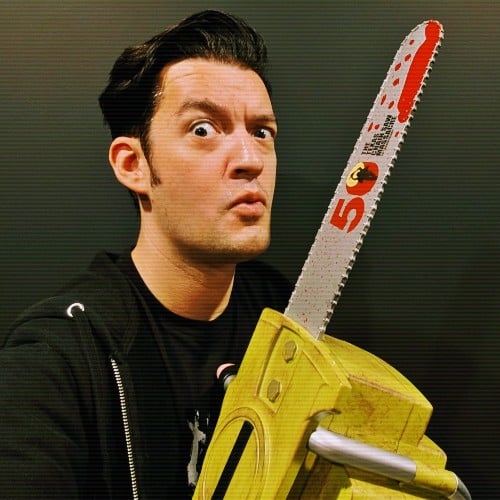
After more than a decade as a consultant in the entertainment industry, Jonathan James launched Daily Dead in 2010 to share his passion for horror. He takes immense pride in Daily Dead's talented team of writers, who passionately explore and celebrate horror as a respected art form capable of telling complex, character-driven stories with deep emotional and cultural impact.
Over the course of his career, Jonathan has written more than 10,000 articles and hosted panels at major conventions, including New York Comic Con and San Diego Comic-Con. He is also consulted with as an expert on horror and pop culture, offering insights on horror history and the latest trends through media outlets, film festivals, and conventions.
After more than a decade as a consultant in the entertainment industry, Jonathan James launched Daily Dead in 2010 to share his passion for horror. He takes immense pride in Daily Dead's talented team of writers, who passionately explore and celebrate horror as a respected art form capable of telling complex, character-driven stories with deep emotional and cultural impact.
Over the course of his career, Jonathan has written more than 10,000 articles and hosted panels at major conventions, including New York Comic Con and San Diego Comic-Con. He is also consulted with as an expert on horror and pop culture, offering insights on horror history and the latest trends through media outlets, film festivals, and conventions.







![[Guest Article] Maggots On Your Body Of Work: Clay McLeod Chapman On Finding His Own Muses](https://dailydead.com/wp-content/uploads/2026/03/Bodies-of-work-1000-180x83.jpg)
![[Editorial] AI of the Living Dead: Why Have So Many Already Accepted the Simulation?](https://dailydead.com/wp-content/uploads/2025/09/M3GAN-180x83.jpg)