







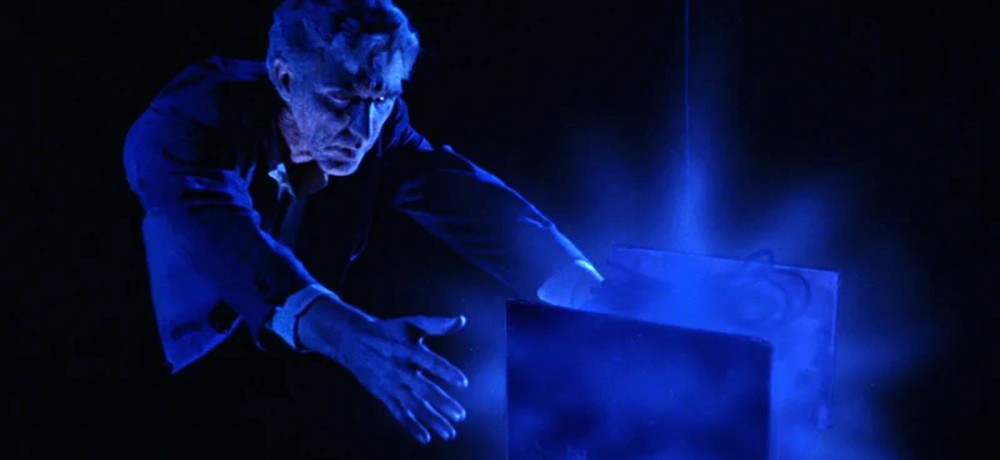
The world is made of smarter brass than me, so I prefer my sci-fi reading and viewing simple and direct; I will watch your time travel movie and its ilk and like it, but that doesn’t mean I know what the hell is going on. Well, roll out the red carpet for 4D Man (1959), a light on its toes, smooth adaptation of “man plays god, man eats shit," a horror truth born of Mary Shelley. It’s modest fun with good effects, solid performances, and a jazz score that’s outta sight.
Released in October by Universal-International, 4D Man was a moneymaker for producer Jack H. Harris and director Irvin S. Yeaworth Jr.; the previous year’s The Blob was a hit for the pair, and this one followed suit with a smaller margin. Critics applauded the special effects and the effective score, and audiences did the same. Deeper than the third dimension but less groovy than the fifth, 4D Man offers up easy pleasures to casual sci-fi watchers and soap opera lovers alike.
Dr. Tony Nelson (James Congdon) sits in a lab and works on his science project to push one solid object through another with an electronic amplifier; we know this because his very own narration tells us. It’s also discarded after the opening.
That’s because Tony now has people to talk to! After he burns down the lab and is naturally fired, he goes to stay with his older brother Scott (Robert Lansing), a scientist working with radiation on a material called Cargonite, supposedly the densest mineral ever created. (I know you know where this is going.) Scott introduces Tony to his assistant Linda Davis (Lee Meriwether); Tony is immediately smitten, which becomes a big problem when Scott tells Tony he is going to ask her to marry him. Crucial old-school staple: the smart girlfriend (associate, fiancé, wife) is sometimes a wedge between two jealous and idiotic males; unfortunately most female roles at the time in sci-fi were given little agency, leaving the women as little more than plot devices. (That doesn’t stop Lee Meriwether from making an impression, believe you me.)
And that’s all that Scott needs to send him over the edge; his radiation headaches mixed with his brother’s amplifier causes Scott to become 4D and pass through solids with minimal effort. It also ages Scott rapidly; a few moments in the 4D state (accompanied by a whirring synthesizer sound that must have been reused for the Star Trek transporter) makes his hair whiten and his skin wrinkle evermore each time.
His jealousy fuels his actions here on out; fifty thousand dollars goes missing from the local bank with no signs of forced entry. Scott gets revenge on those who’ve wronged him with a touch and steals their lifeforce, which he needs to recharge or he himself will grow old and die. Tony and Linda team up to try and stop Scott’s path of destruction, but will they be too late?
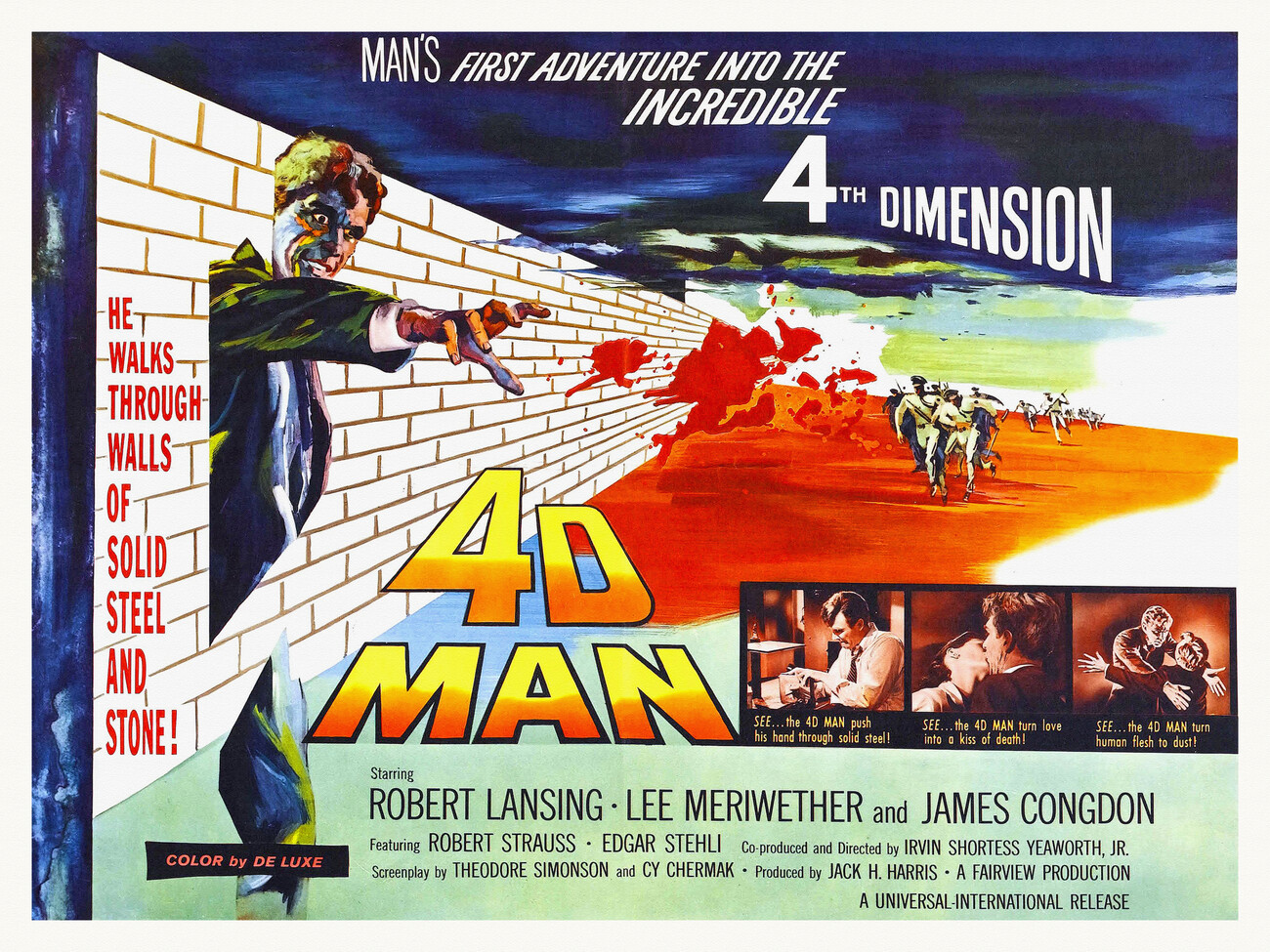
4D Man is a film “of its time,” as the hoary saying goes, but that doesn’t mean it shouldn’t be enjoyed as such. In fact, let’s lean into it. Sometimes we automatically assign weight to these older films (okay, I do for sure), making them seem more culturally relevant than they actually were at the time just by virtue of being there.
This is to say that the distinctions between an A-lister like Them! (1954) and this comes down to the budget and its distribution throughout production; locations versus sets, large cast versus small, grandiose versus intimate. The same ridiculous science takes place in both.
That smaller stature is part of what I like about 4D Man; Scott is just a man whose hubris blinds and binds him to eternity. Seems to be the gist anyway, metaphysical mayhem with a dash of cosmos thrown in; what happens in between dimensions isn’t as important as how it does visually.
The effects are very good for the era and hold up today. There’s no danger of Blob-by, blood-red beach balls breaking the mood; again, the smaller scale offers smaller optical illusions that don’t draw as much attention to the string-pulling due to the size. The biggest trick Scott does is walk through walls (and fences!), so spectacle isn’t witnessed as much as consistent competence, which in low-budget terms is just as valuable.
So the cast are given the task of filling in around the fantastical moments, and acquit themselves well. This was the screen debut of both Robert Lansing and Lee Meriwether, and they make strong entrances to celluloid. Lansing was coming from Broadway and anthology TV shows and Meriwether was a recent former Miss America; they’re quite commanding, even if Meriwether is given less to do (but does well) in a stereotypical role. Lansing would continue to take on horror parts–Empire of the Ants, The Nest, please take a bow–with his steely demeanor and towering presence, and was always welcome in the genre until his passing in 1994 from lung cancer.
The film also benefits by upping the characters from teens to adults, graduating from drag races and blowing stoplights to fighting guys in bars to impress women (shadows of 1986’s The Fly) and growing rage at one’s lot in life. Scott is still a young man at thirty but feels his life is over due to his controlling boss and the unreceptiveness to his marriage proposal. You know, grown-up stuff.
When 4D Man came out, the Beat Generation and Jack Kerouac were still riding high on their writings of wanderlust and sexual liberation, and the decadent jazz score promotes hipness and degradation while really offering up a conservative view against liberation. (Toe the line, Scott, and you’ll go far.) It’s unobtrusive and lively, and if it got some teens in the seats to watch a man walk through walls, that’s just good marketing. (And essential for the modest-budgeted.)
Sci-fi in the 1960s would continue to explore the anxiety behind atomic energy and annihilation as a species through many zippered costumes and larger stakes. 4D Man makes a case for great (or good) things coming in small, radioactive packages.
4D Man is available on Blu-ray from Kino Lorber.
Next: Read Earlier Installments of This Series!
Scott Drebit lives in Calgary with his wife. He has written for Daily Dead since 2015, and in 2024 he released his first book, A CUT BELOW: A CELEBRATION OF B HORROR MOVIES, 1950s-1980s, through McFarland Publishing.
Scott Drebit lives in Calgary with his wife. He has written for Daily Dead since 2015, and in 2024 he released his first book, A CUT BELOW: A CELEBRATION OF B HORROR MOVIES, 1950s-1980s, through McFarland Publishing.