


Takashi Yamazaki holds the antidote to sequelitis: Godzilla Minus Zero. I can’t stress how taken I was by Godzilla Minus One, rating it a near-perfect 4.5/5 skulls for Bloody Disgusting. Yamazaki had so little room to rank higher by critical terms, yet here we are, with my first five-star review of 2026. I sat there in jubilant awe. Yamazaki goes even harder on WWII allegories and family drama that sell like gangbusters—but never forgets the Kaiju excitement. IMAX could barely contain Godzilla’s atomic blast, as Yamazaki’s continuation overshadows its predecessor with a dominating roar.
It’s been two years since Godzilla’s remains sank in Sagami Bay. Hero pilot Kōichi Shikishima (Ryunosuke Kamiki) has wed Noriko (Minami Hamabe), and, together, they raise orphaned cutie-pie Akiko (Sae Nagatani). Kenji Noda (Hidetaka Yoshioka) is director of the Large-Scale Disaster Response Bureau, overseeing postwar Japan as it strives to rebuild. But the threat of a new flying Kaiju dubbed “Ghidorah” sends the bureau scrambling to respond. Noda enlists biologist Kanji Murakami (Min Tanaka) and meteorologist Makoto Aoyama (Masami Nagasawa) to defeat Ghidorah, but every offensive strategy fails. Then, when hope seems lost, Godzilla resurfaces bigger and badder—the only answer to Ghidorah’s apocalyptic threat.
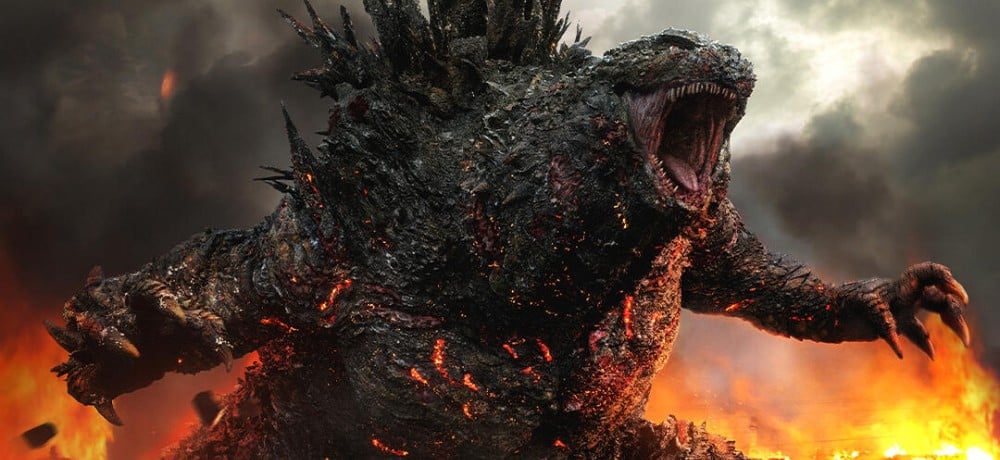
Ghidorah's introduction sidelines Godzilla until the third act, but that’s never a problem. If Godzilla Minus One portrayed Godzilla’s destruction of Ginza as a Hiroshima parallel, Godzilla Minus Zero is about the tragic aftermath. Kōichi and Noriko preserve Akiko’s innocence as much as possible, sifting through rubble for even a morsel of hope. Or there’s the elder Kanji Murakami, who lost his family to America’s nuclear strike on Japan, and harbors vengeful fantasies about redirecting Godzilla’s attacks onto American soil. Yamazaki weightily wades into the dire realities of postwar Japan, confronting grief, resilience, nationalism, and rage as Ghidorah restarts the cycle by trashing surviving territories.
Godzilla Minus Zero never feels like a retread; everything is amplified. Ghidorah’s aerial acrobatics lead to mesmerizing dogfights as Noda sends Kōichi airborne once more, where strategies and formations are crucial to evade this skybound behemoth with a golden pulse beam. Or there’s the unbreakable bond between Kōichi, Noriko, and Akiko that had me blubbering every time wee lil’ Akiko shouted, “Have a safe trip!” with all her lungs, a magical mantra she believed would bring daddy and mommy home unharmed. Then there’s the American scumdoggery of it all: offering warplanes to be flown by Japanese ranks because not my country, not my problem (ahem, at face value). These are the elements that sell harder: Kanji’s heartbroken mad scientist, Makoto’s prophetic weatherwoman, Noda’s regretful orders.
Yes, it’s still a Godzilla movie. But without grounded stakes established by ant-sized civilians, investment has a ceiling. Play Rampage World Tour if you want a metropolis beatdown experience. Godzilla opens the door for Yamazaki to instigate conversations about historical trauma, and he does not miss his shot(s), in the words of Lin-Manuel Miranda.
Academy Award-winning visual effects artist Kiyoko Shibuya returns alongside Takayuki Ueki and Eishin Okubo as supervisors, overseeing outstanding VFX by returning company Shirogumi. It’s not just how seamlessly Godzilla Minus One stages a Kaiju throwdown, as Godzilla and “King Ghidorah” violently smash, thrash, and tear muscle from bone atop Ginza’s ashes. You can count water droplets as Godzilla splashes above the ocean’s surface, or revel in the neon-blinding blasts from each monster’s core. Sequences with meticulous detail—like Kōichi's jaw-dropping flythrough of a village suspended in midair by Ghidorah’s antigravitational wrath—are unseen VFX gems. The massive-scale brutality of Godzilla and Ghidorah's gory battle demands more effects shots than entire US studio productions, and in mere minutes. Godzilla Minus One won gold at the Oscars, and Godzilla Minus Zero raises the bar; make of that what you will.
“But Godzilla’s off-screen for so long, is Yamazaki’s sequel REALLY a Godzilla movie?” Yes. Aggressively, and unequivocally, Godzilla Minus One not only enriches the scaly giganticus’ legacy, but Yamazaki dares any incumbent filmmaker to snatch the throne. The sci-fi tapestries he paints, the reactions his storytelling provokes, and the universal appeal he generates by supercharging Godzilla’s deeply Japanese roots are sensational. American cinema could never, because Roland Emmerich’s Godzilla proved that action-first, blockbustery thrills aren’t what serve the title creature best. Without the foundation Yamazaki lays in terms of locational importance and communal uprisings, Godzilla has nothing substantial to topple. Yamazaki is the Godzilla whisperer, and I hope he makes twenty-five more of these for Toho.
I can’t stress how much I loved Godzilla Minus One, or how flabbergasted (and overjoyed) I am to report número dos only gets better. Godzilla Minus Zero is a gargantuan sequel that blows other kaiju competitors out of the water; an inciting and insightful smashterpiece that is loads more than architectural carnage. Yamazaki takes his time crescendoing to the heavyweight finale we know is coming without losing meaning or momentum. I never really use this phrase because all movies should be watched in a theater when possible, but truly, Godzilla Minus Zero is made to be seen on the biggest screen possible with an excited crowd.
Movie Score: 5/5

Matt Donato is a Los Angeles-based film critic currently published on SlashFilm, Fangoria, Bloody Disgusting, and anywhere else he’s allowed to spread the gospel of Demon Wind. He is also a member of the Critics Choice Association. Definitely don’t feed him after midnight.
Matt Donato is a Los Angeles-based film critic currently published on SlashFilm, Fangoria, Bloody Disgusting, and anywhere else he’s allowed to spread the gospel of Demon Wind. He is also a member of the Critics Choice Association. Definitely don’t feed him after midnight.