



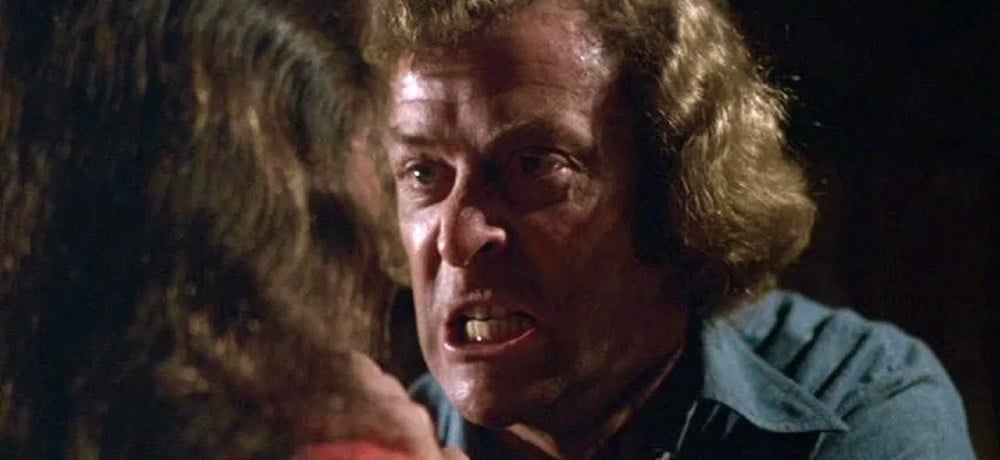
The Hand (1981) is the third Michael Caine “paycheck” movie that I’ve written about, after The Swarm (1978) and The Island (1980). (I promise I’ll never write about Jaws: The Revenge.) These are the films that Caine would take on with financial consideration in the forefront and artistic liberation buried at the back of the crowd; according to Caine, this film paid for a new garage. I’m a fan of these, naturally; his horror output is never less than entertaining, and occasionally they have something to say about the human condition. The Hand seems intended to explore the loss of creativity and how that can drive someone crazy without that outlet. It does do that, but it’s ultimately overshadowed by a landfill of misogyny courtesy of writer/director Oliver Stone. The Hand is a lot of B-movie fun, a fascinating study of man’s acridity towards women, and a showcase for an unjustly ignored Michael Caine performance.
The Hand was the second directorial effort from Stone after 1974’s Seizure, a weird, shambolic horror film. He was coming off winning an Oscar with his screenplay for 1978’s Midnight Express, and got another chance to direct. Despite a wide release by Orion Pictures through Warner Bros., The Hand was not a commercial or critical success, although Vincent Canby of The New York Times liked it. I think it’s worth the price of a new garage.
The film opens in lovely Vermont, where successful weekly cartoonist Jon Lansdale (Caine, sporting a curly pageboy ‘do) lives with his wife Anne (Andrea Marcovicci) and their eight-year-old daughter Lizzie (Mara Hobel). Jon’s cartoon strip Mandro is in its tenth year of Conan-like fantasy (the strips in the film were drawn by Conan artist Barry Windsor-Smith) and he’s happy with the status quo; placated wife, obedient daughter, solid career. This is Jon’s pov, with his Scotch-colored glasses blocking out most cries for attention unless it affects him; a heated car ride with his wife over her relocating to the city causes a car accident in which Jon loses his right hand in grisly fashion. (It’s a good accident too, staged well for maximum suspense by Stone.)
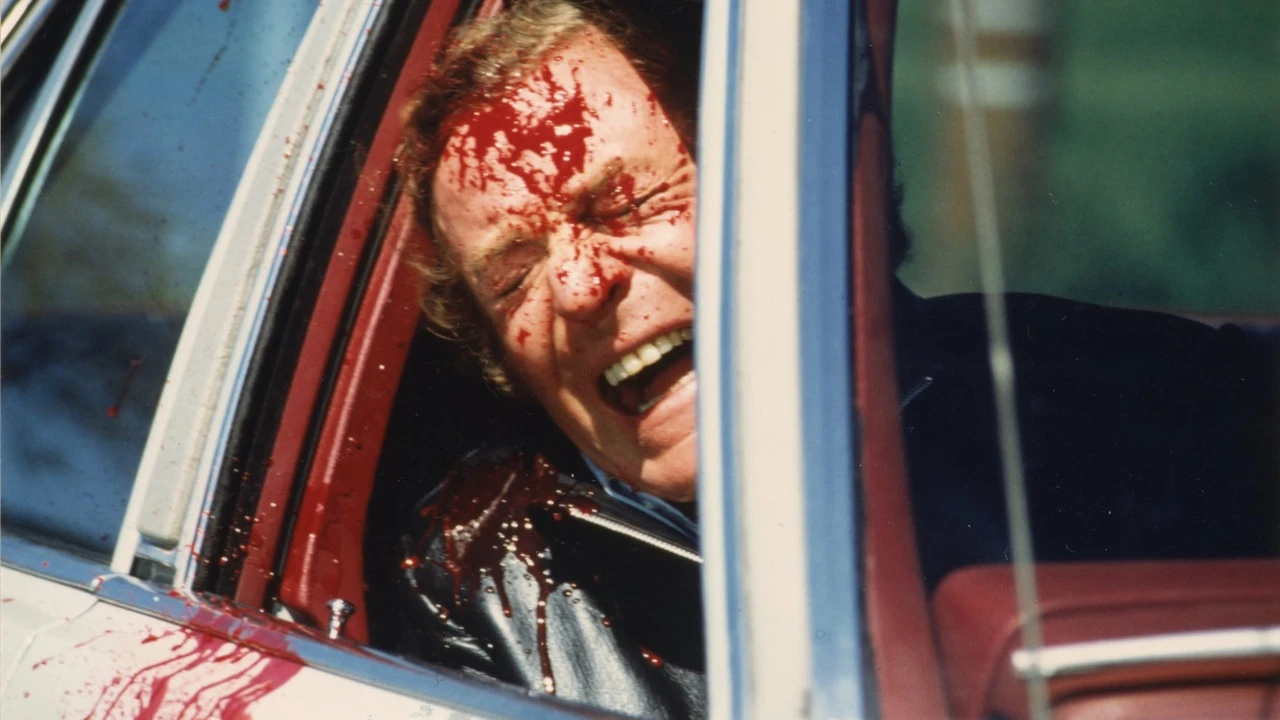
Without his drawing hand, Jon immediately turns within and lashes out at those who care; he reluctantly agrees to try out a new artist for his strip with venom practically dribbling from his mouth. The accident and subsequent fallout prompts the speedup of the marriage’s dissolution as he heads to Northern California for a teaching gig at a community college, and she takes classes at a combo yoga/spiritual institute in New York while connecting with its founder.
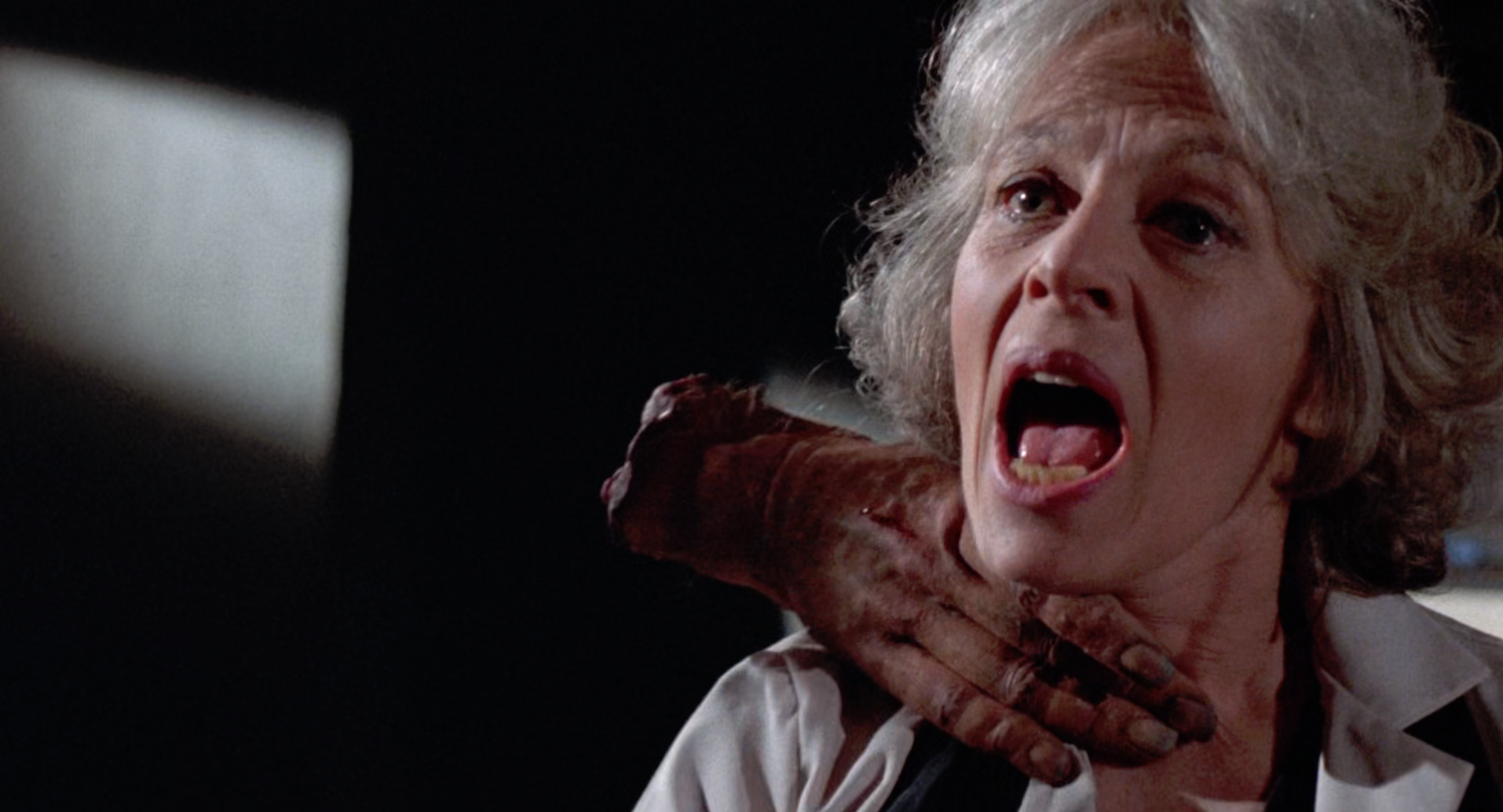
Meanwhile, Jon has started up a relationship with a student from his class, Stella (Annie McEnroe); she doesn’t seem to mind he’s missing an appendage and even likes his new robotic harnessed hand during sex. She may not be so willing if she knew that Jon has visions of his disembodied hand crawling through the grass, the streets, the house. And that he believes it’s alive and killing.
When Jon tells Stella that Anne and Lizzie are coming out for Christmas, she tells him that she’s going to Florida for a couple of weeks for school break. He thinks nothing of it, but finds out at the local watering hole that she’s going away with the psychology teacher (Bruce McGillis). Seething with jealousy, Jon must find and destroy the very thing acting out his darkest impulses. Jon must destroy… The Hand.
Don’t be fooled: Billed as a psychological thriller, The Hand is straight up B-horror that reaches back to The Hands of Orlac (1924 and 1960) for inspiration. In each version, a pianist loses his hands and is given ones from an executed murderer. This is where The Hand and The Hands of Orlac go off on their different paths; the latter deals with an outside force causing havoc, while the former’s enemy is from within, a wild id ride through the mind of Jon Lansdale.
Dealing with an external force has built in sympathies for the protagonist; this is happening to them. But The Hand would rather explore Jon’s rage, and how he reacts to losing his livelihood, his moneymaker. An average looking guy, Jon feels emasculated (right after the accident, he turns to Anne in bed, cries, and says, “it’s so ugly.”) without his hand; he can’t compete with Anne’s new fitness beau, and he holds little sway over his college fling, Stella.
Stone plays both ends; the film flips back and forth between Jon’s insanity causing him blackouts and committing the murders, or it’s causing him blackouts and the hand is killing all those who’ve wronged him. So: Are you voting psychological, or horror?
Oliver Stone wants both, so he offers both up, and I think it works way better as a character study than a shocking horror film; the jumps aren’t very jumpy, and to hear the hand breathing as it moves through the grass is enough to make a shark roar like a lion, I tell you. But as a journey inside the mind of Caine’s Jon Lansdale? It’s terrific.
It’s also fascinating; the story of an arrogant misogynist who feels morally above all is as old as the Hollywood hills, behind and in front of the screen. Jon’s hypocritical rage is always directed towards women; the only one he respects is his agent, his ally in his art. But because the film is seen through Jon’s lens we feel every ounce of hatred towards Anne for wanting a life, and his hatred towards Stella for living one. It’s not a light, fun, popcorn movie despite the B hook, and if Stone had leaned that way at all he may have had a hit. Or maybe not. The venom courses through the veins of the runtime, impossible to extract.
King Baggot’s (Gotcha!) cinematography has all the shadows in the right places and James Horner’s (the big sinking boat movie) music punctuates the terror with an old fashioned charm to go along with the constant thunder. The small cast allows everyone enough screen time to allow their characters’ opinions and thoughts to bounce off of Caine’s Jon; every performance feels natural and authentic.
And then there’s Michael Caine as Jon Lansdale. Smug from the start, Jon wants things his way always, isn’t amenable, and rarely shows signs of empathy. But Caine isn’t some impetuous hustler like William Shatner in Impulse (1974); Jon is more silent and sinister, his smile a vengeance laced with malice. The Hand is wrongly lumped in with his OTT performances like The Swarm because of the subject matter; how could you not expect him to go for the rafters?
Surprisingly, he doesn’t. Oh he looks it, with his flopsweat hair and wild eyes along for the ride, but Caine is a marvel of pain and anger that needs to be pushed down again and again until he loses the strength to resist. (And not much yelling either!) You won’t like Jon Lansdale at all, but he’s impossible to ignore and the performance goes a long way toward excusing Caine from the caustic words he says. After all, he’s just a guy looking to build a new garage.
The Hand is available on Blu-ray from Shout! Factory.
Next: Read Earlier Installments of This Series!
Scott Drebit lives and works in Calgary, Alberta, Canada. He is happily married (back off ladies) with 2 grown kids. He has had a life-long, torrid, love affair with Horror films. He grew up watching Horror on VHS, and still tries to rewind his Blu-rays. Some of his favourite horror films include Phantasm, Alien, Burnt Offerings, Phantasm, Zombie, Halloween, and Black Christmas. Oh, and Phantasm.
Scott Drebit lives and works in Calgary, Alberta, Canada. He is happily married (back off ladies) with 2 grown kids. He has had a life-long, torrid, love affair with Horror films. He grew up watching Horror on VHS, and still tries to rewind his Blu-rays. Some of his favourite horror films include Phantasm, Alien, Burnt Offerings, Phantasm, Zombie, Halloween, and Black Christmas. Oh, and Phantasm.








![[Guest Article] Maggots On Your Body Of Work: Clay McLeod Chapman On Finding His Own Muses](https://dailydead.com/wp-content/uploads/2026/03/Bodies-of-work-1000-180x83.jpg)
![[Editorial] AI of the Living Dead: Why Have So Many Already Accepted the Simulation?](https://dailydead.com/wp-content/uploads/2025/09/M3GAN-180x83.jpg)