



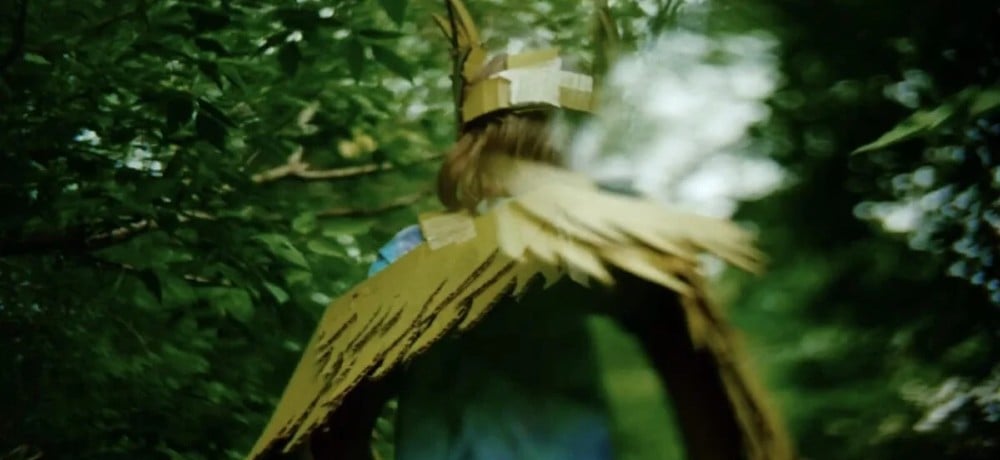
As a director (Let Her Out, Vicious Fun) and producer (Undertone, It Feeds), Canadian filmmaker Cody Calahan has built a career on scaring audiences. His world premiere at this year’s Fantastic Fest, Death of a Yellow Bird? A different flavor—a bona fide tearjerker. Calahan architects a big ol' grief-filled gut punch of a ghost story; familial trauma spills into shot-on-video clues that dredge up suppressed memories. It’s comfortably eerie, whisper-quiet, and meditates on death with such a supremely raw voice. Calahan wades into drama over damnation, and it’s an effective switch.
Ari Millen stars as an unnamed man who decides to cease his burdensome cancer treatments, choosing to pass on his own terms. It’s at his family’s snowy cabin where he tries to accept his fate and find peace in his decision, alone. But after a few visions, he begins to suspect he’s not by himself. Then he discovers old VHS tapes filled with playful recordings of him and his deceased brother (Danny), which become a medium for communicating with whatever presence sits down for kitchen-table chats. Slowly, Millen’s frail man solves the mystery of what his visitor wants, unlocking parts of his life that he’d otherwise forgotten.
Death of a Yellow Bird is overflowing with anguish, contemplation, and sobering revelations. It examines how our brains protect us from unpleasant events by filing away unsavory memories. Millen’s ailing lead is afraid of what could be the spirit of his father, flashing back to his agitated barks, but that’s merely a ruse. As the entity speaks through an outdated camcorder—distorted wavelengths like a digital demon’s mumbles—Millen’s led on a daunting yet freeing journey back to childhood. Remembrances of Danny escape their prisons; sickness be damned, Millen’s determined to bask in truths before he’s gone.
Calahan’s deftly in tune not only with the sorrows Millen’s protagonist faces, but also with life’s cruelty, showing unprecedented grace. Millen shoulders all the performance weight himself: the only other actors on screen are kiddo versions of Millen’s “Man” and Danny. Otherwise, the weakening patient has phone conversations with his fretting wife, fearing he might not return, or his chatty, dementia-addled mother who frequently misspeaks. It’s all so gutting, as Millen remains an anchor in loved ones’ lives, yet passes out at random when he’s so drained or slumps in solace, crushed by the weight of his circumstance.
And yet, Death of a Yellow Bird is caustically beautiful. Millen’s tiptoeing through scenes upholds Calahan’s restraint, matching the audible quietness that presents a cozy isolation. The film is a sensory experience that matches Undertone’s determination to weaponize silence, letting Millen’s battle with sadness linger and sting, while VHS tracking fuzz and warbly stereo sounds evoke the uncanny. Calahan’s ghost doesn’t seem malevolent, not like a trickster—only a few Paranormal Activity-like furniture flings confirm the invisible guest. Everything relies on audio pops, building suspense through playback answers to Millen’s probing questions.
It’s a verbal cat-and-mouse game; Calahan is far more interested in meaningful dialogues than cheap scares. Death of a Yellow Bird isn’t particularly subtle, and its narrative path is direct, but what thrives is this insurmountable sensation of loneliness in Millen’s actions. It’s very Sator, or Landlocked, or The Interior—broody, remote, and dark. The intersection of existence’s inescapable doom, human fallacies, and our psychological blindness to painful milestones is such a treacherous cocktail of themes. Thankfully, Calahan isn’t afraid of such depressive material, which, when handled compassionately, circles back to embracing the warmth that is mortality’s kiss of death.
However, Death of a Yellow Bird is too caught up in its approach at times. Give Millen all his flowers for carrying an entire production with his performance power; it’s no doubt deserved. But the description of “If Terrence Malick made a ghost movie” isn’t always praise. Heck, the title tells us where storytelling is headed in a pivotal moment. Calahan experiments with visual storytelling and the astral plane of retro technology, without making much noise. There’s a morbid wonder to the patient camerawork and shuffle-step pacing, yet the intentional mutedness of Calahan's execution can feel detrimentally slow.
Still, Death of a Yellow Bird is an artfully heart-wrenching venture into compelling unknowns. Death is terrifying and inevitable, yet Calahan finds a faintly fascinating parallel to A Ghost Story that does not overpower viewers with bad thoughts. Sure, on paper, the story sounds like the bummer of the year—and in some ways, it is. But Calahan’s motive isn’t to upset, and any tears shed in the final minutes are of tenderness and empathy. Truth is liberation; there’s nothing gained by fleeing from life’s scariest challenges. Grant Death of a Yellow Bird the chance to hug you close with those reassurances.
Movie Score: 3.5/5

Matt Donato is a Los Angeles-based film critic currently published on SlashFilm, Fangoria, Bloody Disgusting, and anywhere else he’s allowed to spread the gospel of Demon Wind. He is also a member of the Critics Choice Association. Definitely don’t feed him after midnight.
Matt Donato is a Los Angeles-based film critic currently published on SlashFilm, Fangoria, Bloody Disgusting, and anywhere else he’s allowed to spread the gospel of Demon Wind. He is also a member of the Critics Choice Association. Definitely don’t feed him after midnight.



![[Guest Article] Maggots On Your Body Of Work: Clay McLeod Chapman On Finding His Own Muses](https://dailydead.com/wp-content/uploads/2026/03/Bodies-of-work-1000-180x83.jpg)
![[Editorial] AI of the Living Dead: Why Have So Many Already Accepted the Simulation?](https://dailydead.com/wp-content/uploads/2025/09/M3GAN-180x83.jpg)