



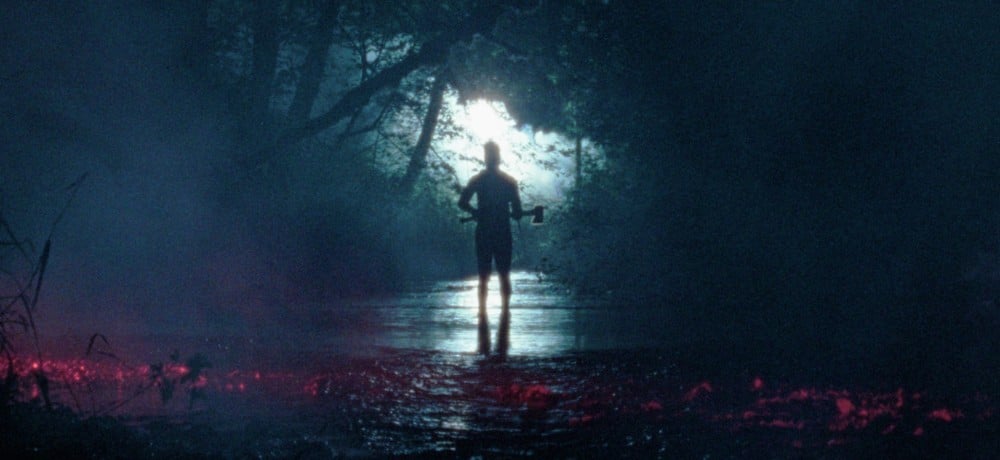
Hurt people hurt people; life is cruel and, at times, unfair. At their core, straightforward adages. In Adam Egypt Mortimer’s deliriously heartrending Pathetic Fallacy, they’re the impetus for karmic cosmic catastrophe.
Mortimer has never played safe and doesn’t start now. His latest is a music-driven existential breakdown in the key of sadness, manifesting grief and loss into a woodland purgatory filled with talking animals, exploding heads, and indie concerts. It’s raucously renegade, bizarrely addictive, and through punk-rock poeticism, reverberates the pain of being alive. Put simply, Mortimer’s best yet.
Scott Mescudi, aka Kid Cudi, and Jessica Rothe star as Asher and Iris, a storybook couple without a happy ending. After a montage of highlights depicting their boundless love for one another, Iris collapses into a seizure and is given a terminal diagnosis. After she passes, Asher is inconsolable. He stumbles upon an advertisement for Mount Samdi, a healing wilderness region with magical powers. Asher’s drawn to Mount Samdi, hoping to somehow connect with Iris again, but only finds a talking black widow spider (voiced by Natasha Lyonne) that offers one granted wish… at a cost.
Pathetic Fallacy is as subtle as a nail between your eyes. Iris’s ghost appears at random, wailing like a demon, “Let me go.” She wants him to move on; bottled grief is poison to our systems. Instead, Asher’s rage against a world that stole the only person he’ll ever love (by his thinking) drives him to Mount Samdi, where demons feed off his aggression. It’s so achingly human to cling to the past out of fear of what’s to come. Writers Andrew Barrer and Gabriel Ferrari aren’t here to say anything prophetic, and the film doesn't require grand epiphanies. Mortimer wants to languish in mortality and bask in the catharsis of communal suffering, if only to speak to the hardships everyone faces and let them know they’re not alone.
While thematic intentions may be bare, storytelling modes and visual representations are gonzo. Pathetic Fallacy is a chameleon watch: a touching romantic drama, a sleek music video, a Son of Sam slasher, a psychedelic hallucination. Lyonne’s sassy, sinister spider is only a sample of the weirdness that Asher encounters. A Refenesque landscape of Mandy-infused color filters meets The Color Out of Shape ethereality and spunky Benson & Moorhead-ass ideologies as devilish, red-eyed digital prairie dogs demand blood sacrifices. Asher’s bleary-eyed screams to the heavens about his lost lover juxtaposed against dive bar stage bands out of Scott Pilgrim vs. The World. It’s an in-movie universe seconds away from imploding, yet Mortimer keeps us sobbing, laughing, and captivated throughout, never losing touch with the connective tissue that binds eccentrics with soulful emotional glue.
Mescudi’s performance is our anchor; an audience proxy just as shocked by what unfolds. The profound misery in his grieving gives a valuable starting point—the reason he’s susceptible to any manipulations. Rothe is his glowing muse who’s granted a dual role as a glam-rock, darkwave-y singer later on, and you can see her light a fire in Asher every time she’s on screen. But it’s Mescudi’s playing of a tortured soul that meets Mortimer’s louder approach, whether that’s going to extremes to display how hurt people can indeed hurt others, or the befuddled gaze of a man seeking answers in all the wrong places. It’s why he ends up listening to Doyle (Travis Fimmel), a twitchy psychopath with numbed feelings, or holding a bloodied axe over a smashed-in corpse, buck naked, smiling like his brain was rewired by a backwoods villain.
Everything works to exploit notions of detachment from reality. Asher’s stuck in an R-rated cartoon and rolls with the punches because it’s easier than saying goodbye to Iris forever. Mortimer’s illustrations are vibrant, yet his material is morose, which does spiral into obscurity too far at times—and yet that’s the film’s charm. It’s an unwieldy fever dream of big reactions because life itself is as unwieldy and unpredictable. When I felt Pathetic Fallacy slipping away, a deeper commitment to identity reeled me back in. What almost feels like an assembly of skits begets a final package that meets the assignment.
Whatever you need Pathetic Fallacy to be, it is. There’s a comfortability the film fights that doesn’t give you answers, but holds your hand through the darkness put on screen. Love is so precious, and existence is so fickle. Mortimer isn’t here to say life is fair, or even to give answers about graceful behavior, but to artfully recreate what hopelessness feels like as a shared experience. With that, audiences come out on the other side having gone down that lonely path of self-isolation, armed with knowledge for the future. Pathetic Fallacy is beautiful and beastly, tragic and tender, but most of all, Pathetic Fallacy makes no excuses for trying to live, and the messiness of it all.
Movie Score: 4/5
Matt Donato is a Los Angeles-based film critic currently published on SlashFilm, Fangoria, Bloody Disgusting, and anywhere else he’s allowed to spread the gospel of Demon Wind. He is also a member of the Critics Choice Association. Definitely don’t feed him after midnight.
Matt Donato is a Los Angeles-based film critic currently published on SlashFilm, Fangoria, Bloody Disgusting, and anywhere else he’s allowed to spread the gospel of Demon Wind. He is also a member of the Critics Choice Association. Definitely don’t feed him after midnight.







![[Guest Article] Maggots On Your Body Of Work: Clay McLeod Chapman On Finding His Own Muses](https://dailydead.com/wp-content/uploads/2026/03/Bodies-of-work-1000-180x83.jpg)
![[Editorial] AI of the Living Dead: Why Have So Many Already Accepted the Simulation?](https://dailydead.com/wp-content/uploads/2025/09/M3GAN-180x83.jpg)