



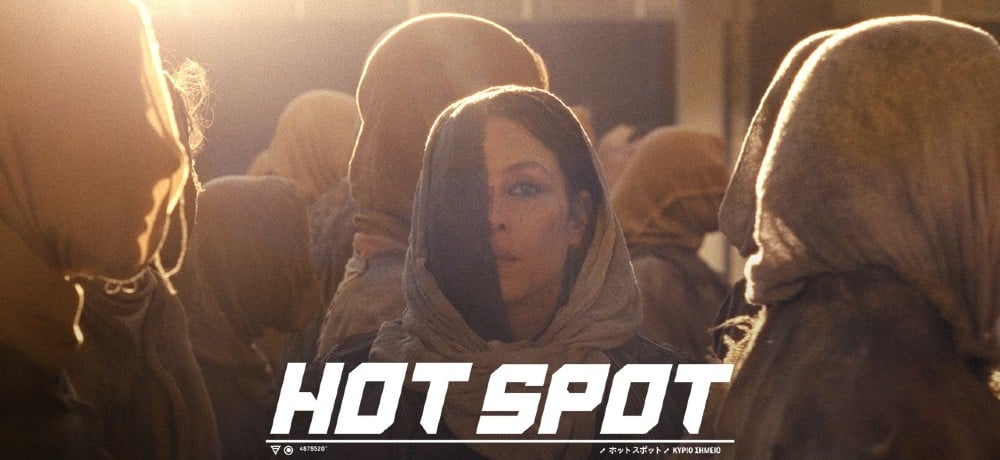
Before I screened Hot Spot, lauded Polish filmmaker Agnieszka Smoczyńska appeared on the screen via recording to set the table. Her message? In a matter of words, “I’m not here to provide answers, merely ask questions.” That warning of sorts, a recalibration of the audience’s headspace, was crucial before swallowing such a psychotropic cinematic drug.
The film, a retrofuturistic take on artificial intelligence, is a vibe. It’s like mainlining a techno-savvy apocalypse as only the creative mind who produced The Lure could manifest. Jan 623 (Andrzej Konopka) is a curly-haired detective living in an AI-ruled world where civilians log into a hivemind program known as “The Head.” Those who submit are promised food, water, and shelter. Those who don’t, like Noomi Rapace’s refugee Rana, are given a duration to change their mind—or be denied access to The Head’s dictatorial overwatch.
It’s a thin veil of a story that stands to examine the soullessness of AI-brainwashed populations that replace consciousness with coding. As Jan investigates a repulsive murder in Rana’s clan, the film sets a stark boundary between obedient AI lapdogs and free-thinking outsiders made to be foreign threats. The same goes for Jan and his compulsive wife, Ayka (Reika Kirishima), who escapes from The Head by leading an industrial rock band—apparently, singing disrupts The Head’s signal. Themes are overt on the surface: Ayka seeks sensationalism and independence, while Jan preaches the comforts of The Head’s protection, which is threatened by a cyber witch (believed to be Rana).
As Hot Spot unfolds, it’s anything but expected. Smoczyńska bravely confronts our impending AI overlords for the neutering software they are, by gliding through an absurdist splice-up of 1980s nostalgia—hell yeah, “The Final Countdown” needle drop—with foreign arthouse nods to anything from Gaspar Noé to underseen indies like Yannis Veslemes’s Norway. The operating mode is “kitchen sink acid trip” as we enter The Head’s void of colorful hallucinations, witness Animorphs-like transformations, watch heads explode Scanners-style, and a host of other curveballs. Wriggly, fuzzy worm things make us think of Star Wars creature puppets, while the sweet seduction of life’s primal urges cuts through the digital hellscape that is neural implants and complete binary control.
The sights of Hot Spot boast in-your-face visual storytelling, with a keen frame manned by cinematographer Jakub Kijowski. A sandy wasteland represents The Head’s territory, devoid of any vibrancy, while pungent reds and blues break through the tan monotony when characters disconnect. Smoczyńska favors showing over telling, leaning into feline symbolism that recalls the folly of “leopards at my face” (except it’d be “AI ate my autonomy”). It’s not as if the filmmaker has nothing to say; Hot Spot is rich with paranoia about the future we must avoid. She’s just doing her best “Quentin Dupieux’s take on a Blade Runner” impression.
That all said, Smoczyńska’s absolutely going to leave fans of cement-poured structure in the dust.
Hot Spot is not for audiences who despise storytelling that lingers on question marks. Smoczyńska’s brand of glitchy tyranny is overindulgent in its “wtf-ery,” as Jan’s futureman gumshoe feels like he’s living in a randomized simulation. Scene transitions might give you tonal whiplash despite the way Kijowski’s camera slowly examines arid landscapes, while the artistic whimsy of Smoczyńska refusing to play by any rules is jarring at points. It’s hard to stay fully immersed throughout, and there’s slight trouble understanding certain lines as a European co-production featuring English dialogue (which detracts from the experience).
There’s a problem fitting all the puzzle pieces together between AI-bred dread, jokey 1980s callbacks, diluted science fiction, and gory horror violence. As Jan swagger-steps his way to work, listening to his favorite tunes, Hot Spot feels like a proud satire of an era. But at the film’s darkest, there’s an indecency that forcefully pushes away from the humor on hand. The back-and-forth of tones can feel like an exhausting ping-pong of ideas, especially when Jan enters father mode, hellbent on protecting his only son, one-legged Zen (George Aurimas Cris).
That all said, Hot Spot is the kind of filmmaking risk that stands out as counterprogramming to Hollywood’s current rotation of marketable formulas. Smoczyńska’s bold direction of societally poignant commentary is wholly unique to her brilliance. “If you can hear a heartbeat, you can (still) feel love.” This is the chorus of Hot Spot, which holds more answers than our introduction alluded to. Smoczyńska’s approach may be avant-garde, but her fears for humanity burn bright at the script’s core. A less talented filmmaker would buckle under the weight of so many daredevil choices. Yet, Smoczyńska’s showing off here—an unflinching display of freeform expressionism that gives viewers oh so much to talk about.
Movie Score: 3.5/5

Matt Donato is a Los Angeles-based film critic currently published on SlashFilm, Fangoria, Bloody Disgusting, and anywhere else he’s allowed to spread the gospel of Demon Wind. He is also a member of the Critics Choice Association. Definitely don’t feed him after midnight.
Matt Donato is a Los Angeles-based film critic currently published on SlashFilm, Fangoria, Bloody Disgusting, and anywhere else he’s allowed to spread the gospel of Demon Wind. He is also a member of the Critics Choice Association. Definitely don’t feed him after midnight.










![[Guest Article] Maggots On Your Body Of Work: Clay McLeod Chapman On Finding His Own Muses](https://dailydead.com/wp-content/uploads/2026/03/Bodies-of-work-1000-180x83.jpg)
![[Editorial] AI of the Living Dead: Why Have So Many Already Accepted the Simulation?](https://dailydead.com/wp-content/uploads/2025/09/M3GAN-180x83.jpg)