



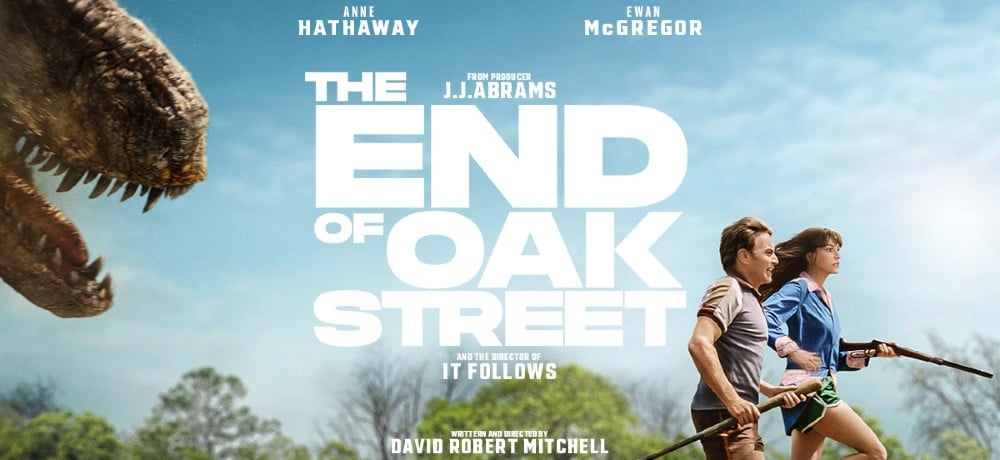
As a joke, moviegoers (and probably archeologists) have argued, “There’s no such thing as a bad dinosaur movie because … dinosaurs.” But, hilariously, The End of Oak Street proves that statement isn’t wholly invalid.
David Robert Mitchell channels the narrative anarchy of 80s and 90s blockbusters that are, in choice phrasing, drunk on dumb bitch juice. (A compliment, I assure you.) Mitchell doesn’t give two hoots about explaining the time-hopping details about The End of Oak Street, because you’re here to watch era-appropriate dinosaurs (feathers and all) destroy a textbook 1980s Metro Detroit suburb. It’s like the San Diego portion of The Lost World but more unhinged, since you’ll be hollering at prehistoric bits neither the Jurassic Park nor Jurassic World films dared to show.
There’s not much depth to The End of Oak Street. Flowervale, Michigan is cosmically transported in a beam of light to a land time forgot. We follow the Platt family as they quickly realize they’re not in Kansas anymore … or the right time period. Greg (Ewan McGregor) and Denise (Anne Hathaway) go from feeling trapped in a stagnant relationship to bashing extinct predators with sledgehammers to save one another. Daughter Audrey (Maisy Stella) and son Brian (Christian Convery) complete their terrified nuclear unit, as they try to defend against very-real threats that are headbutting, clawing, and roaring down their front door.
Now, Mitchell’s script is admittedly a stack of time-hopping, multi-versal questions that the film doesn’t care to explore. In interviews, Mitchell confesses that he used to watch dinosaur movies with his dad—who the film is dedicated to—so he donned his very best Amblin impersonation and made the kind of movie he’d watch with pops. Family values are a prominent topic of conversation, with an emphasis on McGregor’s trying-his-best father, and the whole thing acts as a loose metaphor for strained yet salvageable relationships. Greg’s family is trapped in Dinoland with no means of escape, paralleling Denise’s frustrations with Greg and feeling trapped by marriage—their fights inside their boarded-up safe house mimic those started at an all-smiles summer BBQ pre-zap.
It’s an admirable attempt by Mitchell to turn his heartsongs into a thoughtful adventure-thriller, but there’s a lack of follow through. It’s like Steven Spielberg twice removed (J.J. Abrams produces through Bad Robot), as the family that flees from carnivorous predators together stays together—however schmaltzy. But Mitchell is so preoccupied with the Platts and their rekindled adoration of one another that basic storytelling details feel forgotten. Like, why are the Platts the least aware time-travelers in history, letting gargantuan Canosaurus-types sneak up on them? Or how do time paradoxes work? Over and over, the eye-rolls continue as logic falls off the face of the Earth in favor of Mitchell playing with his dinosaur toys.
But you know what? Every so often, “dumb fun” is enough. That’s The End of Oak Street.
From the moment McGregor investigates his block, after the time-hop, and frantically flees from a velci-bird-o-saurus in 80s-approved tennis shorts, The End of Oak Street is rather intense. Denise stumbles upon a rifle; Brian puts himself in peril to save the family pooch, Starbuck; Audrey finds a soft spot for an orphaned neighbor girl (Jeannette, portrayed by Jordan Alexa Davis). Together, they encounter obstacle after obstacle while unluckier townsfolk are picked apart by meat-hungry beasts in full view. There’s a bleak brutality about how the Platts’ community is eaten appendage by appendage that doesn’t skimp on the ruthlessness of feral violence. The time-capsule nature of 80s Americana keeps the wood paneling, dress code, and Pleasantville-esque vibes, only as a stark contrast to the vicious feeding frenzy that ensues.
However, The End of Oak Street is also surprisingly lighthearted. Hathaway and McGregor are asked to emphasize the turbulent nature of marriages on the rocks, but Mitchell counterbalances this with downright cartoonish depictions of dinosaurs just livin’ uninterrupted. The puppyish, blank stare of a mega-turtle blocking the road, head cocked as Denise contemplates blowing the horn, or Greg’s impromptu photo opportunity that recalls a frequently repeated gag description of The Young Pope (if you know, you know). At times, Mitchell’s hunter-stalker flick acts as an absurdist creature-feature written by a teenager, bringing the filmmaker back to his childhood. Only to come crashing back to reality with a handful of mouth-agape highlights.
Either you’ll howl at these out-of-left-field moments, charmed by Mitchell’s constant desire to make us smile, or you’ll rue each break in tone, as the film snaps back into chomp-some-heads-off mode.
As for the sights and sounds, Michael Giacchino’s score dances with a pleasing sense of wonder and booms when Rexy-sized monsters are snapping their jaws at unwilling snacks. Visual effects are effective—for the most part—as lush jungle backdrops surround Oak Street, and dinosaurs run rampant, relying on digital animations that sell their avian characteristics. Perhaps a few sections are less polished than others, thinking specifically of an opening sequence akin to Dawn of the Dead (2004), except it’s dinos munching on suburbanites, not zombies. Or a few glimpses of Starbuck, which looks about as bad as WB’s unfortunate AI advertisement. But, otherwise, the mixture of Smalltown, USA accents with a land before time blends smoothly together, common studio CG blemishes and all.
The End of Oak Street is an objectively messy movie that’s, subjectively, a switch-your-brain-off slice of primo entertainment. Mitchell serves up popcorn thrills that are better left unexamined. It’s a bit of a Tropeasaurus Rex in terms of plotting the whys of science fiction happenings and the emotional dilemmas, but then it’s back to the saving excitement of another dinosaur attack. At a merciful 100 minutes, The End of Oak Street knows what it is and gets right to the point: cinematic enjoyment that makes us all feel like a kid again.
Movie Score: 3/5

Matt Donato is a Los Angeles-based film critic currently published on SlashFilm, Fangoria, Bloody Disgusting, and anywhere else he’s allowed to spread the gospel of Demon Wind. He is also a member of the Critics Choice Association. Definitely don’t feed him after midnight.
Matt Donato is a Los Angeles-based film critic currently published on SlashFilm, Fangoria, Bloody Disgusting, and anywhere else he’s allowed to spread the gospel of Demon Wind. He is also a member of the Critics Choice Association. Definitely don’t feed him after midnight.










![[Guest Article] Maggots On Your Body Of Work: Clay McLeod Chapman On Finding His Own Muses](https://dailydead.com/wp-content/uploads/2026/03/Bodies-of-work-1000-180x83.jpg)
![[Editorial] AI of the Living Dead: Why Have So Many Already Accepted the Simulation?](https://dailydead.com/wp-content/uploads/2025/09/M3GAN-180x83.jpg)