



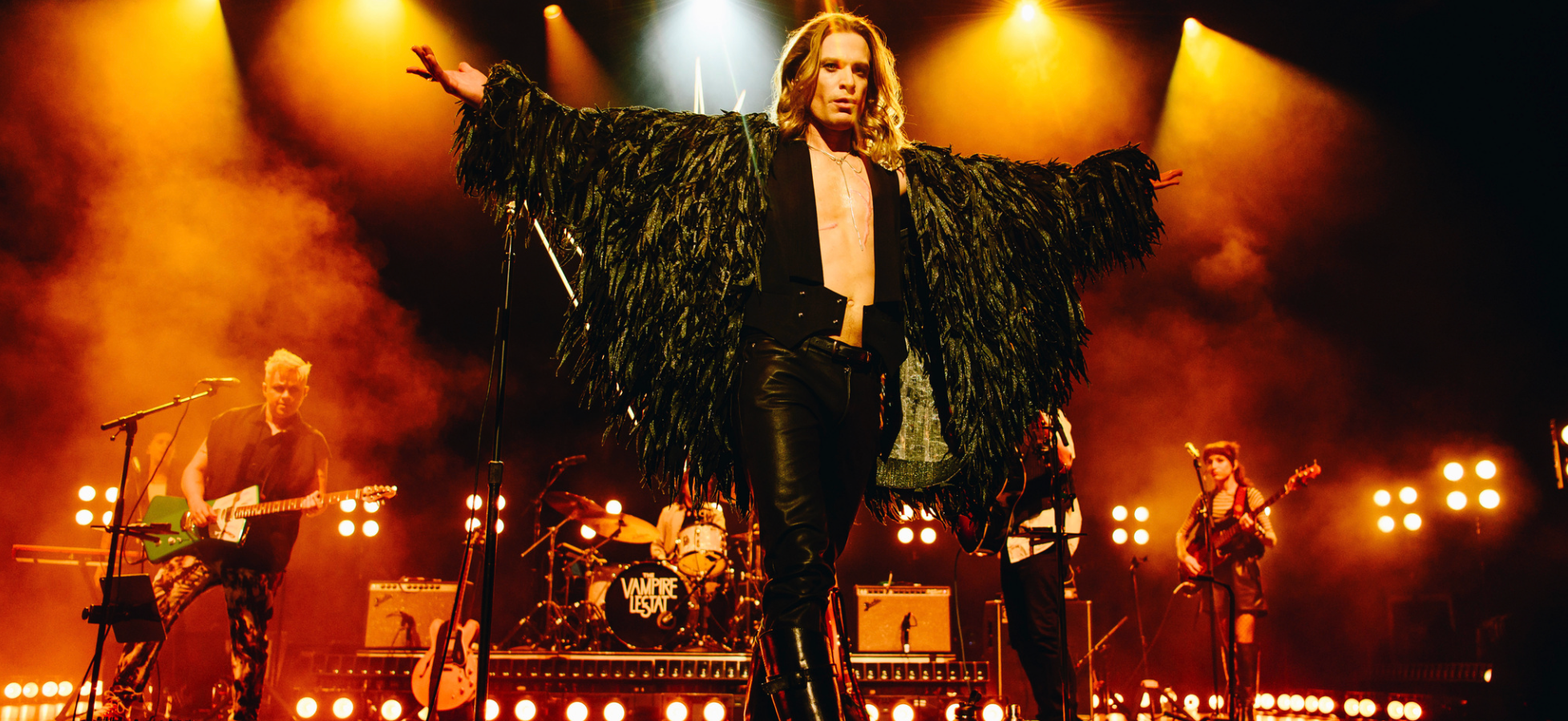
Ears were ringing before Lestat hit the stage at the Beacon Theater in New York City. After Lestat (Sam Reid) and the band left the stage, it's surprising that ears weren't bleeding. At the gig, The Vampire Lestat: One Night Only LIVE, the dapper goth crowd's screams landed between scream queens and Beatlemania.
Lestat de Lioncourt treated the stage like he's forever owned it. When the vamp rocker gracefully hammed it up, he had the crowd in the palm of his hands. Just how Lestat probably likes it. It was a performance every bit as dedicated as what Anne Rice fans saw in Interview with a Vampire and now The Vampire Lestat.
On stage, Reid was joined by composer and songwriter Daniel Hart, who was rocking the show's guitar with fake blood all over it. On stage and television, the two produced a potent mix of glam rock. David Bowie and T. Rex were two key influences for Hart.
The composer has been with the show since the beginning. He's scored films such as The Green Knight, created the band Dark Dooms, and toured with St. Vincent and Broken Social Scene. These experiences bring plenty of rock and flavor to Lestat's band, which Daniel Hart recently spoke about with Daily Dead:
The Vampire Lestat Live at the Beacon was such a great night! Congratulations, Daniel.
Daniel Hart: Thank you very much. It was a lot of fun for me. I used to make my living playing on stage. It's been a few years since I've done it at this level, I guess you could say, and I miss it.
Is it like getting back on a bike?
Daniel Hart: It was for me. There's some part of me that just is drawn to performing for lots of reasons, probably healthy and unhealthy ones. That's all still in here, I guess. Maybe I would have thought that I would get really nervous beforehand, having not done it in a while, but that's not what happened.
These fans go hard. They dressed like it was the gothic ball of the century.
Daniel Hart: The crowd... the screaming crowd... what a delight from start to finish! What lovely people. I'm so grateful for their passion for this thing that we're doing. It did make it hard sometimes to hear what we were doing on stage, but that's how it goes. That's part and parcel.
When you started putting pen to paper and writing songs for Lestat, which of his life experiences were driving his lyrics? How’d you want him to express himself through his music?
Daniel Hart: I've done a little bit of songwriting for Interview with the Vampire in seasons one and two, and I've done a little bit of this writing a song from a character's point of view for other projects over the years. But for the most part, this was new territory for me. It was a little hard to figure out ahead of time exactly how it would go.
But right from the beginning, it felt pretty easy. Song ideas were coming to me very quickly and fairly fully formed from the beginning. I've spent so much time thinking about these characters and writing music for these characters and reading the scripts. Then for season three, I was in the writer's room, and I was working on character ideas and plot points and outlining episodes and writing scenes, writing dialogue for months and months. I felt like I knew Lestat really well, and I read the book, and I read certain passages over and over again because I was quoting the book for certain songs, lyrics during the season. All that to say, it just wasn't as hard as I thought it would be.
What was the first song that really laid the groundwork for you?
Daniel Hart: I wrote the first song, “Long Face,” at the end of June, 2024, because we needed a song for Comic-Con that year. Then I didn't write anything else until September of that year. I had a couple of months off to think about Lestat. In September, when I wrote the first couple of songs, at that point, it became clear that this Lestat that was living in my head had a lot to say. He wasn't making it difficult for me to find that stuff that needed to come out.
What did he really relish about writing for Lestat’s voice?
Daniel Hart: I write songs from my own point of view. Like I have my own band, and most of those songs are autobiographical in some way or another. I toil over lyrics especially, Jack. I'm so desperate to be honest in my lyric writing. It's important to me that I'm being honest with myself and honest with the music. I'm on my journey of self-discovery, so it's all very serious for me. Lestat is petty and silly and over-the-top, and happy to burn it all down, and has complicated, violent relationships with many of his lovers and has been alive and undead for 265 years.
It’s all free rein to say whatever I would want to say. Ideas that I would shoot down for myself, Lestat would say happily and with abandon. If it felt too silly for myself, then I'd be like, "Oh, well, go the other direction. I got to keep this serious. You're a serious songwriter." Lestat's like, "No, no. Silly is all a part of it." The ability to do all of it, to try to make a circus – a beautiful circus – but a circus nonetheless, is a gift.
You strive for honesty in your songwriting. Do you think Lestat does as well?
Daniel Hart: Well, Lestat is going on his own journey of self-discovery throughout Season 3. We charted that journey with the songs. He starts from a more superficial place and tries to find ways to be more earnest as he goes along. There's a song in Episode 3, which is coming out this weekend, called “The Loneliness.” In the show, it's a turning point for Lestat. That's where he starts to get more honest with himself, musically anyway, and starts to be open to truths about himself that he would rather not acknowledge.
It was the first song that I wrote in the writer's room, because I wrote it pretty early on. I wrote it in October of 2024. The version of “The Loneliness” that we recorded and that was used in the episode and that we performed at the Beacon on Tuesday night is version one, version one of the song. No changes to lyrics. No changes to music. Right from the beginning, it was fully formed.
When you first got to the writers' room, given all your touring experience, when did you first start sharing your own life experiences on the road?
Daniel Hart: Day one.
What were some of the major discussions?
Daniel Hart: Day one, I sat down, and they said, "Give us all your stories. Give us all your stories, band man." I said, "Well, I was a professional touring musician for eight years." Before that, I was trying to be a professional touring musician for another five years. It was the thing that I wanted to do most desperately with my life. I considered it a job, and I tried to take it very seriously.
It's a lot of sitting in a van or on a bus, but for me, mostly in a van and driving long distances, and then unloading gear, and then getting to do the thing you really love for like 45 minutes, and then loading the gear back up, and then driving somewhere else, and crashing on friends' floors or couches in a sleeping bag, or on an air mattress, or a camping mat. They said, "Yeah, but what's all the terrible stuff that happened and all the crazy stuff and all the drugs and the sex?" Yeah. Again, it was like a job for me. I'm basically like a glorified mover, a professional mover. I take a bunch of heavy stuff, I put it in a vehicle, I drive it somewhere, and then I'd do the music for a little while.
But then I'd take that gear, and I put it back in the van, and then I drive it somewhere else. And they were like, "Come on!" Then one of the other writers in the writer's room this year was Ryan Kattner, who plays Salamander in season three. He's in the vampire band. Ryan is a musician in his life, and he has an incredible band called Man Man.
They rock live.
Daniel Hart: Yeah, yeah. Ryan and I have been friends for a long time. My touring life was happening at the same time that Man Man was, so we were playing a lot of the same festivals together. And so, Ryan showed up in the writer's room two weeks after I started. As soon as Ryan showed up, they were like, "Do you have any stories from the road that you'd like to share?" He was like, "Oh, yeah, like one time in the van, I got into a fist fight with one of my bandmates, and then we had to pull the van over to the side of the road because you can't really get the distance to properly punch someone in the van. And then one of my other bandmates broke a kombucha bottle on top of my head, and then it was all bleeding, and then I wandered off into a field, and I got stuck on some barbed wire, and somehow I made it. The next morning, I woke up in the hotel. I have no idea how I got there." The writers were like, "That's what we wanted from you, Daniel Hart. You let us down. Thank God for Ryan." Internally, I was like, "Thank God for Ryan."
[laughter] You know what? That tracks. They have good chaos on stage.
Daniel Hart: He's such a beautifully chaotic musician. I love watching him perform. He's incredible. So, I told my stories. They were not satisfactory. Ryan told his stories, and they were absolutely fuel for the band antics in season three.
Obviously, you want to make good music for the series, but how good or flawed should Lestat’s band be? What are their strengths and weaknesses?
Daniel Hart: We talked about this to death in the writer's room. A lot of discussions about what this band should be and how talented they should be, and is Lestat riding their coattails, or are they taken to another level of success because of Lestat? Earlier on in the writer's room, the plan was for Lestat to be wildly successful, for the band to be wildly successful and immensely popular.
As we got more into the story and more into Lestat's journey and talked about the book more and the band more, it became clear, also fairly early on, that the much more interesting story would be if the band wasn't as successful as Lestat wanted it to be. They weren't catapulted to success in the way that he had hoped they would be. And so, the band themselves didn't have to be great in that sense; they didn't have to be amazing musicians.
We decided pretty early on, too, that that wasn't the reason that Lestat wanted them. He didn't want a shredder, necessarily, on guitar, and he didn't need Neil Peart from Rush behind the drums. He probably wanted someone more like John Bonham from Led Zeppelin, someone who had a heaviness to their drumming. John Bonham, one of the best drummers ever, but not showy, not showing off a lot, just anchoring songs. Lestat probably wanted people who had the right feel rather than people who are the most technically proficient. That's what we went with, and that's how it ended up.
There are bands I love where certain individual players, maybe they're not amazing, but with the right bandmates, they are amazing together. How did you look at it from this band in that regard? Are they in sync musically?
Daniel Hart: At least at the beginning, if the band's going on their journey, then they need to start from a place that is not great and get somewhere that is better. The bumps along the way makes the most sense, both because that's great storytelling and because that's generally been my experience of playing music with other people. At the beginning, it's hard to find common ground with some people sometimes. Some people get thrown into a band together for various reasons that maybe shouldn't be in a band together. But they make great music together, and they have a hard time offstage, even though, onstage, it's magic.
Something that rings true about this band is that, at most rock shows, it’s the bassist doing the most on stage. How’d you want to help define their stage presences?
Daniel Hart: There was some debate at the beginning of which character would play which instruments. We wanted it to be, at least in part, informed by the actors who ended up getting cast as to what instruments they already knew how to play. It was pretty easy to find actors who had some experience playing guitar, but it was harder to find actors who had some experience playing drums. We could find great drummers, and we could find great actors, but putting those two together, not as easy.
So at one point, Ryan, who ended up playing bass in this show, might have been the drummer, which he was very happy not to be when he ended up being the bass player. It also allowed him to be much more of the kind of performer... that is wildly entertaining to watch. Because if you're at the drums, then you have to be sitting. You're kind of stuck behind the kit. Of course, you can do amazing things behind the drums, but it's just not as easy to get around the stage and work the crowd as a drummer.
When you got to know these characters more, how did that influence your sense of how they play? How did you want their styles to be an extension of their personalities?
Daniel Hart: Like Lestat, the characters should come out in the music. Larry Reid (Noah Reid), the main guitar player in the band, has a chip on his shoulder from the very beginning because, before Lestat showed up, it was basically his band. But he's just not a very good frontman. Lestat's a way better frontman. Ryan has a bone to pick with Lestat about that, and that makes for a nice conflict between them to explore.
It feels true to other bands that I've been in where people were maybe good at one thing, but doing another, and then they got supplanted, and then they were relegated to a role they didn't particularly want. Or bands who were successful at one point, and then later on in their careers, they're opening for a band that might have been opening for them five years ago. These roles shift all the time. It's good to see people have to butt up against roles that they might not have wanted for themselves.
Let’s talk about Sam Reid’s voice. When you were hearing him sing, how did you want the instrumentals to support his voice?
Daniel Hart: Great singing voice, great baritone.
Great showman, too.
Daniel Hart: Incredible performer. That show at the Beacon... I would think that was his 500th show. It's just so effortless and natural. We started recording Sam's vocals in May of 2025. We did four sessions between May and December of 2025 with Sam recording vocals for various songs. I already knew his singing voice from the song that he sings in seasons one and two of this show. So, I knew what I was working with in terms of his range and the timbre of his vocals. But it's not a rock song, so there are certain unknowns going into it.
We got him a vocal coach immediately, Matthew Santos, who was with us from start to finish and who co-wrote one of the songs with me. We did a remix of one of the songs as well for the season. Sam and Matthew worked together before the three of us started working together on specifics of songs. It was when songs were still being written, and lyrics were being revised.
Sam came on in like March of 2025 and started working on songs. By May, we had a chunk of songs that were ready to go and that needed to be recorded before we started filming in Toronto in June. So, we recorded those songs. I was the producer in those sessions for Sam for his vocal sessions. I tried to give him – I don't know – inspiration and help him find the things that he hadn't yet found for himself. But he did so much homework. He's such a good researcher.
How’d his approach to acting compare to his approach to singing?
Daniel Hart: The thing about Sam's approach to acting that made it a challenge for him to learn these songs is that [from] the school of acting that he comes from, you learn your lines neutrally so that you're not imprinting certain cadences or rhythms or emotions or pitches in your voice or reactions. You're not imprinting those beforehand. You learn everything neutrally so that when you do it in front of the camera or on a stage, when you do it for real in the performance, it feels true and it feels authentic. It's of the moment.
If you have to sing a song, you have to record it. You have to know your lines, yes, but you have to know the pitch and the rhythm and the melody. You have to know everything. It was a challenge for Sam. We had to work on the differences between what it meant to record these songs as a singer versus an actor. He was also thinking about Lestat that whole time and how to sing as Lestat because it's, a little different than the way he would sing it if he was Sam Reid. I just tried to support him in the stuff that he was figuring out for himself, and tried to help him figure out how to best bring his own research into the sessions in a way that would help him the best.
After the show at the Beacon, did you say to Sam, “Hey man, let’s get on a tour bus and hit the road”?
Daniel Hart: [Laughs] I can tell you that we both said to each other that we would really like to do it again. Doing it only once isn't enough. We don't have any specific plans right now. He's off in Australia doing a play, so nothing anytime soon. But we'd like to try and make it happen again. It feels super fun for us.
Any more live performances in your future?
Daniel Hart: I don't think so. I have a couple of solo albums that I need to finish. They're each two albums that are each 70% done. I need to finish those this summer and then maybe some shows towards the end of the year once I get my shit together.
Photo Credit: "Sam Reid performs at The Vampire Lestat: One Night Only – LIVE at the Beacon Theatre in New York City on June 2 ahead of the premiere of “The Vampire Lestat” on Sunday, June 7 on AMC and AMC+. Credit: Nina Westervelt/AMC Global Media"
A film journalist with over a decade of experience writing for Slash Film, The Credits, and High Times Magazine.
A film journalist with over a decade of experience writing for Slash Film, The Credits, and High Times Magazine.




![[Guest Article] Maggots On Your Body Of Work: Clay McLeod Chapman On Finding His Own Muses](https://dailydead.com/wp-content/uploads/2026/03/Bodies-of-work-1000-180x83.jpg)
![[Editorial] AI of the Living Dead: Why Have So Many Already Accepted the Simulation?](https://dailydead.com/wp-content/uploads/2025/09/M3GAN-180x83.jpg)