



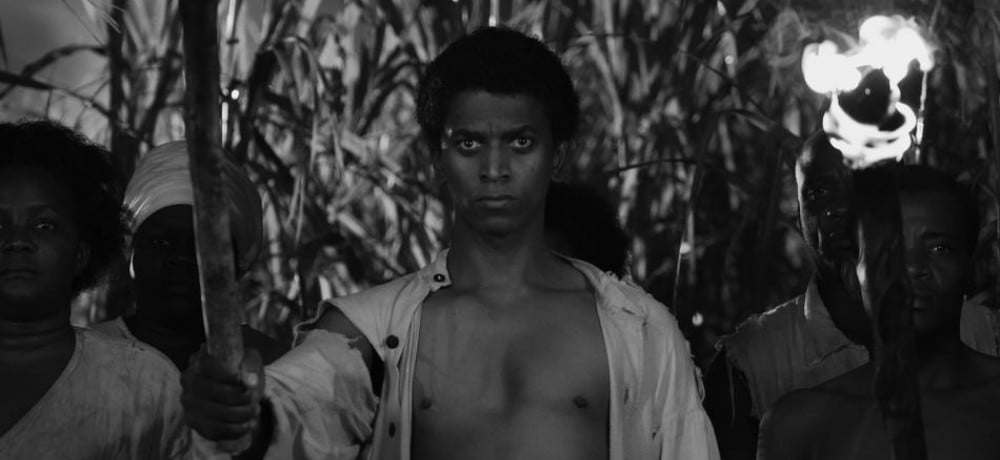
Not too long ago, it seemed that anyone with a camera and a vague understanding of horror movies was churning out genre-specific documentaries. Standouts like Horror Noire: A History of Black Horror ran circles around other puddle-shallow attempts like The Found Footage Phenomenon. Even more announced titles circa 5-years old never saw the light of day (as of yet), despite lucrative crowdfunding campaigns and announced talent. All to say, when the iron was hot, many filmmakers tried to strike, and few did so with a lasting impression. Apprehension was inevitable before Maya Annik Bedward's Black Zombie, but my fears were quickly quashed—it's one of the better horror documentaries I've seen in a minute.
It's not another cursory glance at the shambling undead. Bedward's intentions are anthropological, citing the Black origins of zombie cinema, specifically as a demonization of Haitian people and cultures. Assembled is a smaller-than-usual gallery of talking heads, but we know we're in good hands when author and film historian Tananarive Due appears up-front to drop knowledge. Where documentarians like those behind Doc of the Dead mention White Zombie before AMC's The Walking Dead or George A. Romero monopolizes time, Bedward reckons with and stays on the uglier beginnings of zombie cinema.
Black Zombie is rich with historical context, viewing horror through the Black experience. Specifically, Bedward includes Haitian spiritualists and academics who watched Hollywood villainize Haitian Vodou traditions. The works of journalistic tourists, William Seabrook and Wade Davis, positioned white men in the center of Black stories—which other white men purchased the film rights to, only for different white men to poorly represent Haitians as these mystical monsters for an untamed land. Movies like White Zombie and The Serpent and the Rainbow are turned upside down with fresh readings, as Haitians explain how detrimental these depictions remain.
Knowledge is power in Black Zombie. Speakers tether horror cinema to Haiti's tumultuous timeline, from slavery in cotton fields to the Haitian Revolution, to economic punishments for an uprising that freed Haiti from French colonial rule. Black Zombie isn't just dissecting movies and themes as criticism; Bedward finds it most important to remind us of media's impact beyond entertainment. Haiti's hardships directly correlate to Hollywood's stereotyping Vodou as evil, a bastardization that is continually exploited. Haitian singer Erol Josué is asked by Bedward, "What do you think of my movie?" And he responds, with such a cutting tone, "I want to trust you." Hollywood has failed them, other nations have failed them, and it's such a gut-punch to hear a Haitian in 2026 still not be convinced Vodou can be presented as peaceful, soulful, and beautiful by non-Haitians.
That's the beauty of Black Zombie. Instead of being another redundant at-a-glance documentary about the zombie genre, it zeroes in on an oft-forgotten, knowledgeably explained topic. Rock' n' roll legend Slash and Zombie Walk founder Thea Munster provide context as zombie movie lovers; goremaster Tom Savini and Night of the Living Dead co-writer John A. Russo provide industry commentary, but the film dedicates far more time to the Haitian experience as influenced by outsiders. The entire identity of zombies as a parallel to otherness—hordes of braindead corpses stripped of their humanity bashing down the doors of affluent white families—is drawn back to the Haitian zombie and Vodou. Bedward has a clear motivation as a documentarian and never loses her angle; she holds Hollywood accountable for gross generalizations leveled against Haitian people.
Black Zombie is an informative, passionate, and insightful documentary that goes far deeper than the average subgenre clip show. To appreciate the horror genre is to understand its origins; Bedward's pulling at fragile roots that've been buried under pop culture lore. George A. Romero is considered the "Godfather of the Dead," but the flesh-munching zombos that took theaters by storm have a darker past that, when overlooked, erases the Black experience. Bedward's narrative is as much about preservation as it is acknowledgment and reassessment, in a time when Haitians remain under fire from corrupt regimes who exploit societal fears of the "other" for their own personal gain. That's why documentaries like Black Zombie are so important in today's landscape, because bigotry will always exist. The more education the masses receive, the better equipped we are to fight against weaponized misrepresentation meant to stoke that fear of "The Other," lest the revolution finally erupt.
Score: 4/5
Matt Donato is a Los Angeles-based film critic currently published on SlashFilm, Fangoria, Bloody Disgusting, and anywhere else he’s allowed to spread the gospel of Demon Wind. He is also a member of the Critics Choice Association. Definitely don’t feed him after midnight.
Matt Donato is a Los Angeles-based film critic currently published on SlashFilm, Fangoria, Bloody Disgusting, and anywhere else he’s allowed to spread the gospel of Demon Wind. He is also a member of the Critics Choice Association. Definitely don’t feed him after midnight.







![[Guest Article] Maggots On Your Body Of Work: Clay McLeod Chapman On Finding His Own Muses](https://dailydead.com/wp-content/uploads/2026/03/Bodies-of-work-1000-180x83.jpg)
![[Editorial] AI of the Living Dead: Why Have So Many Already Accepted the Simulation?](https://dailydead.com/wp-content/uploads/2025/09/M3GAN-180x83.jpg)