



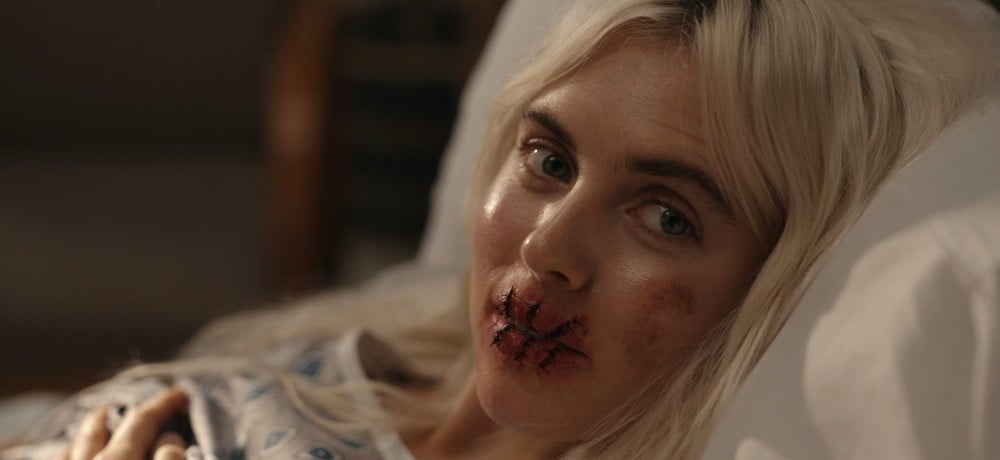
To resurface the old argument yet again, horror has always, and will always, be political. It’s part of its nature. It’s a reflection of our times, our society, and ourselves. Sometimes the social commentary is subtle, and other times, it bursts into the room and hits you in the face with a sledgehammer. From writer-director Justin Floyed comes Jollyface, a horror film that is part home invasion, part crime thriller, and part think-piece. And like many films that try to fold layered social commentary into their plotlines, it does so with varying levels of success.
When Nick (Kofi Siriboe) is killed in a seemingly random act of violence in front of their apartment, his fiancé, Blair (Emily Kimball) is devastated. The police are quick to write it off, but she believes there might be more to the story, and fights to uncover the truth. She investigates claims of so-called “gang-related” crime across the country, prints out a number of articles relating to the murder, and hunts for any information that she can get her hands on. She streams regularly in an attempt to keep the case in the public eye and keep the fight going. The next step in her investigation is to finally get access to the camera footage that showed Nick’s final moments. That promises to be the key to unlocking the truth to the entire event. The footage remains elusive, however, with the police and the justice department keeping it under lock and key.
Blair finally is able to utilize a friend in the department to gain access to the footage. As she suspected, this is much more than the simplified “Black on Black crime” that the police and the media seem so ready to paint it as. At this point, the story switches gears completely and becomes more of a home invasion story, as the killer abruptly turns up at her apartment building and starts wreaking havoc on her friends and neighbors.
The film makes some bold choices, yet struggles to balance these two aspects. The first half feels like a thriller rooted in the world of true crime, and then, suddenly, we’re in slasher territory, with a lumbering, menacing boogeyman stalking from room to room, leaving a trail of blood in his wake. The result is a film that is rather uneven, but when it hits, it hits. It is a tension-filled story that never skimps on the fright moments.
Floyd does a great job in establishing his characters and the connection between them. Blair and Nick are a fully-realized couple, deeply in love. They are young and the excitement of their life together is infectious. Nick’s death is palpably devastating, and even though we have only known the couple for a few minutes onscreen, we feel the loss. The sudden loss of Nick is one of the more affecting moments of the film, and it works.
There are also several really solid moments in the back half, once the film goes full-slasher. The killer offers an intimidating and formidable presence when Blair finds herself trapped in her building with no way out, and Floyd really makes the most of those scenes, both when building tension and offering the occasional jump scare.
Filling in the texture of the story are the ever-present themes of modern racism, and the complexities of where we find ourselves in the current political landscape. The microaggressions that accompany being in an interracial relationship, even to this day. The performative allyship that can easily crop up. The strained relationship between communities of color and law enforcement. It’s all here, woven into the fabric of the story. Like life, these themes are ever present throughout the film, and also like life, they are a little messy. But their inclusion enriches the story and offers audiences a lot of complexities to consider.
In Jollyface, Floyd has constructed a bold and affecting horror story. It covers a lot of ground and has a lot on its mind. Not every idea comes across smoothly or fully formed, but its presence and inclusion is nonetheless meaningful.
Movie Score: 3/5

Emily von Seele hails from Seattle, where it rains a lot, which gives her plenty of excuses to stay inside and watch movies. She has written for Bloody Disgusting, Daily Dead, the Women in Horror Annual and Grim Magazine, and is co-host of the Dead Ringers podcast. You can usually catch Emily on Twitter (@horrorellablog), where she has been known to gab excessively about movies and tweet adorable pics of her two cats - seriously, they are the cutest ever.
Emily von Seele hails from Seattle, where it rains a lot, which gives her plenty of excuses to stay inside and watch movies. She has written for Bloody Disgusting, Daily Dead, the Women in Horror Annual and Grim Magazine, and is co-host of the Dead Ringers podcast. You can usually catch Emily on Twitter (@horrorellablog), where she has been known to gab excessively about movies and tweet adorable pics of her two cats - seriously, they are the cutest ever.













![[Guest Article] Maggots On Your Body Of Work: Clay McLeod Chapman On Finding His Own Muses](https://dailydead.com/wp-content/uploads/2026/03/Bodies-of-work-1000-180x83.jpg)

![[Editorial] AI of the Living Dead: Why Have So Many Already Accepted the Simulation?](https://dailydead.com/wp-content/uploads/2025/09/M3GAN-180x83.jpg)