



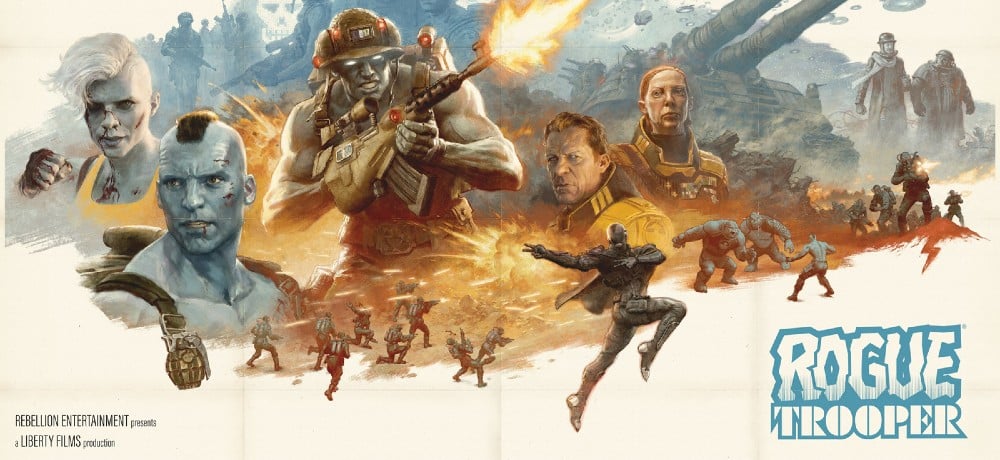
Duncan Jones’ name hasn’t been on the big screen for far too long. Jones’ last film, Mute, was for Netflix eight years ago, so it’s actually been a decade since we’ve seen a theatrical release from the very talented filmmaker behind Moon and Source Code. Now, he’s back with Rogue Trooper – a movie that plays like pure, uncut Duncan Jones. Based on the 2000 AD comic strip, the R-rated animated film follows a soldier named Gunnar (Jack Lowden) fighting through a war-torn Nu Earth. Along the journey are his genetic infantry comrades. When they die, their consciousness is transferred to guns and backpacks.
The filmmaker is pleased Rogue Trooper creators Gerry Finley-Day and Dave Gibbons gave their thumbs up to the end result. “They genuinely loved the film,” he told Daily Dead at TIFF. “To know that they were on-side made me pretty confident that, okay, most of the people who do know this comic book should be pretty happy with what we’ve created.”
For those who don’t, there’s plenty of oddball, radiant spectacle in Rogue Trooper. Jones, clearly, is as happy as we are that he’s got another film in the can. There’s nothing but glee in the animated war film.
There is so much detail in this movie. It’s just jam-packed with ideas and sights, so I’m seeing it again to take it all in.
Duncan Jones: Well, I think that’s a good thing. It’s tricky these days to get films made which are not already based on very well-known IP. Although this is based on a comic book, it’s a British comic book, so it’s mainly British people who know the character. But we were trying to make something that took all the things that we loved about that comic and hopefully was something that everyone can enjoy.
What were some ideas from the comics you absolutely wanted and needed in Rogue Trooper?
Duncan Jones: Oh, man. I don’t know. 2000 AD has always been a little bit anarchic and always had a little bit of a political undertone to their stories, whether it’s Judge Dredd, the other ones, and Rogue Trooper. What I liked about it was the camaraderie of the characters going through hell. That group of buddies being able to stick together and look out for each other, no matter what insane things were being thrown at them. Again, we were trying to capture the horrors of the Nu-Earth war, but at the same time maintain that anarchic sense of humor.
The horrors, but also, some pretty cool violence.
Duncan Jones: [Laughs] Yeah, for those who like action, we had some fun with that. Also, by doing it as an animated film, we were able to really find some of the visual DNA from the comic book, which was always in my mind. We wanted to try and find ways of how we can put this in this medium.
What were the early tests you did where you realized, “We can do this”?
Duncan Jones: Oh, man, the visual side of it was very, very tricky and a long process. It took about four years to make the movie, and the technologies that we were playing with changed along the way. We felt we were in a good place with what the script was going to be and how that was going to work.
But we started off using the Unreal game engine, and we ended up finding that that wasn’t actually going to give us what we needed, and went back to some traditional techniques. We brought in [VFX supervisor] Marty Waters, who I worked with on Mute. He came up with some excellent ideas of how we could create a bit of a hybrid of technologies that would allow us to create something that is pretty unique as far as the look of the film.
I’m really, really pleased with the result of what is an animated movie, but it’s allowed us to really capture performances. Everyone’s using mocaps these days, so there’s nothing new about that. But capturing real actors’ performances and then also managing to stylize them in a way so that they become more comic book, that was something we did which I was really very proud of.
It is the sweet spot between animation and live-action rather than an uncanny valley. How did you and the team pull that off? What were strict rules you had to maintain this aesthetic?
Duncan Jones: Well, we had some amazing people we worked with at Treehouse. It was one of the companies that we worked with to create the visuals. The brief that we gave everyone was, again, 2000 AD has this wonderful history of, I would call them grotesques, but they’re not grotesque. It’s accentuated, slightly extreme-looking visuals on how characters are designed and what their faces look like and things.
It was really about, especially with our regular human characters, pushing them into the extremes and then keeping our GIs as the more human-looking characters, even though they weren’t the fully human ones. The humans were a bit more extreme, and then the GIs were more human. That brings the audience along with the GI characters and, again, helps us stay away from that uncanny valley.
Did you want to move the camera similarly to how you would in a live-action movie?
Duncan Jones: Well, to be honest, it was very much an animated film in that there was a lot of iterating as we went along. It’s not like you go out and you shoot your film and then you just cut it and see what you’ve got. We had the freedom to be able to move the camera after we were really comfortable with, or happy with, the performances and the placement of characters, because we were able to move that as well.
As the backgrounds started coming through and the environments that we were in, those were not fully developed when we were actually working with the actors. So it was constantly moving and changing the camera as environments and things popped into place and got more and more developed.
It was a really weird and interesting way to make a movie because nothing was really firmly in place. Everything was improving and changing along the process. The only thing that was nailed down was the actors’ performances and their voice performances. Even when we wanted to make a change, we were able to make tweaks along the way.
Through this four-year malleable process, it’s a long time, but is it also more comfortable than live-action where you’re always running out of time?
Duncan Jones: [Laughs] The difficulty in it – a real, legitimate difficulty – is knowing when to say, “Okay, it’s finished.” Because with a traditional film, you have your performances, you have your rushes, and there are things you can do, but you know what you’ve got.
With this, because there was this constant changing of what the results were and what we could do to things, it was having the discipline to say, “Okay, we’ve got to call it here now. We’ve done something that we can definitely feel proud of in front of an audience. We could just keep doing this forever. So, let’s stop here.”
Can you walk us through how a scene, like an action scene with your hero and a whole lot of smoke, gunfire, and almost a trance song, evolve?
Duncan Jones: The inspiration for that was Dave Gibbons, who did the original comic book with Gerry Finley-Day. He went and did a kind of revamp of it with a different artist, and it was in Heavy Metal magazine. It was a one-off thing called “War Machine.” It had these incredibly beautiful, watercolored panels, and it had a very different look. It actually reminded me a little bit of the old Simon Bisley Sláine work.
So it had a very different look from the comic book that got me first interested in Rogue Trooper. But as a visual reference point, it was something I really wanted to try and find a way to match.
That whole sense of really smoky environments – actually, sorry, I’m jumping all over the place.
Please do.
Duncan Jones: There was another thing that was really inspiring to me, which was Excalibur, the John Boorman Excalibur. All of the fights that happened in the smoke. I wanted to try to find a way to do that. It’s so hard because as soon as you start playing with smoke and stuff, you lose everything. You can’t see it. You really have to get the balance right of being able to see things, but still being able to tell a story with visuals when so much of it is being disguised and hidden.
By the way, I love Excalibur, but I appreciate how much filmmakers love that movie.
Duncan Jones: Oh, yeah. It’s amazing. It’s so great. I love that film. There’s a new Blu-ray out now. I’ve got to get hold of that.
Neil Jordan directed a doc on it that’s supposed to be really good.
Duncan Jones: Oh, my God. I haven’t seen that yet. A deep dive after I’ve done all my press for this, and go back and start watching all my favorite movies again [Laughs].
As someone who grew up reading a lot of comic books, how much do you think comics influenced your compositions?
Duncan Jones: It definitely has had an impact. Certainly in Rogue Trooper, where I was really trying to go back to camera school when looking at the frames from the comic books.
There’s a freedom and exaggeration in foreground and background as far as putting things really close to camera, having stuff really close to camera and stuff in the background. You have these types of quite exaggerated framings. It’s been around in film for ages, but it’s not something I was used to doing.
For me, it was fun to play around a little bit out of my comfort zone. I would say that a lot of the time, I’m quite conservative in the way I frame things and more painterly in some ways. But in this one, I tried to push myself a little bit more, to be a bit more punk in how I frame things.
How do you define a cinematographer’s role with a movie like Rogue Trooper?
Duncan Jones: Oh, it’s a hard one. We had a few people come in and out of the project as we were working out how we were going to do it. It was such a long project as well. It was hard to have that consistency of a 30-day shoot where your cinematographer has a grand plan for it.
Because I was able to mess around with it a lot as we were going along, it was more working it out as we were doing it, even up to the point of being in the editing room where we were able to make those kinds of adjustments.
So it’s very unique. I had a pretty strong feeling of what I wanted, scene by scene, and what I wanted the camera to do. I was able to get a lot more involved myself than on a traditional shoot, where it’s a more traditional way of using the camera.
Before you even directed a movie, you showed up to a pitch meeting, sporting a Mohawk
Are you happy, after making Rogue Trooper and looking back, that the Mohawk Duncan Jones, who originally pitched the movie with no filmmaking experience, did not make this movie?
Duncan Jones: [Laughs] Yeah. What a horror show that would’ve been.
What was the vision for Rogue Trooper before you were even a filmmaker?
Duncan Jones: Man, I don’t know. I would’ve probably tried to end up on some beach in Iceland or something and tried to shoot it live-action, in an alien-looking piece of landscape. It would’ve been interesting. Like I said, there was a 25-year gap between when I wanted to make it.
In those 25 years, what was the moment where you said, “I can finally do this. This is the right time to make Rogue Trooper”?
Duncan Jones: It would’ve been very different. But I’m glad that the technologies we ended up using, we waited long enough for that to actually happen. I kept going back to it over the years to see, “Can we do it now? Can we do it now?” It was never quite the right time, but finally Stuart, my producer, and I were like, “Yeah, we’re at a point now where, at the budget we can afford to do it, we can do this film and capture the ‘War Machine’ aesthetic that we both really loved.”
Was there also a mindset of, “Okay, I’ve developed these skills as a director through my filmography. These are the skills I now want to apply specifically to Rogue Trooper, that it would benefit from”?
Duncan Jones: Just having had a little bit of experience with more action. On Warcraft, I got to do quite a lot of action, and that was definitely a wonderful experience for me. I learned so much and got to work with so many amazing professionals on that film.
That was unique, spending nine months up in Vancouver with all these top people in the industry and getting to learn from them. That was phenomenal. So, that experience gave me a lot more confidence on the action side of things.
The films I’d done before that, Moon and Source Code, were a little bit more thinky and less action-y. So it was Warcraft that really gave me my confidence that I could tackle some action.
After you made Moon, how did you envision your filmography or the filmmaker you wanted to be?
Duncan Jones: I have to be honest, I did not expect myself to be doing so many genre movies.
Really?
Duncan Jones: I thought I'd be doing a few more contemporary pieces. I want to correct that. But I’m like Al Pacino from The Godfather [Laughs]. Every time I think I'm out, they pull me back in. I keep ending up doing these genre movies.
I mean, I love it. I love doing science fiction. But I would love to try and do something that's a little bit more of today. I mean, there's a lot going on. There's an awful lot to say. I'm gonna try and nail myself down to doing something contemporary. Maybe a little political, but we'll see.
We won't have to wait as long for your next movie, will we?
Duncan Jones: I don't know. I really don't know. I don't enjoy spending such a long time between movies. I just find it really hard to… I know exactly what I wanna do. And then, when I do it, I keep ending up doing these movies that take four years to make [Laughs] So, it means I can't make that many movies, but I'm happy with the things that I'm making.
I was rewatching Moon last night. I had forgotten Matt Berry was in it. How long have you known Matt?
Duncan Jones: Well, Matt and I – I don’t drink anymore – but a long time ago, there was a pub in London where a lot of the theatrical crowd used to hang out. I used to go down there every once in a while and got to know Matt down there. I was always like, “Oh yeah, you should come be in my first movie,” and I got him to come and be on the Moon. I knew him after that, and bringing him in on Rogue Trooper seemed like a fun option.
Also, because I’m a huge fan of Jemaine Clement, I thought the chemistry of Jemaine and Matt together would work really well.
They really do.
Duncan Jones: There are so many British comedians and people that I got to work with. It was a dream to work with so many people that I love. I got to work with Sean Bean. Reece Shearsmith is an amazing British actor, who played Bagman. There were so many people that I’m a big fan of, like Al Murray and Henning Wehn, just loads of funny people.
The way the shoot worked is that every two or three days, new people would come in because it’s very episodic. So every two or three days, new comedians would come in, and they’d all be trying to outdo each other. It was so much fun.
Plus, you had Bear McCreary scoring it all. Never a bad thing.
Duncan Jones: He’s fantastic. Obviously, him and his love of bagpipes, I gave him full license. I was like, “You know, Spinal Tap, go up to 11. As many bagpipes as you can put in it, I love it.” He was in heaven.
Do you think we’ll see any more from the Mooniverse at some point?
Duncan Jones: Well, I made Mute, which I love and am very happy with, but it had a mixed reaction. There’s a graphic novel that I made with Alex de Campi called “Madi.” It depends. Like I was talking about, I want to do a contemporary film, but at the same time, “Madi” would lend itself to the technologies that we were working on and developed doing Rogue Trooper.
A film journalist with over a decade of experience writing for Slash Film, The Credits, and High Times Magazine.
A film journalist with over a decade of experience writing for Slash Film, The Credits, and High Times Magazine.




![[Guest Article] Maggots On Your Body Of Work: Clay McLeod Chapman On Finding His Own Muses](https://dailydead.com/wp-content/uploads/2026/03/Bodies-of-work-1000-180x83.jpg)
![[Editorial] AI of the Living Dead: Why Have So Many Already Accepted the Simulation?](https://dailydead.com/wp-content/uploads/2025/09/M3GAN-180x83.jpg)