



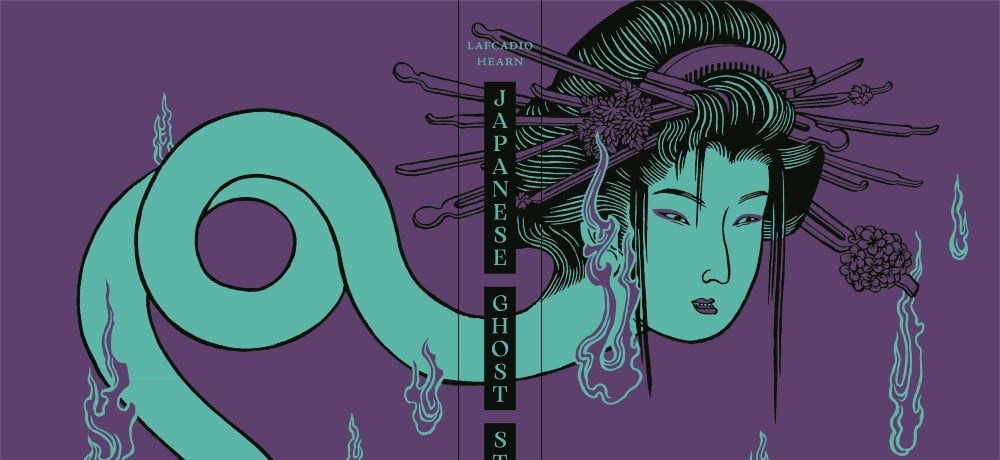
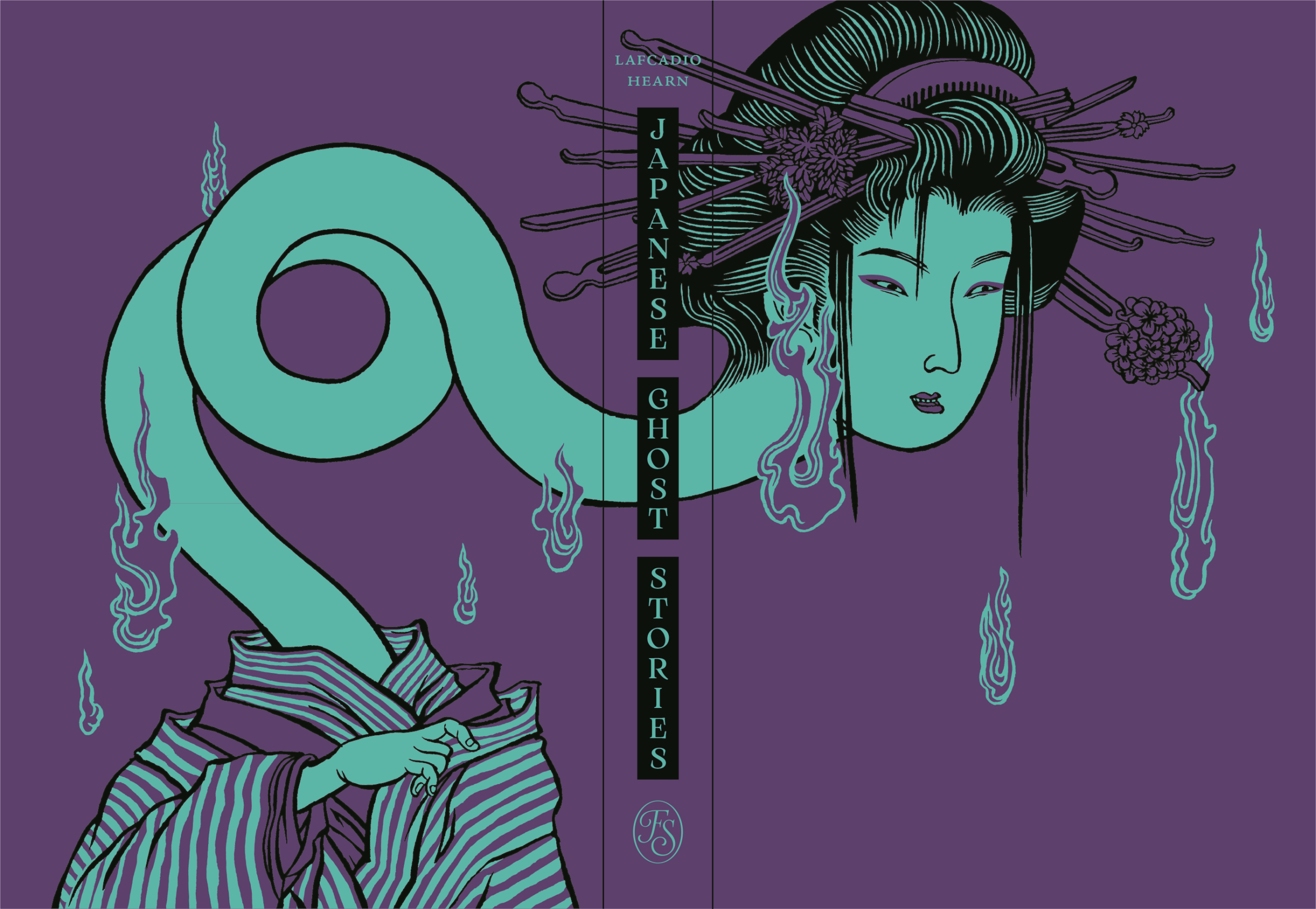
This fall, Folio Society will publish JAPANESE GHOST STORIES, "a stunning, collectible collection of twenty spine-tingling tales illustrated by award-winning artist Yuko Shimizu. Set in the haunted world of Ancient Japan, the classic tales were collected and translated by Lafcadio Hearn, a 19th-century traveller and resident of Japan whose collections of supernatural stories drawn from folklore are wildly popular in Japan."
Now available to purchase on Folio Society’s website, I caught up with Yuko Shimizu to discuss Japanese ghost stories, the book's illustrations and calligraphy, and more:
With Japanese Ghost Stories collecting so many legendary tales, can you discuss any early memories of traditional Japanese ghost stories and the impact they had on you?
Yuko Shimizu: I grew up in Japan, so they were a part of my life as a child. I grew up with those stories told by adults, in TV shows and books. All Japanese kids can tell famous ghost stories like Hoichi, and name the yokai like Rokuro-kubi.
For readers who might be more accustomed to traditional Western horror, what do you think differentiates these classic Japanese ghost stories the most from Western supernatural folklore?
Yuko Shimizu: Japanese ghost stories are more like western fairy tales and fables, in a way that they are staples of short tales often talk about morals and ethics to live by. Like, in the story of snow ghost, you are given a secret to bring to the grave, and the tragedy happens when the promise is broken.
Can you talk about your approach to the artwork in this book, knowing that the stories are set in ancient Japan? Did you research ancient artwork that depicted the supernatural?
Yuko Shimizu: I am from Japan, so I am relatively familiar with Japanese history of art, but also, I did look at traditional illustrated books from the Edo period a lot. The format of my illustrations and the general look mimic those books from the time period the stories were written (the stories are old, but they were retold in a book published in 1904, slightly after the Edo period ended).
Of course, this edition is published in the 21st century, and though I made the illustrations Edo-style, I also added some more modern colors and tones to bridge the 120 years or so between two publication dates.
I understand you collaborated with your close friend Ai Tatebayashi to create stunning Japanese calligraphy for the book. Can you talk about that collaboration?
Yuko Shimizu: Yes! I am really happy about this collaboration. Ai is a wonderful illustrator. We studied together at the MFA Illustration program at School of Visual Arts in the early 2000s. She has since gone back to Japan and we are still really close friends.
I can draw anything with my ink and brush, but I cannot really write Japanese calligraphy, because you need to have a formal training to do it right. She has some calligraphy training, and I thought it would make the pages look really authentic if the page edges had Japanese writing of each story title like the traditional edo books did.
I did all the double page drawings, then put them in two boxes per spread like those Japanese books, with her calligraphy on the edges. The outcome looks very convincing, I think!
Which of the twenty stories in this collection resonated with you the most? And which did you find the most challenging or exciting to bring to life visually?
Yuko Shimizu: The story of Hoichi is one of the most iconic classic Japanese ghost stories. I was excited to make this into an illustration, but also very challenging, because every Japanese person has a certain idea in their head. This has to look traditional as well as surprising, right?
I had a lot of fun drawing the ghost of the soldiers. I hope this looks fresh to some readers.
From working across different visual mediums to teaching, it seems that your interests and projects are varied. Do you have any advice for aspiring artists with a distinct visual style who are looking to focus on their art for a living?
Yuko Shimizu: I think it is important to not lose sight of who they are as artists, and what wakes them up in the morning to create. With social media and algorithms it is so easy to get sidetracked to feeling we need to create what is popular or second guess what people may want from us, which we can never guess. We need to stop guessing, and keep focusing on us. I believe that is the key. Be you!
----
From the Press Release: This fall, the Folio Society, independent publisher of beautifully illustrated hardback books, will publish JAPANESE GHOST STORIES, a stunning, collectible collection of twenty spine-tingling tales illustrated by award-winning artist Yuko Shimizu. Set in the haunted world of Ancient Japan, the classic tales were collected and translated by Lafcadio Hearn, a 19th-century traveller and resident of Japan whose collections of supernatural stories drawn from folklore are wildly popular in Japan. JAPANESE GHOST STORIES is the latest literary classic from Japan to be published by the Folio Society, alongside contemporary classics by Kazuo Ishiguro and Haruki Murakami and Japanese Tales, a treasury of Japanese folklore and wisdom, beautifully bound by Folio, translated by Royall Tyler and also illustrated by artist Yuko Shimizu. The Folio Society edition of JAPANESE GHOST STORIES will include an all-new introduction from Japanese novelist, Yoko Ogawa, whose novel The Memory Police was a finalist for the National Book Award for Translated Literature, the International Booker Prize and the World Fantasy Award. JAPANESE GHOST STORIES will be available on the Folio Society’s website on October 20, 2026, just in time for Halloween.
JAPANESE GHOST STORIES features twenty transportive and sometimes terrifying tales, including “The Story of Aoyagi,” in which a young samurai falls in love with a mysterious woman only to discover she is not what she seems; “Oshidori,” the haunting tale in which a mandarin duck mourns the loss of her lover, who was shot and killed by a hunter’ “The Dream of Akinosuké,” in which a man becomes the king of an ant kingdom; and “Rokuro-Kubi,” an action packed story in which a monk battles five flying heads.
In JAPANESE GHOST STORIES, the dead wreak revenge on the living, paintings come alive, spectral brides possess mortal men and a priest devours human flesh. These tales draw on the phantoms and ghouls of traditional Japanese folklore—including the headless 'rokuro-kubi', the monstrous goblins 'jikininki' and the faceless 'mujina' who stalk lonely neighbourhoods. The stories are massively popular in Japan and highly regarded by folklore aficionados and horror enthusiasts alike.
The stories in JAPANESE GHOST STORIES are provided by Lafcadio Hearn, a writer, journalist and translator whose works introduced Western readers to the culture, folklore and literature of Japan. Born on the Greek island of Lefkada to an Irish father and Greek mother, he emigrated to the United States before settling in Japan in 1890. There he married, became a Japanese citizen under the name Koizumi Yakumo, and devoted himself to recording the country’s stories, customs and beliefs. His ghost stories—Kwaidan, In Ghostly Japan, Glimpses of Unfamiliar Japan—which were drawn from Japanese folklore, appeared in collections throughout the 1890s and 1900s. He remains today a much-celebrated figure in Japan.
“Lafcadio Hearn's 19th-century ghost stories are famous throughout Japan and are part of that country's culture of the supernatural. I love the way we've taken something traditional and given it a modern twist,” said Folio Society Editor Mandy Kirby. “At first glance, you might think Yuko Shimizu's illustrations are from the time of Hokusai, but look closer and you can see that they have modern touches, and the cover is unmistakably 21st century. One of Japan's contemporary novelists, Yoko Ogawa, has provided an introduction in which she talks about Japan's obsession with ghosts and demons, and how unsettling and scary these stories actually are. She's right - they are absolute gems of the supernatural, the perfect read for the ghostly season.
JAPANESE GHOST STORIES is accompanied by 5 haunting double-page illustrations—as well as a frontis, cover, slipcase and endpaper art—by the New York-based Japanese artist Yuko Shimizu, who has received multiple Gold and Silver Medals from the Society of Illustrators. JAPANESE GHOST STORIES marks Shimizu’s third collaboration with The Folio Society, following Japanese Tales (2018) and The Great Gatsby (2025).
Shimizu is a multi-award-winning Japanese illustrator based in New York City. She is also an instructor at The School of Visual Arts and has more than twenty years of experience illustrating. Her work includes multiple disciplines; from pages of The New York Times, TIME, Newsweek, and The New Yorker to WIRED, covers for DC Comic, Penguin Random House, and Scholastic, and advertising for BBC, Apple, Google, Microsoft, Intel, Universal Pictures, SONY, Paramount, MTV, Nike, Hasbro, and Target, to name a few. Additionally, she has collaborated with the United Nations, Smithsonian Museum, Philadelphia Museum of Art, and Library of Congress.
Shimizu has illustrated multiple books including two Caldecott Honor-winners: The Cat Man of Aleppo (2020 written by Karim Shamsi-Basha and Irene Latham) and Up, Up, Ever Up! Junko Tabei: A Life in the Mountains (2024, written by Anita Yasuda) the Museum of Tolerance Young Reader Award winning Barbed Wire Baseball (2013 written by Marissa Moss), A Wild Swan by Pulitzer Prize winning novelist Michael Cunningham, and Godzilla: The Official Pop-Up Book (2024 written by Chip Carter and Matthew Reinhart). This is her 3rd book from Folio Society, following Japanese Tales (2018, written by Royall Tyler) and The Great Gatsby (2025, written by F. Scott Fitzgerald). She will be providing both cover and interior art for Haruki Murakami’s highly anticipated upcoming book Abandoning a Cat ( October 2026 from Knopf). Shimizu has also provided art for multiple films for the Criterion Collection, including The Ballad of Narayama (1958 directed by Keisuke Kinoshita), Demon Pond (1979, directed by Masahiro Shinoda), Godzilla (1959, directed by Ishirō Honda), The Mikado (1939 directed by Victor Schertzinger), The Samurai Trilogy (1954 - 1956 directed by Hiroshi Inagaki) and Tospy Turvy (1999, directed by Mike Leigh) and created art for films including John Wick 4 (2023, directed by Chad Stahelski) and 60th anniversary of Darling (1965, directed by John Schlesinger).
“Coming up with a good concept, or, at least a concept I am excited to materialize, is the most important and crucial part of the process,” said Shumizu. “After looking at a lot of old Japanese books and its formats, I wanted to make the illustrations look like a traditional Edo period EHON. These picture books are like an ancestor of manga. They are magazine format story books for adults that are heavily illustrated. But of course, this book is coming out in the 21st century, so it’s a traditional Edo Ehon look with a modern twist.”
“The full spread illustrations were created first, then they were dropped into the framed pages, in the style of typical Ehon,” added Shumizu. “Each image has the title written in Japanese on the edges of the page, which I asked my very good friend Ai Tatebayashi in Japan to create the calligraphy of. I can draw anything with brush, but I cannot write, and I needed her help.”
JAPANESE GHOST STORIES is perfect for fans of J-horror and classic Japanese horror films like Kwaidan. The 200 page hardcover edition will be on October 20, 2026 exclusively from https://www.foliosociety.com/."
For more information or to purchase, visit: https://www.foliosociety.com/usa/japanese-ghost-stories
After more than a decade as a consultant in the entertainment industry, Jonathan James launched Daily Dead in 2010 to share his passion for horror. He takes immense pride in Daily Dead's talented team of writers, who passionately explore and celebrate horror as a respected art form capable of telling complex, character-driven stories with deep emotional and cultural impact.
Over the course of his career, Jonathan has written more than 10,000 articles and hosted panels at major conventions, including New York Comic Con and San Diego Comic-Con. He is also consulted with as an expert on horror and pop culture, offering insights on horror history and the latest trends through media outlets, film festivals, and conventions.
After more than a decade as a consultant in the entertainment industry, Jonathan James launched Daily Dead in 2010 to share his passion for horror. He takes immense pride in Daily Dead's talented team of writers, who passionately explore and celebrate horror as a respected art form capable of telling complex, character-driven stories with deep emotional and cultural impact.
Over the course of his career, Jonathan has written more than 10,000 articles and hosted panels at major conventions, including New York Comic Con and San Diego Comic-Con. He is also consulted with as an expert on horror and pop culture, offering insights on horror history and the latest trends through media outlets, film festivals, and conventions.












![[Guest Article] Maggots On Your Body Of Work: Clay McLeod Chapman On Finding His Own Muses](https://dailydead.com/wp-content/uploads/2026/03/Bodies-of-work-1000-180x83.jpg)

![[Editorial] AI of the Living Dead: Why Have So Many Already Accepted the Simulation?](https://dailydead.com/wp-content/uploads/2025/09/M3GAN-180x83.jpg)