



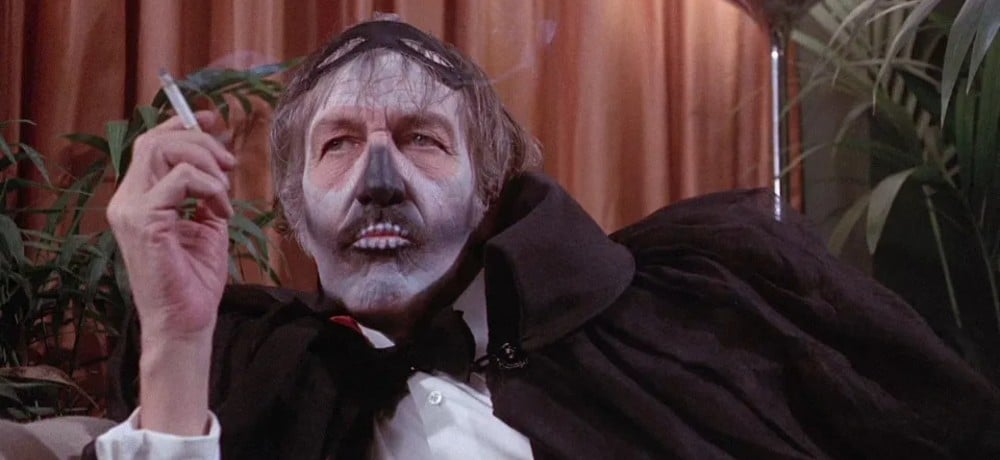
The shadows of Vincent Price and Peter Cushing hang over the history of horror like enveloping cloaks; they would often portray men as monsters, sometimes literally but always with wit and considerable charm. While coming way into both their careers, Madhouse (1974) offers up both. It’s cheeky, fun, and gives us a chance to watch Price and Cushing spend some time on screen.
Madhouse didn’t do well at the box office; this Amicus co-production with American International Pictures had Amicus switching to family friendly fare until they fizzled out in ‘77, and AIP would be done by ‘81. Madhouse wasn’t responsible for the dissolution of these two legendary indie studios, but offered further proof that times were changing.
People weren’t responding to the quaint anymore–it just didn’t seem appropriate. The same year saw the release of Tobe Hooper’s The Texas Chain Saw Massacre; a big success, it showed the genre moving successfully through a grittier and more grounded time in a film that reflected the restless vibes of the U.S. of the day. The castles and cobwebs were only to return as cultural kitsch, a shorthand for the corny and old-fashioned.
Madhouse is well aware of this; the film is a tribute, nod, and elegy to the simpler times and grim romanticism of Poe told from the POV of a faded and mentally unstable horror idol. It tells the story with a mix of affection for the ‘60s (actual footage from Price’s Corman AIP pictures–The Raven and Tales of Terror– is prominently featured) through Price’s portrayal of Paul Toombes, that mentally unstable faded idol. It’s the heart of a movie that wants to navigate the new carnage market while holding onto some genteel from ago. It balances both pretty well.
The story opens with a party on Toombes’ estate as he celebrates the release of the latest Dr. Death movie, a Dr. Phibes-like character with skull makeup, a fedora, and a cape. The celebration hosts a cabal of hanger-ons, never-weres, and wannabes eager to be in Toombes’ aura. Paul is joined by Herbert Flay (Cushing), the creator of Dr. Death and the films associated with the character.
When the screening of the movie is complete, Paul announces his engagement to his latest leading lady, Ellen Mason (Julie Crosthwaite), to the surprise of everyone, including Oliver Quayle (Robert Quarry), a soft-core producer that Ellen did some films for. Oliver tells Paul that Ellen not only had sex with other men on screen, she had sex with him. This enrages Paul and he upsets Ellen, leaving her to go up to her room. Paul shortly follows but lays down in another room and falls asleep. When he awakens–with his Dr. Death gloves on the bed– he goes to Ellen and apologizes but finds her without forgiveness or a head.
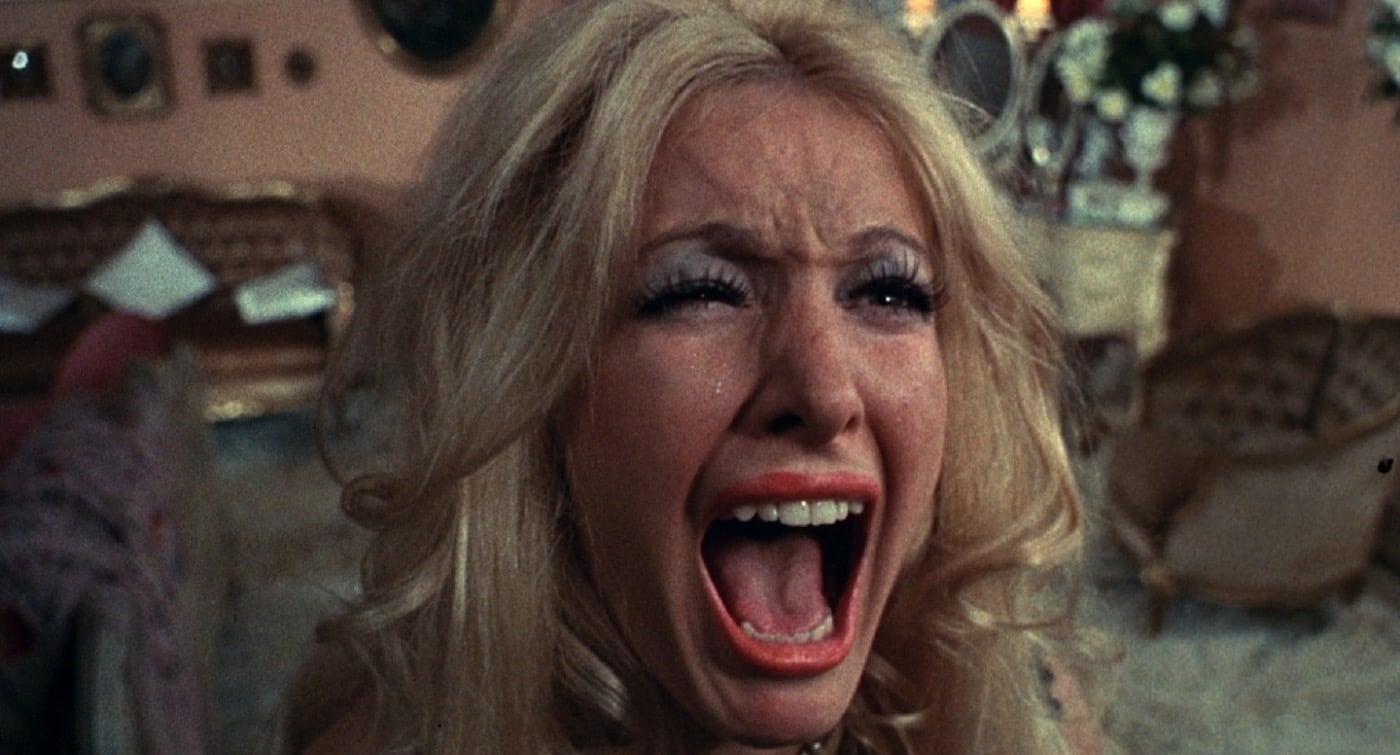
Paul proclaims his innocence, goes mad, and finds himself in a contained building for restless and antsy folks for 12 years. Upon release, Paul is met by his old friend and partner Herbert, who tells him the BBC wants to do a Dr. Death TV series; Paul is reluctant to play ‘him’ again, but the draw is too great. As the show starts to shoot, people start being killed just like characters in the Dr. Death movies; Paul continues to pass out at inopportune times, leading him to believe that he’s the killer himself.
Has Paul blurred the lines between reality and fiction, or is someone trying to drive him right back to the Madhouse?
Before one gets the notion of Price swirling a chainsaw around his head, kicking up dust (which would be so perfect it would give me palpitations), Madhouse doesn’t offer that kind of radical reinvention; instead it gives the viewer an opportunity to see two seasoned horror legends (plus the underappreciated Quarry) comment on the genre they helped shape while participating in the new horror scene.
This was meta commentary on horror long before the ‘90s and in place of cynical trope talk, Madhouse offers a tame takedown of film politics, making sure to leave some flesh on the hand that feeds. It lends some poignancy to the portrayal of man as commodity and folly for the masses, but in a lighter way than I seem to be implying; there’s melancholy to be mined that it drops in favor of melodrama. That’s not cutting the film down either–the tone just seems to fit the stars perfectly.
It’s a tone that brings out the best instincts in the cast, especially Price, who made a career of tongue-in-cheek rogues and scoundrels, with the occasional hero thrown in for balance. He’s in the latter mode in Madhouse; Paul Toombes is the tragic yet goodhearted center of a, it must be said, rather ordinary mystery. A PhD in Poirot isn’t required to guess the killer, so the joy is watching the cast play with what they’re given, and they give the story the juice it needs. As I said, it’s a mild satire that doesn’t push the knife in very deep but lays you in a warm bath while you blissfully bleed out.
If you love the stars, that is. Madhouse is a fan service film to Price and Cushing, but especially Price; Cushing’s character is peripheral until the final act when he takes center stage with Price. He’s reliably good as is Quarry, who is always believable as a sleazy upperclassman.
But Vincent Price is the epitome of the horror villain, in both large and intimate strokes. Madhouse followed the success of the Dr. Phibes films and Theater of Blood, so within horror he was rightfully revered. But those are tough acts to follow, and the direction of Jim Clark along with the screenplay by Ken Levison and Greg Morrison (based on the novel "Devilday" by Angus Hall) doesn’t take any risks or produce sharp barbs against the industry. But while it hangs in the tier below those films, it has its place not only in Price’s catalog, but in the horror continuum. For Price, it’s the entertaining afterwave of three peak pictures. For horror? Madhouse is a film that is eager to plunge into the visceral while still waltzing with the weave of the cobwebs, and it’s a solid bridge from the gentler days–Basil Rathbone and Boris Karloff are featured in the old clips and honored in the credits–to the gory ones that lay ahead. Shadows not included.
---
Madhouse is available on Blu-ray from Kino Lorber and Eureka Video and is currently streaming on Tubi.
Next: Drive-In Dust Offs: The (Sort of) Sordid Love Saga of JULIE DARLING
Scott Drebit lives and works in Calgary, Alberta, Canada. He is happily married (back off ladies) with 2 grown kids. He has had a life-long, torrid, love affair with Horror films. He grew up watching Horror on VHS, and still tries to rewind his Blu-rays. Some of his favourite horror films include Phantasm, Alien, Burnt Offerings, Phantasm, Zombie, Halloween, and Black Christmas. Oh, and Phantasm.
Scott Drebit lives and works in Calgary, Alberta, Canada. He is happily married (back off ladies) with 2 grown kids. He has had a life-long, torrid, love affair with Horror films. He grew up watching Horror on VHS, and still tries to rewind his Blu-rays. Some of his favourite horror films include Phantasm, Alien, Burnt Offerings, Phantasm, Zombie, Halloween, and Black Christmas. Oh, and Phantasm.






![[Guest Article] Maggots On Your Body Of Work: Clay McLeod Chapman On Finding His Own Muses](https://dailydead.com/wp-content/uploads/2026/03/Bodies-of-work-1000-180x83.jpg)
![[Editorial] AI of the Living Dead: Why Have So Many Already Accepted the Simulation?](https://dailydead.com/wp-content/uploads/2025/09/M3GAN-180x83.jpg)