



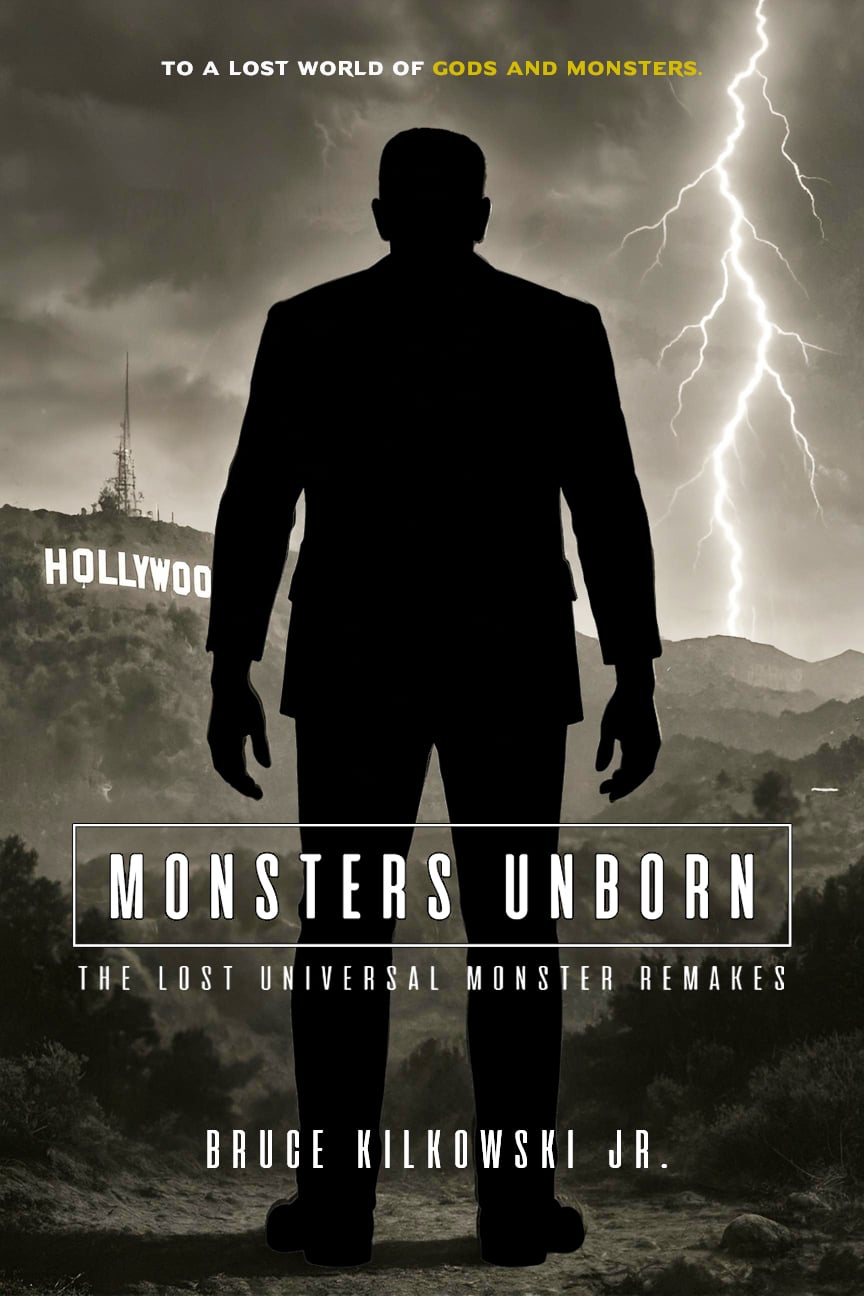
[Editor's Note: Guest author Bruce Kilkowski Jr. recently released Monsters Unborn: The Lost Universal Monster Remakes via Harker Press. A deep dive into the "lost" history of the Universal Monsters, Kilkowski Jr. shares exclusively with Daily Dead readers a preview of what you can find within his new book!]
10 Things You Didn’t Know About the Universal Monsters
1. Despite being one of the premiere Universal Monster movies, a direct remake of Frankenstein was seemingly never on the books. The studio mainly focused on reimagining The Bride of Frankenstein in various forms, none of which ever got past the finish line. The closest they came to reviving the original film was a proposed CG animated movie from Stampede Entertainment, the creators of the Tremors franchise. While information is limited, it apparently would have been a direct sequel to the 1931 film, picking up after the climactic windmill fire.
2. In the mid-1990s, the Creature from the Black Lagoon remake, now being produced by Ivan Reitman, was set to take a drastic departure from the original movie. With the setting shifted to a South Florida resort island, the script by Timothy Harris and Herschel Weingrod took very apparent influence from two popular blockbusters. The first half of the story, following an investigation of mysterious killings in the lagoon and nearby ocean, has the definite flavor of Jaws. Later on, a hurricane hits the resort and the Creature, explicitly compared to a Velociraptor, begins stalking the remaining guests, not unlike the third act of Jurassic Park.
3. Beginning in 2007, frequent DC movie writer David S. Goyer was set to write and direct a remake of The Invisible Man. His script took the form of a sequel to the original H.G. Wells novel, following Jack Griffin’s illegitimate son Nathan, who finds his father’s formula and gains an enhanced version of the invisibility powers. Captured by Queen Victoria’s government and forced to spy on Czarist Russia, Nathan is equipped with an explosive wrist bangle to keep him from escaping. This premise shows some influence from Goyer’s comic book movie roots, as it makes Nathan into a one man parallel of DC’s Suicide Squad.
4. Joe Dante’s version of The Mummy, from a script by Alan Ormsby and John Sayles, fell afoul of budgetary concerns, with the studio not wanting to spend more than fifteen million dollars on a horror movie. Dante’s friend Steven Spielberg attempted to help by setting up a meeting with studio head Sid Sheinberg on the mansion set of Casper (1995), but it all fell apart when Sheinberg insisted the movie should be a period piece. Dante tried to argue against this, citing the fact that the original film was set in the year of its release, but Sheinberg wouldn’t hear it.
5. In the director’s cut of The Wolfman (2010), Lawrence Talbot comes into possession of an elaborate silver sword cane, with the handle in the shape of a wolf’s head. While it doesn’t play a major role in the actual film, it seems to have had a journey through development hell all its own. In the original script written by Andrew Kevin Walker, a similar cane, this time with a devil’s head handle, makes a brief appearance during the title character’s London massacre. It is owned by a man who is heavily implied to be Jack the Ripper, who flees when confronted with the werewolf.
6. John Carpenter’s remake of Creature from the Black Lagoon, which had stalled for several years, became part of a trade with the studio when executive Tom Pollock asked Carpenter to remake Village of the Damned instead. Carpenter agreed and directed Village, in exchange for the chance to make Creature later. However, by the time that film was finished, new executives were in charge at Universal, and Carpenter’s chances at moving ahead with Creature evaporated.
7. Universal’s original Mummy series consisted of two distinct segments. The original 1932 film focused on the undead sorcerer Imhotep, while the four films from the 1930s featured Kharis, the more traditional image of a walking bandaged corpse. While the eventual remake chose to utilize Imhotep as its main villain, some earlier attempts went a different way. The scripts written by George A. Romero and Mick Garris used Imhotep as a central character, but also cleverly inserted Kharis into the plot as his undead enforcer, a clever way to incorporate both of Universal’s mummies into one story.
8. When Brian Grazer’s Imagine Films took over the Bride of Frankenstein remake, it moved away from being a straightforward retelling of the original movie. One early take from Laeta Kalogridis reimagined the story as a dystopian science fiction action film, with clear inspiration from Fritz Lang’s Metropolis. Two more followed, from Shari Springer Berman & Robert Pulcini and Jacob Aaron Estes respectively, which focused more on telling modern stories that explored the themes of the Frankenstein story, rather than the specific Universal imagery.
9. The first attempt at a Creature from the Black Lagoon remake, written by Nigel Kneale, was potentially a continuation of the original trilogy. One of the revisions revealed that a Creature had been captured and taken to the United States in the past, which lines up with the events of Revenge of the Creature. While the details are left sketchy and the third film, The Creature Walks Among Us, is left unaddressed, perhaps the remake could have been more appropriately titled Creature from the Black Lagoon 4 if it had gotten off the ground.
10. Much like Frankenstein, Universal put little effort into remaking Dracula, despite it kick-starting their monster films and being an iconic part of the lineup. Between the release of the 1979 film and 2014’s Dracula Untold, only one standalone Dracula film was in the works, from Glory writer Kevin Jarre. With Sam Raimi in talks to direct, it got as far as location scouting before Universal canned it. This was allegedly in response to Francis Ford Coppola’s film beating it into production in 1991, despite studios releasing similar films fairly frequently.
---
"Step into the shadowy world behind Hollywood’s most iconic creatures with Monsters Unborn! Drawing on unproduced scripts and decades of behind-the-scenes history, author Bruce Kilkowski Jr. uncovers a treasure trove of “lost” stories from haunting gothic reimaginings to bold futuristic reinventions that never made it to the screen. Packed with new research, this book brings to life abandoned visions of legendary monsters like the Bride of Frankenstein, the Mummy, and the Creature from the Black Lagoon, revealing just how close they came to rising again. Equal parts film history and thrilling “what might have been,” Monsters Unborn is an essential, fun, and eye-opening journey for horror fans and cinephiles alike."
Monsters Unborn covers lost remakes written by:
To learn more and find out where you can purchase a copy, visit: https://www.harkerpress.com/monstersunborn





![[Guest Article] Maggots On Your Body Of Work: Clay McLeod Chapman On Finding His Own Muses](https://dailydead.com/wp-content/uploads/2026/03/Bodies-of-work-1000-180x83.jpg)
![[Editorial] AI of the Living Dead: Why Have So Many Already Accepted the Simulation?](https://dailydead.com/wp-content/uploads/2025/09/M3GAN-180x83.jpg)