



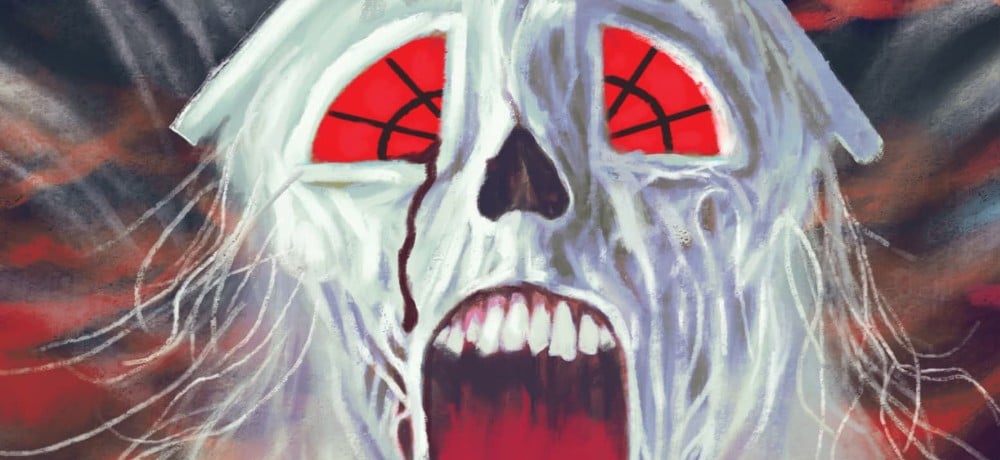


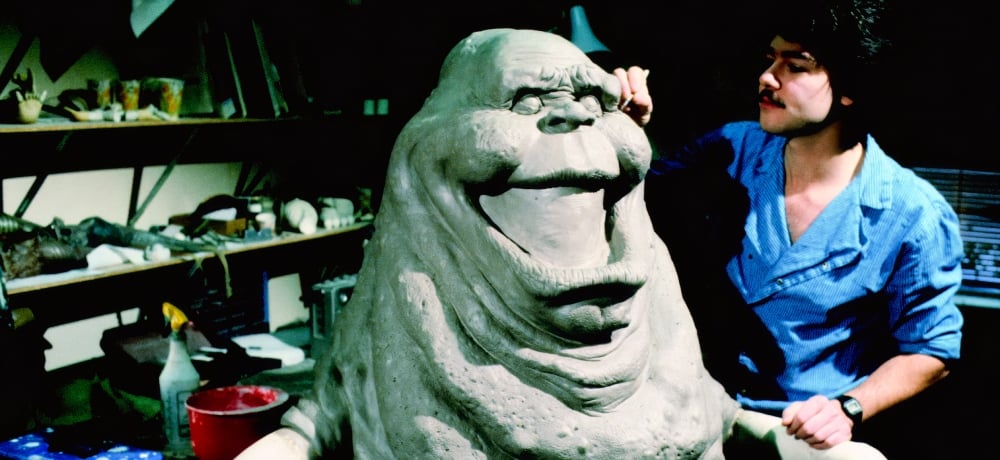
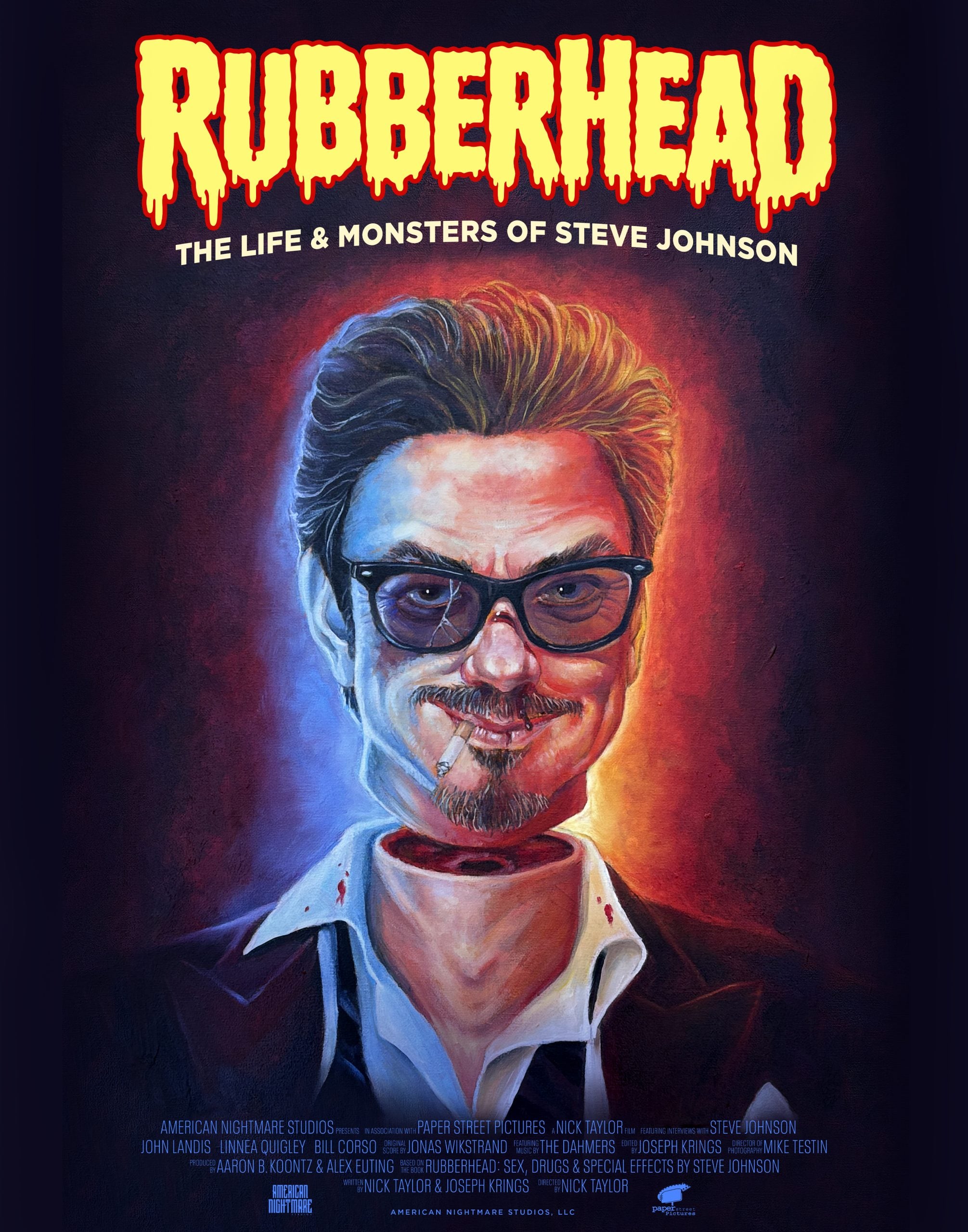
"Known for his intense work ethic, perfectionism, and obsession with breaking new ground, Steve Johnson created iconic creatures and effects for some of the most beloved horror and sci-fi movies in cinema history. RUBBERHEAD is a humorous and heartfelt portrait of the life and times of one of Hollywood’s most prolific monster makers, as well as a historical journey through the golden age of special effects makeup."
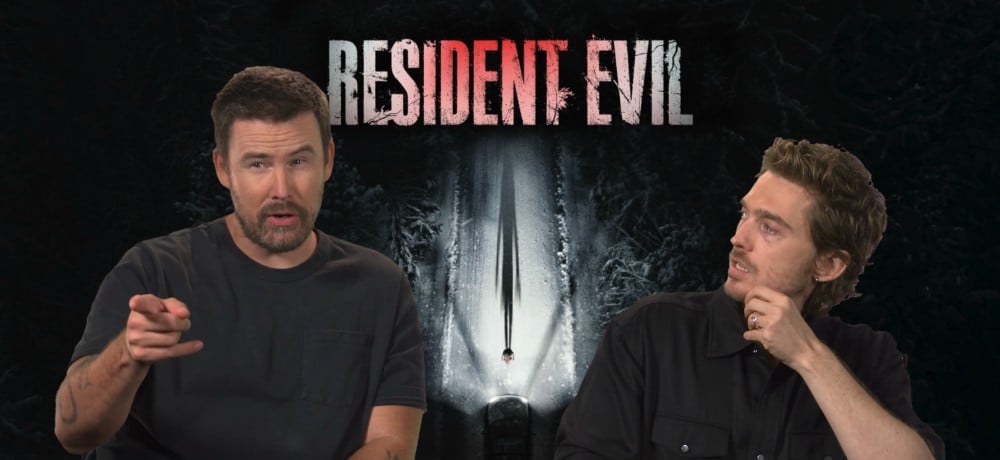
Ahead of Rubberhead's world premiere at the Fantasia International Film Festival on July 23rd, I caught up with director Nick Taylor to learn about the journey to create this documentary, surprises along the way, and the incomparable work of Steve Johnson:
What are some of Steve Johnson's films and effects that were foundational to your love of cinema and horror growing up?
Nick Taylor: Definitely Fright Night and Ghostbusters. I was a total horror nerd growing up, and I didn’t have a lot of friends who were into the weird monster stuff I was into. I feel like a lot of us who loved horror as kids probably felt this way. There’s something about being a horror kid that can feel magical but also lonely, and you can feel like a bit of an outcast.
I first felt the connection with Steve when I saw him on Scare Tactics with Linnea. I suddenly saw this cool, handsome, and very successful guy who made a living making the kinds of weird monster stuff I loved, and it validated that passion and life for me. In that way, he became like a silent mentor or role model.
He was the first person who really dignified my love of horror and the weird monster stuff that I loved. Steve showed me that you could build an entire life around the scary stuff you’re passionate about. He had the studio, the skills, the monsters, the gorgeous wife, the rock-and-roll lifestyle. He showed me that an integrated life was possible, where the things that make you strange can actually become your biggest superpower. But overall, he made me feel less alone.
What was the process for officially moving forward with this documentary as your directorial project?
Nick Taylor: It took many years. We would shoot a little bit when we had the money, then stop, then shoot more, then go back to pitching it. All the while, I just kept going through archival, finding new material, having ideas, and discovering weird little corners of Steve’s life and career that made the whole thing feel bigger and more complicated.
For me, the documentary process was more complex than I ever imagined because you don’t really know the story until you’re in the edit. You think you know what the movie is, then you find one interview or one piece of archive and suddenly the whole thing shifts. Then you are dealing with hundreds of possible paths, archival footage, news footage, movie clips, personal photos, behind-the-scenes materials, and, in Steve’s case, a gigantic amount of personal archives. Back in the ’80s and ’90s, before the internet, Steve filmed everything: every phase of every effect. He would messenger VHS tapes to the directors and producers, so the archival material was an amazing and abundant resource.
The process of collecting all of that, sorting through it, and then finding the real emotional narrative was a huge challenge but also a TON of fun.
Luckily, Steve’s life story presented itself in these almost mythic archetypes. It has the hero’s journey, where he’s this young, humble kid from Texas who loves monsters and teaches himself how to make them on his own. Then he has a chance meeting with Rick Baker, his Obi-Wan Kenobi, and Rick beckons him to Hollywood and shows him the ways of the force on the set of movies like An American Werewolf in London. He starts making it in the industry and faces this series of impossible trials: working with James Cameron, working on Predator under brutal deadlines and expectations, constantly being asked to do the impossible. He takes his hits but ultimately rises to the occasion, again and again.
I’m a huge monster and effects fan, and it was a mission to not make a fan doc. As much as I love those, the prime directive was that the movie had to stand on its own two feet as a compelling biopic about an artist that non-horror fans would still appreciate. But I didn’t want to water it down or homogenize it either, so it was a fine balance achieved by myself and the movie’s editor, Joe Krings, who admittedly is not a horror fan, which allowed us to stay cinematically and narratively focused.
So the process was really about finding the narrative spine inside this massive, messy, incredible life. It could not just be “here are the cool monsters.” It had to be about the monster maker, his highs, his lows, his brilliance, his insanity, and the possibility that his greatest monster may have been himself.
Can you talk about the cast you assembled? Was there a particular cast member you were especially interested in, aside from Johnson?
Nick Taylor: We wanted people who really knew Steve. That was the big thing. We didn’t want celebrity talking heads, we wanted eye-witnesses. There are endless people who could have spoken intelligently about Steve’s place in horror history, but I was much more interested in people who were in the trenches with him, either personally or professionally.
I wanted people who could dimensionalize him and his very intricate artistry and personality through personal stories and anecdotes, not just explain his filmography.
Linnea was someone we really wanted because she was there during one of the most defining periods of his life, both personally and professionally. She saw him when he was probably at his most iconic, and she brings a very personal and unique perspective to that time because she saw both sides of him, since they worked together AND lived together.
John Landis was also hugely important because he has worked with so many of the great effects artists, including Rick Baker, Rob Bottin, and Steve. He can contextualize Steve’s place in that history because he is not only a filmmaker, he is also a real historian of horror and cinema.
The person who surprised me most might have been Bill Corso. Bill went out of his way to explain that so much of who he is as an artist came from his time at Steve’s studio. He talked about learning artistry, high standards, creative risk-taking, and the courage to push things way beyond what you thought was possible through Steve’s methodology, which often bordered on madness. That really helped me understand Steve and his studio as more than just a workplace and more like some insane hybrid of Warhol’s Factory meets Pixar, via a mad scientist lab. It was this miraculous, chaotic place where everyone was inventing techniques, testing ideas, blowing things up, staying up all night, and pushing the envelope on what practical effects could be. It was not clean or corporate. It was wild and messy and probably unhealthy at times, but it produced magic. Bill’s interview really helped articulate Steve’s undeniable legacy of innovation.
Throughout this process, new stories or details are always uncovered. Did you learn anything surprising about Johnson or his films?
Nick Taylor: One of the biggest things I learned from Steve was how many creative lessons he absorbed from every movie and every artist he worked with. Every director, every effects artist, every chaotic job seemed to give him another piece of knowledge that contributed to his success.
With H.R. Giger, for instance, Steve learned the importance of working really, really fast. Giger would have an idea and vigorously sketch it out, and if he didn’t get it out of his head quickly enough, the idea would start to change. That taught Steve that when an idea comes to you, you have to act on it. If you overwork it too much, or wait too long, you can lose the original lightning.
Rob Bottin gave him something else entirely. On the set of The Howling, Steve watched Rob sculpt these amazing werewolves, then smash one after the other and start again because he thought he could do better. He would stay up all night chasing perfection. That taught Steve to have an intensely high work ethic and to be your own harshest critic. All of these lessons later presented themselves in Steve’s career and company.
But there is obviously a dark side to that. There is a very fine line between artistry, genius, and madness. Steve was probably more influenced by Rob Bottin than anyone else, and I think he tried to recreate some of that mania and that almost punishing work ethic. There is greatness in that, but there is danger in it too. I think Steve might have benefited from observing a little more of Rick Baker’s calm steadiness and attention to detail, rather than absorbing so much of Bottin’s gonzo intensity. But the work speaks for itself.
The most emotional part of the experience was realizing that I was mainly drawn to this story because I learned that Steve was a lot like me as a kid. He was into monster movies. He was not good at sports. He was not particularly popular. He often felt like a misfit. And he channeled all of that insecurity into his art. He thought that if he could make amazing monsters, maybe he would belong. Maybe the popular kids would accept him. Maybe he could validate himself.
That hit me very hard because I understood it. I think a lot of horror fans understand it. And then I realized that this wasn’t just some childhood detail. That insecurity drove him through his entire career. The monsters were not just monsters. They were ultimately a way of being seen.
When filming a documentary like this, what was the biggest challenge in telling Johnson's story?
Nick Taylor: The biggest challenge was trying not to make a paint-by-numbers documentary. I love documentaries, but they’re starting to feel the same structurally, and there is a version of this movie that could have been very standard: here is where Steve was born, here are the movies he worked on, here are some fun clips, here is what happened to practical effects. That was never the movie I wanted to make.
So much of the challenge became structural. I had a million stories I loved. I had whole sequences that I thought were amazing. But eventually you have to commit to the movie you are actually making, not just the stuff you think is cool.
One of my favorite documentarians, Brett Morgen, gave a piece of advice for documentary directors in an interview that haunted me. He said to find your favorite sequence in your documentary and just cut it. When I first heard that, I laughed and thought, “There is no way I’m doing that.” Then, of course, I ended up cutting my TWO favorite sequences out of the movie.
Both were about Steve’s relationship with H.R. Giger, first on Poltergeist II and later on Species. We still touch on Giger, but there were these longer, elaborate scenes full of wonderful, insane stories that I absolutely loved. They just did not work with the overall structure and flow. It killed me to cut them, but they belonged to a different version of the movie. Definitely something for the special features.
We also had an entire sequence called “The Ones That Got Away,” about Steve’s movies that never got made. There was an endless treasure trove of material there: the Tim Burton Superman project, a very ambitious Hulk movie where they built an entire animatronic Hulk suit, Clive Barker’s Mummy project, Joe Dante’s Jetsons. The list goes on and on. That sequence was so fascinating and fun, but it just did not fit anywhere.
There was also an incredible story about Steve working on Richard Pryor’s autio-biographical movie Jo Jo Dancer, Your Life Is Calling. Steve had to create burn makeup and studied photos from Richard Pryor’s actual hospital visit. When Richard saw the makeup on the actor, it hit him so hard emotionally that he ran out of the studio, and Steve was fired. In other words, Steve was fired for doing too good a job.
There were endless stories like that and I kept hearing new ones. Cutting them got me very used to killing my darlings. But ultimately, you have to protect the movie from all the cool stuff that wants to drag it off course. Gotta save that stuff for the special features. (Go physical media!)
For our readers more familiar with Johnson's work, what is a more obscure project of his that you'd recommend?
Nick Taylor: I am always shocked by how few people have seen Freaked. I think Freaked might be my favorite work out of Steve’s studio. It is an insane, fantastic, hysterical movie with some of the most exciting special effects ever made and it somehow doesn’t age and is nearly beat-by-beat perfection and unlike anything else. That movie is a miracle.
There are also a lot of deep cuts that we really went out of our way to showcase work from, like Night Angel, the Howling sequels, Innocent Blood, and Brainscan. Steve brought magic to every single project he worked on. That was his work ethic. Even if the movie itself was uneven, or low budget, his monsters, creatures, gags, and effects were always up to the highest possible standards of both artistry and innovation. Steve was never content to do the same thing twice, and when you watch his filmography, you really begin to see that. He brought the same madness to everything he did, regardless of the prestige or budget.
---
"Known for his intense work ethic, perfectionism, and obsession with breaking new ground, Steve Johnson created iconic creatures and effects for some of the most beloved horror and sci-fi movies in cinema history. RUBBERHEAD is a humorous and heartfelt portrait of the life and times of one of Hollywood’s most prolific monster makers, as well as a historical journey through the golden age of special effects makeup.
Steve shares endless, outrageous anecdotes about his freewheeling adventures in Hollywood, while also telling the inspirational but tragic story of his meteoric rise and subsequent fall. His drive and ambition led to some of cinema’s most groundbreaking effects and techniques, but also to heartbreaking acts of self-sabotage, divorce, and serious struggles with addiction.
RUBBERHEAD is a captivating reflection on the game-changing practical FX glory days and a fascinating, entertaining, and moving story of an FX master whose greatest monster may have been himself."
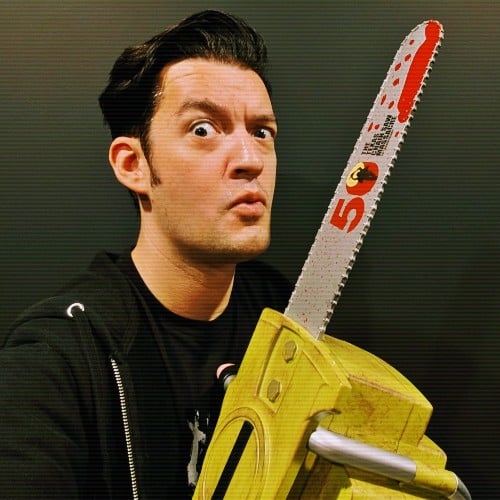
After more than a decade as a consultant in the entertainment industry, Jonathan James launched Daily Dead in 2010 to share his passion for horror. He takes immense pride in Daily Dead's talented team of writers, who passionately explore and celebrate horror as a respected art form capable of telling complex, character-driven stories with deep emotional and cultural impact.
Over the course of his career, Jonathan has written more than 10,000 articles and hosted panels at major conventions, including New York Comic Con and San Diego Comic-Con. He is also consulted with as an expert on horror and pop culture, offering insights on horror history and the latest trends through media outlets, film festivals, and conventions.
After more than a decade as a consultant in the entertainment industry, Jonathan James launched Daily Dead in 2010 to share his passion for horror. He takes immense pride in Daily Dead's talented team of writers, who passionately explore and celebrate horror as a respected art form capable of telling complex, character-driven stories with deep emotional and cultural impact.
Over the course of his career, Jonathan has written more than 10,000 articles and hosted panels at major conventions, including New York Comic Con and San Diego Comic-Con. He is also consulted with as an expert on horror and pop culture, offering insights on horror history and the latest trends through media outlets, film festivals, and conventions.








![[Guest Article] Maggots On Your Body Of Work: Clay McLeod Chapman On Finding His Own Muses](https://dailydead.com/wp-content/uploads/2026/03/Bodies-of-work-1000-180x83.jpg)
![[Editorial] AI of the Living Dead: Why Have So Many Already Accepted the Simulation?](https://dailydead.com/wp-content/uploads/2025/09/M3GAN-180x83.jpg)